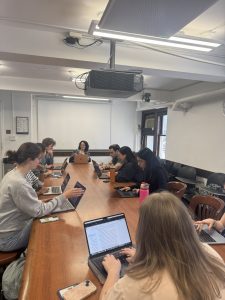
Senior Thesis Seminar Classroom. Photo courtesy of Julia and Sarah.
In Part One (link) of this series, Julia and Sarah spoke with our seminar instructor, Hannah Farber, about the role of collaboration in a long-term, independent research project like the senior thesis. Professor Farber shared with us how, from the instructor’s perspective, the senior thesis process works most smoothly with peer collaboration. In this installment, we are turning our attention to the student experience: what is it like to work in a cohort of researchers, and how can students make the most of this opportunity?
For both of us, the senior thesis is the most sustained, complex, and challenging piece of research we have ever pursued. It has been hugely beneficial to do this on a team: we can cheer each other on, share complaints, and keep each other on track. By observing how our classmates research, draft, and edit, we’ve all been able to improve our own working process. We’ve become more cognizant of our working and thinking habits.
In my case, I (Sarah) have lifted a few writing strategies from my peers, such as a “graveyard” document for all my reluctant cuts. Similarly, I’ve started bracketing problematic parts of my writing with “citation needed” or “in progress,” after observing something similar in a classmate’s drafts. In seeing my classmates’ work move through various stages, and hearing them respond to the various stages of my own work, I’ve also come to realize that there is never a perfect way to formulate my ideas– a huge relief for me, since I can be a perfectionist.
We were curious about the experience of students in other seminars. To find out how peer feedback works in other classes, we spoke with Grace Kaste, a senior majoring in history and economics. Like Julia and Sarha, Grace is also writing a senior thesis in the history department, and her seminar instructor is Tunç Şen. Grace’s thesis focuses on the history of the deinstitutionalization movement in the 1960s and 1970s, which sought to close state-run mental hospitals due to humanitarian concerns and financial pressure, and the movement’s relationship to the dramatic growth of New York City’s homeless population. Her second reader is Professor Kimberly Phillips-Fein.
SB and JS: Can you explain a bit about how your thesis seminar works as a class? How do you guys work together? How does your professor support you? How much feedback do you get from your classmates versus your professor?
GK: In terms of structure, Professor Şen has split the eight of us into two groups. For each major writing deadline, the first group will submit a week before the second, and every member of the second group reads all four of the first group’s drafts. In that week’s class, the members of the first group present their work one at a time, and the members of the second group and Professor Şen deliver their feedback for each member in front of everyone (Professor Şen also gives us more detailed notes on our drafts electronically after class). The next week, the groups switch roles. I was initially nervous about receiving so much criticism in front of my whole class, but I’ve become grateful for this system. I’ve learned an incredible amount about the writing process, about citing sources, and about history itself by getting to hear the feedback given to other people and reading so many different theses. We learn from each other’s mistakes and get to hear about each other’s topics!
SB and JS: Do you benefit from having your thesis seminar professor in a completely different specialization than what you are writing your thesis on?
GK: My thesis professor’s specialization is completely different from my own in terms of both time period and location. This has proven helpful because we have used our time in seminar to focus strictly on the nitty-gritty things like writing process, formatting, and citations, while also prompting me to seek out my Second Reader’s advice when I have questions related to content. I’ve also found myself feeling grateful for the difference in specialization because it has reminded me to write for an audience that is fluent in history but not necessarily fluent in my hyper-specific area. I believe it has made my work a bit more reasonable and approachable.
SB and JS: How does your thesis differ from other long-term projects or research that you have engaged with at Columbia, particularly in terms of peer-to-peer feedback and workshopping?
GK: This is the first history class in which I have presented my writing or research to my peers, rather than just submitting it to the professor. The structure has prompted me to work more consistently and to be more intentional about my research process because so much of it is open to examination by my own peers. I’ve found that I feel more rewarded by my writing and attached to my topic than I usually do for research papers because I know that my seminar peers and professor will read my work.
Grace’s thesis experience is just one part in the patchwork of collaborative learning that the Columbia Senior Thesis in the History department encourages. Even in the most independent of research settings, collaboration can play a major role. We hope this series has been helpful in demystifying the senior thesis seminar, and has highlighted some of the (many) benefits of treating research as a team sport!
Sarah Bryden, CC’26 and Julia Sherman, CC’26