
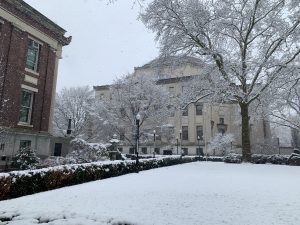
East side of Low Library during snowy weather from February 13, 2024. Photo courtesy of Ishaan Barrett.
As a senior in the urban studies program, the yearlong thesis is a requirement for graduation and, at least in the four months since I began my work, a deeply formative experience. But from what I can tell, the experience of writing a senior thesis looks different for everyone. Some folks spend only a semester working on a project with a faculty member or research supervisor. Others, namely some of my friends in the engineering school, work on a capstone project on everything from rockets to robotic prosthetics. The senior thesis process looks different for everyone and depending on the department, can involve intense work over the course of just a few months, or focused attention over an entire academic year. Regardless, whether you’re working on a yearlong thesis or other research project, the stamina required to successfully steer the work to its completion feels like a marathon. And even though I’m a little over halfway through the process, with an April deadline on the horizon, I thought sharing more about the process and an honest outlook on my past progress would be worthwhile. More specifically, I want to be transparent about the type of procrastination and delays that happen when you begin working on a senior thesis, and perhaps the panic that might ensue that, eventually, despite perhaps best intentions, pushes you over the finish line.
A story that immediately surfaces comes from a Ted Talk by Tim Urban, who talks about the inner workings a “master procrastinator.” While I don’t describe myself as such, I would be lying if I didn’t mention the extreme amount of procrastination that happened during my final exam week last fall. Nonetheless, Urban describes the process of procrastinating for his senior thesis, and the progressive delays that forced him to write his entire ninety-page thesis in three sleepless days. He shines light on the push and pull between two conflicting forces in the mind of a master procrastinator: the rational decision-maker, and the “instant gratification monkey.” Panic, for Urban and others, is the motivating factor that seems to bridge the “dark playground” of procrastination with the rational realm of hard work when the chips are down. In other words, the panic of a deadline seems to motivate us into panic and gives us enough power to usurp distraction. Yet, I think with a yearlong thesis, the end-of-year deadline is so far away that a sense of panic is hardly enough to push the pen. My fall deadline was enough to push me to write my entire (partial) first draft in three days, but I don’t know if panic was the source of my feverish writing frenzy.
Again, here is when I turn to yet another Ted Talk by Adam Grant, who talks about the surprising “habits of original thinkers.” Using Warby Parker as a key example, Grant talks about how late entrants into markets, industries, and even individual entrepreneurial projects isn’t necessarily about procrastination. Late entrants ruminate over the complexity of their product or idea, taking stock of current trends, and acknowledge their doubts before converting thought to action. Motivation and success can come from slowness and doubting the initial ideas that you generate or test out. “Originals,” as Grant calls them, produce creative concepts by embracing lots of bad ideas before eventually landing on good ones. I think this same logic can be applied to the senior thesis or other yearlong projects: don’t shy away from the bad ideas or the concepts you think might fail. Creative, original research arrives slowly and often on the heels of many rough drafts and failed attempts.
I think procrastination is an inherent part of the research process. I know it is for me. But I think we must be a bit more judicious so as not to confuse late entry, rapid ideation, and an embrace of failure for counterproductivity. Otherwise, I think we risk undermining an open culture of high-risk, high-reward that can empower undergraduate research for the better.