Categories
EDforSD

Day 3: Climate Education into Action

Dvita Bhattacharya, Millburn Middle School, NJ

Asha Swaroop, Millburn Middle School, NJ

In Day 3 of the Climate Summit, we explored education and how it relates to climate action. We got to hear from a group of inspiring educators and students who shared how they have made an impact in the fight against climate change. Their stories perfectly illustrate the dedication and passion we should all strive to replicate.

First, we had a discussion panel with three teachers to understand their perspective on education for climate change. Our first panelist was Shakira Provasoli, a science and hydroponics teacher at PS 333 in Manhattan. Ms. Provasoli spoke about the importance of hands-on learning and engagement. In order to truly learn and absorb information, students have to go beyond memorization and be able to apply their knowledge in the real world. Actually ‘doing’ science helps students visualize themselves as scientists. She highlighted the need to expose children to the sciences and the concept of sustainable development from an early age.

Our next panelist was Becky Higgins, a science educator and Johns Hopkins University Science Content Specialist from Connecticut. Ms. Higgins discussed her program “Speak with a Scientist”. The program focuses on having actual scientists come into classrooms to engage with students. This interaction helps the students feel in touch with science, bringing textbook concepts and ideas to life. Ms. Higgins also spoke about how she helps her students take initiative and stand for their beliefs. For example, when her students were concerned about fracking waste being dumped in their neighbourhoods, Ms. Higgins encouraged them to write letters to their mayor regarding the issue. Through her support and help, she shows her dedication to her students and to learning.

Next, we got to meet Cassie Xu, an Associate Director of Non-Degree Education & Outreach Programs at the Earth Institute at Columbia University. Ms. Xu told us about the importance of passion and standing for your opinion. She stressed how important it is to take initiative and ‘take the leap’ with your ideas. Through her teaching career, she has helped students make a difference in issues that they care about and continues to do so today.

Our last panelist was William Bertolotti, a high school teacher at Plainedge High School in New York. Like Ms. Xu, he spoke about the importance of passion and getting involved. His message to students today was to always have the spirit to fight and focus on how we can make the world a little bit better. We don’t have to make huge changes at the beginning – as he said, we can start by doing something simple. Emailing a teacher, finding a way to get engaged, for example. Taking baby steps will help us move onto bigger and bigger ones once the time comes. The common thread between all the panelists’ responses was the message that change is always possible. No matter how insignificant our contributions may feel, we can always make a difference in the outcome. And through their support and dedication to their students, all of our panelists have shown us how much of a difference education can make in the climate crisis.

Next, we spoke to Gabriela Mendosa, Sara Poon, and Elena Rubenstein, three high school girls. They are the creators of the Climate Education Resources Toolkit. The main idea behind the creation of this toolkit was to provide useful, vetted resources to help students and teachers become more aware of climate change. The toolkit is not finished yet, but they plan to publish it on a website by Earth Day 2021. Gabriela, Elena, and Sara’s contribution once again circles around the theme of how education can help us all fight climate change. Their determination to not only inform themselves but also inform others is inspiring and shows us all that we can make change no matter how young or old we are.

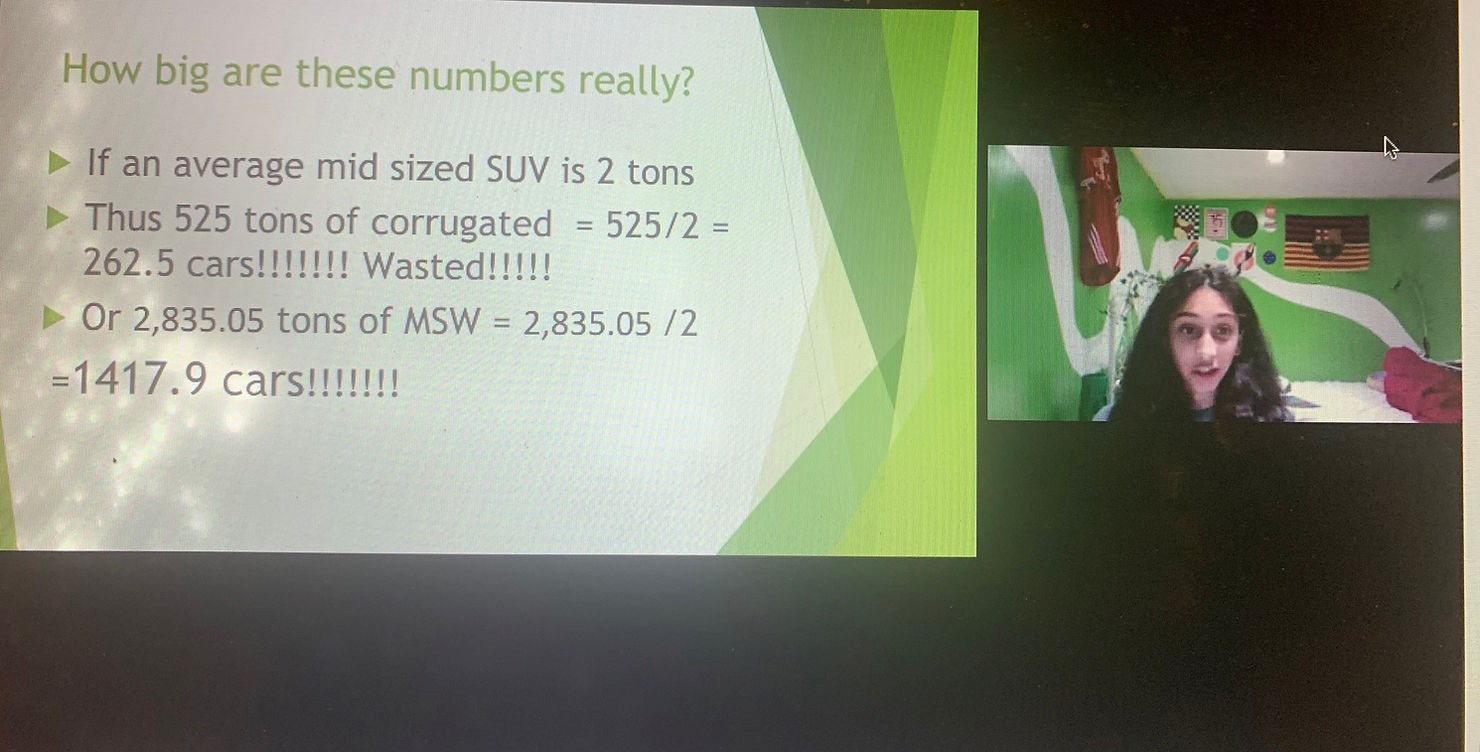
Our last event for the day was a discussion panel with a group of students who have done climate-change-based research. First, we spoke with Vidya Bindal, a seventh grader from Millburn Middle School, about her Yard Cardboard Collection Analysis. Through a series of carefully chosen statistics and figures, Vidya showed us how much waste we produce in Millburn as a town. Her comparisons helped put into perspective the excessiveness of our consumption. Vidya continued to propose a plan outlining which aspects of our waste we should work to cut down first, as well as how to approach doing so. Her work in this area is incredibly impressive, especially considering her youth.

Lastly, we heard from the Readington Middle School Research Team about their own research and analysis. The team was composed of Eddie Lou, Bronwyn Downey, Tatiana Hinka, Riya Gupta, Cristopher Serrao, Olivia Davis and Callum Suggitt, all current students or alumni of Readington Middle School. They shared some of the amazing projects they have worked on. First, they worked to solve the issue of food insecurity by investigating sustainable hyperlocal food production. Through their research, they came up with FIG – an indoor vertical garden. It uses every drop of water to the max, minimizing waste. The garden is fully automated and uses sensors to detect when the soil is too dry and needs to be watered. They are now working to make this system more regenerative and environment-friendly. Their work is truly impressive and shows how even middle and high school students can use science to solve real-world issues. They also found new ways to help virtual learning be more engaging during the coronavirus pandemic. The Readington Research also spoke about the importance of acting now and how we shouldn’t leave the issue of climate change to future generations. Through their own impressive research, they have shown that they are already taking matters into their own hands – and we should all aspire to follow in their footsteps.

All in all, today’s session was filled with amazing people and stories from across states. We got to hear students and teachers talk about their efforts to fight climate change both inside and outside of the classroom. As the Climate Summit continues, we’re sure to hear from even more exciting and inspiring individuals.


Categories
EDforSD

Day 2: Pushing for Climate Action Inside and Outside the Classroom

By Ashna Swaroop, Millburn Middle School, NJ

Dvita Bhattacharya, Millburn Middle School, NJ

Today’s session was all about Education for Sustainable Development, Curriculum Advocacy, Design and Implementation. Aalok Bhatt, a junior at Millburn High School in New Jersey led this session. Aalok is passionate about the environment, keeps up with current events, and hopes to make a difference to his community. The topic that was covered today was something that not many people think of on a day to day basis. Thankfully, we had the experts to help us understand the broad idea of Education for Sustainability.

Those experts, our panelists, consist of Ms. Jaimie Cloud, head of the Cloud Institute of Sustainable Education and Mr. Marc Rogoff, who was once a consultant to NASA and the National Wildlife Federation, and many other note-worthy organizations. Joining them was Mr. Michael Heinz, who works as the Science Coordinator for the NJ Department of Education. All of these remarkable people are working to include sustainability in the education system. Along the way, there have been problems and hardships that they had to overcome. And their journey isn’t over yet! Let’s see where they are now on the road to global education for sustainable development (ESD).

Ms. Cloud, who also works internationally in places such as Qatar, is working on developing benchmarks with school systems about green learning. Mr. Heinz has helped pave the path for New Jersey in becoming the first state to introduce sustainable education in school curriculum. Mr. Rogoff is working on establishing statewide climate change resilience. Finding an appropriate sustainable education curriculum is the challenge according to him. In addition, all three panelists made remarks about teachers not wanting to “add on” to the curriculum they already have. “Adding on” is not the right term for it. ESD needs to be integrated into the school’s existing curriculum. It should be included in other subjects, such as Math and Social Studies.

This problem of integrating ESD was also touched upon by Ms. Cloud. She referred to an example of how educators teach writing. Kids don’t learn how to make longer and longer sentences, she explained. They learn how to make their sentences with richer vocabulary and more meaning. That is how ESD should be assimilated. Making the existing curriculum richer, not longer. The teachers are already doing an astounding amount of work, and they don’t need more things to teach. ESD should benefit teachers, Mr. Rogoff said. After all, kids are the future. Teaching them about sustainability will help them understand their impact on the future.

Speaking about kids and the future, the panelists also had some great advice for youth who want to make an impact on the environment. Advice like that making a change can be hard to balance with other commitments, so it is important to not burn yourself out. Also, when you’re talking to someone with different views, avoid arguing, and instead find common ground that you can both agree on. This could be anything from the quality of food, to air pollution’s effects on people. Look at the things you eat, wear and use. See how you can improve that. Start small, think of the impact on small things. If it affects money and time, you’re going to have to think more about it. Make small steps, little changes. All it takes is a small effort to start the journey to making something great happen. Remember, it’s not only adults who can make a difference. The youth can too!

In our next session, we met 3 inspiring teenagers who prove that kids can make just as much of a positive impact on the climate as adults. Let’s see how they are making an impact on the world. Our teen panelists, speaking about Community Organizing Through Storytelling, were Amina Castronovo, Faiza Azam, and Jade Lozada. Amina is working on advocating for climate justice education, on a statewide and citywide level. Faiza is currently behind Ourclimate’s social media accounts. Through that forum, she is making sure people know how to volunteer and get involved with Ourclimate. She was inspired by living in Bangladesh, where the economy was being drastically affected by climate change. Jade was inspired to join organizations like TREEage, because of a poem contest she entered. The theme for the contest was climate change, and Jade wrote a poem about it. Afterwards, she got hooked into learning more about the environment.

Did you know that climate change affects other things besides the environment? In fact, agriculture is impacted greatly by climate change. For example, in India, millions of farmers are protesting, and even locally in California, the wildfires were brought by global warming. To stand up against this and make your voice heard, you could start at your very own school. Get a group of your peers who are interested in the club you want to create, and a teacher that is willing to help. Each public school in NYC is required to have a sustainability coordinator. Have a conversation with them and come up with a virtual event or a meeting that can take place to start off your movement in school. From there, you can talk to the city government, who can put pressure on the state government. Always hold people accountable so that they get the job done, says Amina. Remember that as youth, we know more than we think we do.

All three panelists mention how women are the main representatives in meetings about the climate crisis. There are a lot of females of color and people from the LGBTQ community. There are rarely any men, though. While it is empowering that they are mostly made up by women, they still need everyone to join. The feeling of empowerment was gone when the VSCO girl trend started up . Faiza recalls that she was really sad that it happened, and she was glad to have it end, because caring for the Earth should not be shameful. Instead it should be a passion that shouldn’t seem like work because you love it so much, like the panelists we met today. We hope they inspire you to go out and make a difference for the world. As Amina said, the sceptists say that we can’t change anything. Maybe we can’t, but we have to try. Believing in yourself is what is going to get us through.

Personally, these two days have been very inspiring, and I can’t wait to learn more in the coming workshops.


Categories
EDforSD

Day 1: NY/NJ Climate Education Youth Summit

Updated: Feb 10, 2021

By

Dvita Bhattacharya, Millburn Middle School, New Jersey

Ashna Swaroop, Millburn Middle School, New Jersey

Day 1 of the Climate Education Youth Summit went off with a bang! The theme for today was “Why Climate Action Through Education?”. To help answer this question, we got to hear from a group of amazing change makers and climate activists who are working to help solve the issue of climate change. Their inspiring stories and insightful messages highlighted the importance of this issue and the need for us all to do our part.

To start off the session, First Lady Tammy Murphy of New Jersey spoke about her efforts to solve climate change through education. She proposed introducing elements of climate change education into the school curriculum in 2019. After advocating for this change with the Standards Review Committee, climate change is now a part of the NJ curriculum, and will be going into effect in schools by September 2021. Mrs. Murphy’s work perfectly exemplifies the main point of today’s session: how education can help solve the climate crisis. Our world is slowly and fortunately shifting more towards clean energy(even though there’s still a long way to go). As Mrs. Murphy put it, teaching children about climate change helps prepare them to solve the great issues in our world and gives them the skills to thrive in a world that is more green. Her work proves to us all that education is one of the most important and impactful tools that we have.

Following up that speech, Professor Jeffrey Sachs joined us for a discussion panel facilitated by several young highschoolers and middle schoolers. He is a senior UN advisor, and has done amazing work to battle climate change. Professor Sachs spoke about the work that needs to be done in regards to this issue and addressed some important questions. He compared the fight against climate change to the famous “Moonshot” speech. In 1962, John F. Kennedy set a goal for the USA as a whole: landing a man on the moon. Today, our goal needs to be to decarbonize and turn to clean energy. Professor Sachs stressed that we, as a country, should aim to cut down on our fossil fuel consumption and move towards greener methods. He also answered an important question about climate change and the economy. In our efforts to reduce fossil fuel use, many jobs in that sector have already been lost. How can we balance our economy and our fight for a greener future? His answer was simple: while we may lose jobs on the way to a cleaner, healthier world, the long-term benefits of green energy far outweigh the losses. The new industries that will be sustained by this change will provide new jobs and help the economy flourish as a whole. We all stand to gain more happiness and welfare when our planet is safer and healthier. Lastly, Professor Sachs spoke about our need to grow closer and more trusting as a world. Countries need to work together to solve issues like lack of education and climate change. When we all focus on being global citizens, humanity benefits as a whole.

Next, we had another panel discussion with three inspiring people working to solve climate change. First, we heard from Professor Andre Correa d’Almeida from the School of International and Public Affairs. He spoke about his work creating the Development Practice Lab, which focuses on helping students use research to solve real problems. Professor d’Almeida teaches about sustainable development and works toward possible solutions. He emphasized the need to connect with the real world and get hand-on with reality. Like Professor Sachs, he also believed that global citizenship and international cooperation were the key to solving climate change and many other issues. Our next panelist was Priya Patel from the Environmental Commission in Millburn, NJ. She spoke about how she helped pass the No-Plastic ordinance in the town, limiting the amount of plastic stores used. She talked about how important it is to make your voice heard and just stand for your beliefs. Ms. Patel’s work is inspiring and shows how change is always possible. Lastly, we heard from Radley Faulknor from AmeriCorps VISTA, Public Works Department of Baltimore. He spoke about how redlined groups often face the worst effects of climate change, and how race factors into this issue. These groups face unsanitary living conditions because of their circumstances and homes. All three panelists showed us how faceted the issue of climate change is, and its importance in the world today.

Finally, we heard from Frida Ruiz and Bianca Palomino, two high school girls who decided to take initiative and fight climate change. Frida and Bianca are the founders of the Green Cause, an organization that works to increase environmental education (visit their website here). They produce lesson plans and educational content to help raise awareness within students. The Green Cause’s work perfectly shows how education can make an impact in climate change. Their work is also inspiring to us as the youth – they prove that we don’t need to be adults or have college degrees in order to make a difference. We should all strive to follow their example and work towards fighting climate change, no matter how big or small our contributions are. It takes all of us to make a change in battle, and today’s panelists have shown us all that we can make change regardless of age or circumstance.

Register for the conference here-

Register here: tiny.cc/climatesummit

The New York – New Jersey Youth Climate Education Summit is organized by the Center for Sustainable Development at the Earth Institute Columbia University in partnership with New Jersey Audubon and the National Wildlife Federation in New York City. The main objective of this weeklong Summit is to increase awareness about local environmental issues in the two States and to encourage community activism thought citizen science and other approaches. The Summit will also make youth aware of career pathways in sustainability and environmental education. There will be networking sessions with current sustainability track Columbia University students. The Summit will also provide opportunities for Q and As with world-renowned economists such as Jeffrey Sachs, marine biologist Joaquim Goes, and New York Times reporter and Earth Institute journalist Andrew Revkin. In addition, there will be numerous workshops designed to help youth enhance environmental skills, and play an active role in their communities to address sustainability issues. The Summit is a great opportunity to open young minds to the possibilities in research and activism. The Summit’s Keynote Speaker is New Jersey’s First Lady, Ms. Tammy Murphy who is spearheading Climate Change Education as an integral topic in New Jersey’s K-12 school curriculum.

Join us to ask questions, debate and participate!

Find the recording of Day 1 Here: https://youtu.be/9yD717ApGeQ


Categories
EDforSD

FIVE SHORT Videos TO WATCH on youtube, as we stay socially distanced.

Updated: Jan 15, 2021

By Vidya T. Bindal

As virtual schooling keeps most of us staring at our screens, I fear that locked in our rooms, we might be beginning to feel that the four walls of our rooms define our world. The truth is that our world is literally the huge planet we live on, and even when we live a hectic un-changing routine of long screen-based hours of school and homeworks, the real world–our planet and everything in it is constantly changing. The Bad news is that most of the current changes are in a bad direction. The Good news is we might still be able to do something. So here is what I did over the short winter-break in December. I kept adding to my Santa list, reluctantly wrapped a few gifts for my sister, made a few greeting cards, drank a lot of hot chocolate, tossed my soccer ball a zillion times, but most significantly, I watched five short films that continue to echo for me almost daily. I want to share my take on these five very short youtube based films. They give us interesting insights into Climate Change, and did I mention, that these are short (so we could easily squeeze these into our busy schedules, and not wait for a weekend to watch them).


Video 1

Climate Change Short Film: The End of Humanity

https://www.youtube.com/watch?v=sEbAaPhshUM

Review for video 1

In this five minute documentary, I was fascinated to see all the possible things that will happen when climate change crescendos to its absolute worst! With factual evidence and an alarmingly long list of what will happen, I was shown captivating yet horrifying pictures and videos of our oceans that will soon turn acidic, of the many species that will soon die out, and of the drought that will hit and wipe out civilization as we know it. The pictures were extremely saddening and brought reality to my eyes, and also touched on the biggest reasons for climate change. I recommend this capsule show to see what looks very distant right now.

Video 2

How to Save Our Planet

https://www.youtube.com/watch?v=0Puv0Pss33M

Review for video 2

In a more positive view of climate change, this video touches on what the downfalls of climate change will be, while also talking about what we can do to prevent such a disastrous end to our planet. One of the main points in the short film is that we have to learn to live in harmony with the earth. We need to figure out how to live sustainably, and as the narrator puts it, “In the next few decades we need to do something unprecedented.” The fact that this is something humans have not been able to do is quite disappointing and really puts reality into perspective as well as the greed of humans. This short film brings a more effective view of climate change while still reminding us of the dangers ahead. I felt a bit optimistic upon seeing this video, because I felt I can start a positive change.

Video 3

His Epic Message Will Make You Want to Save the World

https://www.youtube.com/watch?v=B-nEYsyRlYo

Review for video 3

“How are we not a miracle? We are perfectly positioned to the sun so we don’t burn but not too distant so we don’t turn to ice. Goldilocks said it best, we are just right.” This is a quote from the video, the video that had me overcome with emotions within the span of 4 minutes. Sadness, happiness, anger, and shame. As the narrator put it, we have been alive on this earth for 3 seconds compared to how old the earth is. We have caused so much damage in those three seconds, whether it be our animals completely dying out, not having enough clean food to eat, or not having enough water to drink. Through rhymes and gripping imagery, I was shown how beautiful our earth is, and just how much we would lose. I would recommend this short film for people to watch because of the feeling of empowerment and the feeling of saying to yourself, “I can do this. I can save our earth.”

Video 4

This is us – Climate Change is Real

https://www.youtube.com/watch?v=ap24Ep9vjB0

Review for video 4

In this particular short film, I saw something that wasn’t seen in the other ones. The main element was about getting people to raise their voices. Together. As one. As stated in the video, when humans spoke out against something together, it worked. Unnervingly clear pictures and videos showed trees being chopped down and of the ice caps melting, but also showed empowering pictures of people coming together to protest what our current leaders are doing for climate change. As the short film said, “This is us.”

Video 5

Nature Is Speaking – Julia Roberts is Mother Nature

https://www.youtube.com/watch?v=WmVLcj-XKnM

Review for video 5

In a new take on environmental videos, we are shown Mother Nature’s point of view on climate change. This video may make you rethink what you think of mother earth because through this video, yes she is hurt, and she is bitter. She realizes that if she flourishes, we flourish, and if she falters, we falter. She has taken out species bigger than ours and kept species bigger than ours alive. Nature does not need us, it makes no difference to her if we are there or not. We neednature because we rely so heavily on it, and without it we cannot survive. “One way or the other your actions will determine your fate. Not mine. I am nature. I will go on. I am prepared to evolve.”

Haunting!


I hope you enjoy these videos and feel inspired!


Vidya T. Bindalis a 7th grader at the Millburn Middle School, NJ. She is an avid soccer player and an eco-ambassador and thus she can be found kicking a ball in the wooded backyard by herself all day long!


Categories
EDforSD

Education and Sustainability

By Aalok Bhatt


From the way we study, work and go about our lives to how we view the inequalities in our society in terms of race, gender and economics, change is everywhere. And yet, beyond the pandemic there is another crisis that threatens us all. It’s climate change.

Until I became a part of the Eco Ambassador program, brought to our local community by Dr. Iyengar and Ms. Shin, I thought I was doing my bit for the environment by carrying a reusable water bottle to school and saying no to the occasional single use plastic bag. It was at a talk I attended at the UN conference on climate change two years ago that the seriousness of the issue hit me. The amount of water it takes to produce a pound of steak is the same as the amount of water used by an average person to shower over a three year period! The amount of water it takes to produce a t-shirt is a staggering 2700 litres! Besides the environmental degradation caused by the meat and fashion industry, I also learned about the abuse of animal rights and workers’ rights, and the lack of ethics in the fashion and food industry.

I found these facts very interesting and I thought to myself, why is this not taught at school? We are taught about the effects of climate change, but we are not taught what to do, and why well enough. I believe that environmental studies should be an integral part of our curriculum just like math, history and science. Education is not just about preparing ourselves for a career but also about making us responsible citizens of the world. Unfortunately for my generation, it is a world threatened by rising temperatures, shrinking forests and oceans brimming with plastic. When I spoke about this in spring at a virtual conference organized by the Earth Institute, I shared the link with my Biology teacher, Mr. Rollo. He agreed with me and told me that going forward, he would consciously talk about how to combat climate change while teaching.

Our high school does offer a course in Environmental Studies, but it is an AP course that only high school seniors can take. Also, there is a tough entrance exam to qualify for this course, so not everyone can access it. Maybe schools should make important courses like these accessible to all students and start educating them from the elementary school itself.

In terms of education, we not only need to revise our textbooks and curriculum, but also need more programs at grassroots levels to encourage community participation and practical learning for students. I’ll give my own example. In my first year as an eco-ambassador, I designed a poster campaign highlighting the adverse effects of plastic in my town. As part of my initiative, I went to local businesses to understand their single use plastic consumption and educate them about this issue. I also met up with the recycling director of my town and realized that most of us were recycling the wrong way by adding contaminants. So, Wouldn’t it be nice if we all learned about this in our schools? Most of the local restaurants agreed to display my posters and ask their customers whether they wanted plastic cutlery and bags. The superintendent of our board of education allowed me to put up these posters in our schools. They were also put up in our town library. Not only that, my fellow eco ambassadors and I along with boy scouts members, members of the high school environment club and our town’s Green Team rallied for a ban and a tax on single use plastic bags at our town council meeting and we were successful in getting it approved.

Recently too, our school environment club organized a flyer competition to highlight the recycling rules of our township for all high school students. This encouraged many of us to research and present the rules in a creative manner and we ended up internalizing important points without trying too hard. This summer, I tried to spread awareness in my town on reducing meat consumption and the importance of eating local produce. Since we were all stuck at home because of COVID, I made a short film on Meatless Mondays and had fun researching the material and making it. It would be great if such initiatives and projects become a part of our mainstream curriculum and everyone benefits from the knowledge. Thankfully, we will soon have a government that believes in addressing the climate crisis and plans to allocate $2 trillion towards this cause.


Aalok Bhatt is a Millburn High School Student and is passionate about environmental issues.


Categories
EDforSD

The Biden-Harris agenda should commit to Education for Sustainability

By Julia Sommer

Member of Green Team for South Orange Maplewood School District (NJ) and sustainability educator


The formal education system experienced by millions of American youth is one in which academic subjects occupy separate silos that often lack relevance and timeliness to students’ lives. As Covid-era schooling is now conducted mostly through screens at home, parents are seeing firsthand how such a structure leads to lack of engagement, both cognitive and emotional. At the same time, Americans’ levels of civic learning are dangerously low as public schools for years have prioritized math and reading over civic literacy. We no longer expect or demand that our schools will focus on what it means to participate actively in our democracy. The Biden-Harris administration could address all these ills through a commitment to Education for Sustainability. Imagine if the government provided incentives for every school, K-12 and beyond, to hire a Sustainability Coordinator and every district to hire a Climate Literacy Officer? (A handful of schools already do the former and Portland, OR has actually done the latter.) Educators in such roles could support teachers and administrators in developing interdisciplinary projects that ensure all students learn about the causes and effects of climate change. An empowering education would teach students how to work within democratic institutions to enact local, state, and federal policies that ensure a healthier planet as well as economic stability in the coming years. Students’ education would become both relevant and timely if they studied local problems related to the environment and devised real-world solutions with the support of educators trained in Action Civics. Teaching this curriculum successfully is a serious shift from the system currently in place and will only happen with significant financial support for professional development. I can think of no initiative that could have a greater impact on Earth’s future than empowering youth to mitigate Global Warming’s effects through civic engagement.


Categories
EDforSD

Seven Habits of Highly Effective (U.S.) CITIZENs

Building towards global citizenship virtues

by Nidhi Thakur

  1. They VOTE(as often as they can, but especially in the general election that everyone agrees is the election for the ‘soul’ of the world’s most developed country).
  2. They VOTE, even when the act of voting is just a choice, not a mandated duty like ‘jury duty’. No one will put them in jail for not voting, but they know that voting is the bedrock of democracy (unlike dictatorship and monarchy).
  3. They VOTE, despite a global pandemic, because, either they have a no-hassle mail-in ballot, or even if they have to physically stand in a line to vote, they vote, because they realise, and strongly cherish, their RIGHT TO VOTE, knowing fully well that this right is a privilege acquired after many a hardships. (They are amazed to learn that African Americans did not win the right to vote until the 15thAmendment to the U.S. constitution in 1870- approximately a 100 years after Independence, and that women were not granted this right up until the 19thAmendment in 1920!).
  4. They VOTE, because the right to vote is granted to only ‘special’ people– who are at least 18 years of age on voting day, have legal (and sometimes hard earned) citizenship of the U.S.A. and are eligible to vote as per the specific rules of the State they are registered to vote in. Being ‘special’ enough to be thus granted this right, is not something that they take lightly. (https://www.usa.gov/who-can-vote)
  5. They VOTE, because each vote matters way more than one imagines. Of the 240 million eligible voters this year, going by past trends, approximately 40% of these voters may NOT vote. This number would not be troubling, if elections were NOT as close as they have been in recent years. For example, the 2016 election went one way versus the other largely because of non-voters in the state of PA.
  6. They VOTE because voting record is public information! They know that their peers/employers/families (can) know whether they voted or not.

(Please note: WHO they voted for is ALWAYS confidential, but whether they voted or not is not.

Source: https://www.ncsl.org/research/elections-and-campaigns/access-to-and-use-of-voter-registration-lists.aspx)

  1. They Vote because all civic societies are formed by/around laws and laws are formed by elected officials. They know that their only shot at influencing the laws that are made, is by ELECTING the people who reflect their sense of basic/universal human value.


Dr Thakur can be contacted –[email protected]


Categories
EDforSD

Post COVID-19 demands Social Emotional Learning to be prioritized

Radhika Iyengar,

Earth Institute, Columbia University

Human beings, while capable of the worst, are also capable of rising above themselves, choosing again what is good, and making a new start, despite their mental and social conditioning. We are able to take an honest look at ourselves, to acknowledge our deep dissatisfaction, and to embark on new paths to authentic freedom.”Laudato Si, Pope Francis.

COVID-19 had led to mass destruction of lives and economies, but it has also shown us that humanity can come together in many unique ways. Among many lessons from the pandemic, we should not forget the lesson of empathy that COVID19 teaches us. Many ordinary citizens from across the globe have become #coronaheroes. Some are running community kitchens for migrants, others are organizing mass mask supplies for frontline workers. What can we learn from each other and how do we integrate this in our curricula? Social Emotional Learning (SEL) has become even more important for the COVID-19 era and beyond.

The National Education Association in the United States has put out a statement that Social Emotional Learning should be the priority during and post-COVID-19 crisis[1].Many teachers and experts are calling to include SEL in all components of the current curricula. The World Bank education experts agree that the SEL component has been neglected thus far and given that millions of children are out-of-school and families continue to suffer financial, mental, emotional and health risks, SEL must be prioritized[2]. The World Bank report states that nearly half of the students surveyed in the United States reported feeling worried about the potential risk of a close relative getting infected, but they are also concerned about not learning enough at home to be ready for the next school year. The report also quotes a survey study by the University of Oregon, showing that children are experiencing difficulties in their socio-emotional development and present higher rates of disruptive behaviors than before the pandemic started. At the same time, families are experiencing household economic insecurity that limits their capacity to meet their basic needs. Given this need, the World Bank has started a youth skilling program in Kaduna State Nigeria that gives SEL the substantial treatment it deserves[3]. Therefore, there is ample evidence that SEL needs to expand much more than what was required before COVID-19.

With SEL being the immediate need in curricula across all levels, values such as empathy towards each other and towards the planet will help communities to recover from this pandemic and avoid future pandemics. Religious leaders like the Dalai Lama and Pope Francis have emphasized empathy towards each other and our environment. Pope Francis’s Laudato Si[4], or “On Care for Our Common Home,” urges us to be empathetic about our environment. This “Environmental encyclical” is a meeting point between the environment and spirituality. He delicately balances using scientific words such as “global warming” and “carbon emission” and puts it in a spiritual perspective. Pope Francis takes his inspiration from St Francis of Assisi and relates to nature as “sister earth”, “brother sun” and “sister moon”. He urges us to get connected with different aspects of the planet to cultivate the “ecological virtues”. A broadened understanding of SEL that incorporates empathy for our shared home on earth as an extension of empathy for each other, and that links individual and community resilience to environmental resilience, can help raise awareness of how issues like environmental degradation and biodiversity loss pave the way for spread of deadly pandemics like COVID-19, droughts that cause mass hunger, and other human challenges.

Pope calls for a “consciousness-raising” to prevent further all the health and environmental risks caused by humankind. An approach to SEL that incorporates empathy for each other and for environment will help us to be mindful of our own actions and will help us to look deeper within ourselves to break the “myths” of a modernity grounded in a utilitarian mindset (individualism, unlimited progress, competition, consumerism, the unregulated market).” This reflective practice will also help in “establishing harmony within ourselves, with others, with nature and other living creatures, and with God.”

The mass destruction has taught us about empathy in real-life, how can we take this lesson and integrate it into our schooling systems? Pope Francis thus explains the real purpose of environmental education, which can be incorporated into SEL, is to not teach facts, but an approach to question one’s own practices and meaning-making. He urges educators to encourage “ecological ethics” in developing “ecological citizenship.” Pope Francis gives examples of small, but essential practices that we could all learn from this form of education”…such as avoiding the use of plastic and paper, reducing water consumption, separating refuse, cooking only what can reasonably be consumed, showing care for other living beings, using public transport or car-pooling, planting trees, turning off unnecessary lights, or any number of other practices. “This could be such a profound way of “cultivating sound virtues” where people will be empowered to “..make a selfless ecological commitment”.

This pandemic has given us the time to reflect on our past, including the way we have mistreated sister earth. The sixth mass destruction is underway[5]. In order to reverse these catastrophic trends in human health and environmental degradation, it is time to revisit Laudato Si and bring humanity back to humans.

The SEL intervention that has been part of the SENSE activity should therefore be broadened to include supplemental teaching and learning materials that help teachers, pupils, and community education volunteers make links between foundational SEL concepts like self-awareness, empathy, and resilience with critical challenges of our time like COVID-19 and climate change. Stories, discussion questions, role-playing activities, and other SEL activities can be curated to align to the current curriculum, with key messages shared within school communities through the engagement of community education volunteers and school-based management committees. This broadened approach to SEL implementation will help young people, teachers, and communities build the critical consciousness that will enable understanding and mobilization around solutions to protect our shared environment and promote health and well-being.

[1]https://www.nea.org/advocating-for-change/new-from-nea/social-emotional-learning-should-be-priority-during-covid-19 [2]https://blogs.worldbank.org/education/importance-monitoring-impacts-covid-19-pandemic-young-children-and-their-families [3]https://blogs.worldbank.org/digital-development/new-skills-youth-succeed-post-covid-world [4]http://www.vatican.va/content/francesco/en/encyclicals/documents/papa-francesco_20150524_enciclica-laudato-si.html [5]https://www.theguardian.com/environment/2017/jul/10/earths-sixth-mass-extinction-event-already-underway-scientists-warn


Thank you to Tara Stafford Ocansey for her valuable inputs to this article.


Categories
EDforSD

Reimagining Education for SDG 4.7 and Sustainable Future

Anant Bhaskar Garg and Manisha Agarwal

Director, HaritaDhara Research Development and Education Foundation(HRDEF)

Abstract

As per data from various studies, quality, climate education, and 21stcentury skills are ignored in mainstream education. To bridge this gap, HRDEF provide quality skillful education, problem solving, creativity, communication, design and computing. Building capacity for citizenship, Climate Action, and Sustainable Development Goals (SDGs) among school students and youth so that they are able to tackle future challenges.

HRDEF is using games, project, and hands-on approach for interactive learning. HRDEF conduct teachers, student’s development programs for capacity building on ICT, SDGs, climate change, disasters, STEAM, andwork towards Sustainability, Green Swachh, (Hindi word for Clean) and Sustainable Campus/Living in government schools.

Students, youth of our after-school GOAL program become motivated, equipped with self-confidence to excel in life and creating sustainable future. As systemic changes required continuous working and time for visible performance. Change, transformation will come through working gradually taking a step-by-step approach.

Keywords

Climate Action, Education for Sustainable Development, Quality Education, Hands-on, Game, Project Based Learning

1 Introduction

Beginning with 21stcentury the United Nations (UN) started Millennium Development Goals (MDG) and decade of Education for Sustainable Development (ESD) (2005-2014) that highlighted vibrant role of education towards sustainable development for saving our planet as world witnessed extreme events due to climate change. Further, the UN adopted the 17 Sustainable Development Goals (SDGs) in September 2015 to advocates for SDG 4 that provide inclusive, equitable quality education and promotes lifelong learning opportunities for all to build sustainable, inclusive and resilient societies. SDG 4.7 targets that by 2030 all learners acquire the knowledge, skills needed to promote sustainable lifestyles, human rights, gender equality, peace, non-violence, global citizenship, and cultural diversity (UN, SDSN Reports).

Through education we transfer knowledge, values, and skills across generation to facilitate societies to build the foundation for sustainable future. But many barriers to education access, outcomes, and monitoring of progress are main challenges that need to be addressed for achieving SDG 4.7. The global climate educationand the concept of ESD are unable to provide radical transformation of education systems needed to guard against climate change. Five roadblocks identified in a Brookings report needed to resolve in a time of climate change (Kwauk, 2020). India’s Philosophy of ‘One World’, Global Partnership, and culture of support is known for centuries. Uniting all stakeholders for their role in shaping the 2030 Agenda and the SDGs on three pillars of economy, social, environment with culture based on the principles of equality and humanity was very important for the global society.

2 Why need Transformative Learning for ESD, Climate Change Education

As per UNICEF study, 50 % of Indian Students don’t have 21st Century Skills required for Jobs and around 15 Crore school students lack job skills by 2030 published in 2019. ​21st century skills such as critical thinking, inquiry based learning, collaboration, communication, and SDGs, sustainability, and hands-on learning are missing in school educational institutions. School education system require maker spaces, DIY (Do it yourself), smartphone, tablets, relevant software, and computers for successfully implementing STEAM education.Yale University research on climate change communications pointed out that 65% of the Indian population is not aware of climate change published in 2016. Thus, everyone urgently needs to include climate change and ESD in a radical way to address future challenges.

3 Experiential, Embodied Learning for Sustainable Development

How do we learn? As a child we learn by exploring, by touching things, moving things and taking things apart. This is really an experiential way of learning i.e. learning by doing. But in school’s classroom, we sit down quietly, without moving, talking or playing. Making as a construction, DIY process provides various insights, knowledge about our surroundings, and actively participate in enjoying transformative learning. Playing games, making provide an entertaining, fulfilling experience of doing, creating new things, have many advantages for students, as it makes the player, a decision-maker, facts investigator, evaluating strategy, prioritizing their actions and abilities.

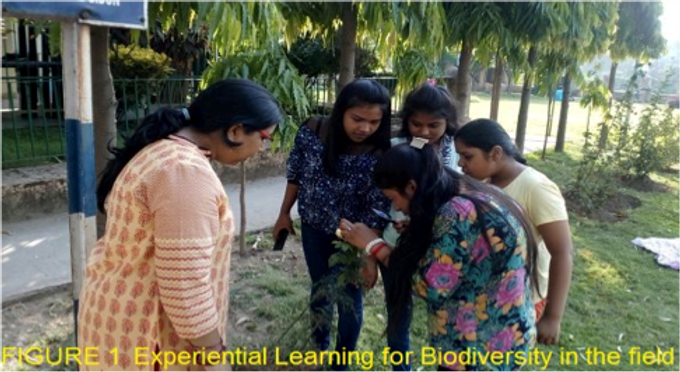
Integrated, hands-on, project, game-based learning that incorporates technology is crucial for the 21stCentury Skills. MAKER (Manufacturer, Author, Knowledge analyst, Exhibitor, Recycler), Project, Game-based learning provides a new emerging ways to understand difficult concepts and further it provides opportunities for students, learners to experience the phenomena. Therefore, it promotes interactive, experiential learning that helps the learner to develop curiosity, creativity, critical thinking, collaboration, and problem-solving that are essential for the 21stCentury skills. Thus, learning a concept, its understanding, and practice involve different steps such as exploration, curiosity, asking the question, discussion, create, design thinking, making model, games, role play, drama, story, and present (Scott, 2015). Students of our GyanDhara Opportunities for All with Learning (GOAL) worked, developed a miniature, presentations, played board games, card games for embodied, immersive learning related to climate change, and sustainability concepts as given below in the case study. Figure 1 describes experiential learning for biodiversity concepts in the field.
4 Quality Skillful Education: Games for SDGs, Sustainability

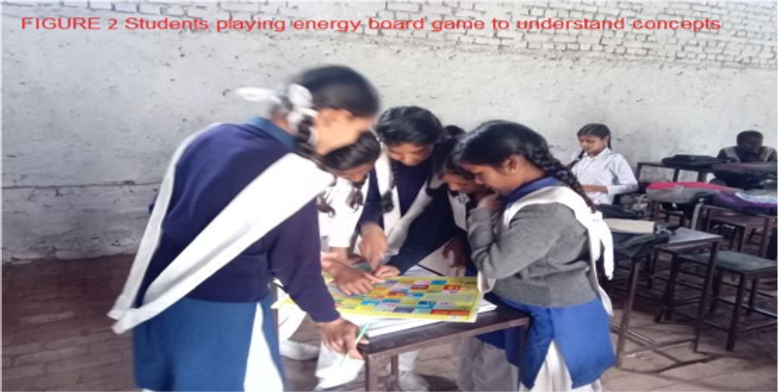
Games require players to think systemically and consider relationships instead of isolated events or facts for sustainability and sustainable development (Stommen et. al., 2016). Some games are externally designed while we designed games keeping in mind Human Work Interaction Design approach through studying work settings and embedding screenplays, rules for better understanding (Clemmensen et.al., 2005), (Campos et. al., 2009). Games need not be restricted to educating schools or colleges, but on learning new things, maybe cooking virtually, learning yoga, explaining and teaching complex problems such as climate change, and sustainable development (Katsaliaki et. al., 2012). In figure 2 students playing an energy board game to understand concepts such as electricity conservation, renewable energy.
The educational game is a form of social interaction, as learners tries to map out situations that will encourage solving compelling problems. For example, to learn about climate change and sustainability problems, learners team-up for gathering and discussing information in a project way (Garg et. al, 2017). Such games foster effective learning habits to change our lifestyle for sustainable living as described in fireworks example later on.

5 Transformation of Education to create “Sustainable Consciousness”

We need more focus on skill development, innovation, decision-making, and problem-solving through establishing Centre of Excellence with focus on 21stcentury skills. With the advent of sustainable consciousness, our GOAL program youth decided to reduce pollution during Diwali celebration, thus some children haven’t burn any crackers to save the environment and others burned 60 to 70% less firework as per previous years based on student and parents stories. Further, they saved Rs. 200 to Rs. 600 that made them very happy. Some senior students decided to devote time for providing quality education to poor students. Now, same students dream is to become a doctor, IAS, IPS, Judge, dancer, cricketer, banker, lawyer, army officer, and teacher (maximum girls dream) rather than focusing on their social background as most of them come from low income group.

Thus, we are doing capacity development programs for 21stcentury skills, STEAM, and Sustainability through:

– Teacher development programs designed to develop and teach students for SDGs, climate change, and 21stcentury skills

– Focusing on employability, skill development and entrepreneurship with industry orientation and linkages

– Learning science, technology, engineering, arts, mathematics (STEAM) linking with SDGs with hands-on, game and problem-based approach

– Establishing learning centers with the community to imbibe responsibility, accountability, global citizenship, gender equality, values

Therefore, ESD is crucial for the SDGs awareness and success for all. Education in school and higher education institution (HEI) play key role as prevalent in our golden time, e.g., Nalanda, Takshila Universities in India. Schools (Ashrams), universities happen to be not only seat of learning but also providers of solutions to humanity’s problems; however, modern schools, universities are not very well connected with their local communities and the environment.

6 Conclusion

Using games to teach a specific curriculum topic related to sustainability such as climate change, water cycle, energy, biodiversity, associated concepts such as light, plant identification, disaster management, and renewable energy increased players’ motivation towards science and sustainability. Besides this, learners showed interest in English, personality development, and improved their leadership skills.

Games and makerspaces can motivate students to turn to textbooks with the intention of understanding rather than memorizing. Learning occurs not just in the gameplay but other kinds of making activities, encourage collaboration among participants, thus provide a context for peer-to-peer teaching and for the emergence of communities of Learners. It will go a long way in nurturing a spirit of inquiry, fostering creativity, and developing a culture of innovation among students; equipping them with skills and competence to create an equitable and sustainable future.

References

Campos P., Campos A. (2009), An Educational Game Created through a Human-Work Interaction Design Approach. In: Gross T. et al. (eds) Human-Computer Interaction, INTERACT 2009. Vol 5726. Springer, Berlin, Heidelberg

Clemmensen, T., Orngreen, R. & Pejtersen, A. M. (2005). Describing Users in Contexts: Perspectives on Human-Work Interaction Design. Workshop Proceedings of Interact’05

Garg, A. B. & Agarwal, M. (2017). Educational Games for Learning Sustainability Concepts, INTERACT Workshop Human Work Interaction Design meets International Development, pg. 290-297

Katsaliaki, K. & Mustafee, N. (2012). A survey of serious games on sustainable development, Proceedings of IEEE Winter Simulation Conference

Kwauk, C. (2020). Roadblocks to quality education in a time of climate change, Centre for Universal Education, Brookings Institution

Scott, C. L. (2015). The Futures of Learning 2: What kind of learning for the 21st century? UNESCO Education Research and Foresight, Paris. [ERF Working Papers Series, No. 14]

Singer, N., Farahaty, E., Mahmoud, E. S. (2020). Motives of the Egyptian Education Future for Sustainable Development: A Comparative Analysis Between 2020 and 2030, Humanities & Social Sciences Reviews, Available at SSRN: https://ssrn.com/abstract=3585908

Stommen, S.M. & Farley, K. (2016). Games for Grownups: The Role of Gamification in Climate Change and Sustainability, Indicia Consulting LLC

https://sustainabledevelopment.un.org/content/documents/23669BN_SDG4.pdf

https://indicators.report/targets/47/#:~:text=Target%204.7%20by%202030%20ensure,%2Dviolence%2C%20global%20citizenship%2C%20and

https://www.unicef.org/press-releases/more-half-south-asian-youth-are-not-track-have-education-and-skills-necessary

https://environment.yale.edu/climate-communication-OFF/files/Climate-Change-Indian-Mind.pdf

About Authors

Anant Bhaskar Garg, Director, HRDEF, Engineer and Educator with 23 years of exp. in various capacities in academia, industries. Published two books, 53 papers in Intl. Journals, Seminars, 2 chapters in Springer’s book, Invited Speaker at 98th ISC, member of Prof. Societies IEI, ACM, CSI, ISCA, IETE, ISTE. Senior Member 2011 of ACM, USA. Climate Reality Leader, #MentorofChange, AIM, NITI Aayog, MIEE. Organized various seminars, faculty, and student development prog. Learned best practices on education, environment through visiting Denmark, Sweden, Switzerland, USA, involved in community services for computer, and sustainability.

Manisha Agarwal, Director, HRDEF, Educator having done M. Sc. (Botany), PhD (Forest Botany) Forest Research Institute University. MBA in Education Management. Sixteen years of research experience in the field of Botany, Wood Anatomy, medicinal plants, papers in international, national journals, member of Indian Botanical Society, ISCA, Climate Reality Leader, Society of Wood Science and Technology, USA – 2013-14, Involved in environment education, climate action, STEAM teaching, raising awareness and skills development

HRDEF established as non-profit social enterprise and in Special Consultative status with the United Nations Economic and Social Council (ECOSOC) since 2018. HRDEF established afterschool program, conducting workshops, and training on climate change, Sustainable Development Goals, and STEAM. HRDEF worked with school students, youth to develop their learning capacities for 21st Century Skills through game, project based interactive learning. Provide makerspace, hands-on experiments for school children to understand concepts, Climate Change, SDGs and Sustainability.
 

Categories
EDforSD

Reducing Meat Consumption for Human and Planet Health


By Aalok Bhatt, 

Millburn Highschool


Watch Aalok Bhatt’s video here- 

https://youtu.be/vXFN6LPZzeM

My name is Aalok Bhatt and I am an Eco-Ambassador and a junior at Millburn High School. This summer, I decided to raise awareness in my community about the health and environmental benefits of reducing meat consumption. I chose this topic because last summer I attended a talk in NYC about sustainable development, where I was shocked to learn about the detrimental impact of increased meat consumption on our environment. The amount of water it takes to produce a pound of beef is equal to the amount of water used by an average person to shower over three years! Another reason why I picked this issue is that Covid-19, which has brought the entire world to a standstill, also originated in an unhygienic meat market in Wuhan.  I knew I had to do something to convince people that even if we abstain from eating meat for one day a week, it will have a huge impact on our health and the health of our planet.

      As I was researching this topic, I found that the entire public school district of New York City has adopted the Meatless Mondays initiative. A lot of hospitals like the New York Presbyterian and restaurants, too, have implemented this program. My goal is to launch this program in my community and then scale it up to include New Jersey public schools and hospitals.

      Given the fact that we are living through a global pandemic, I realized that I would need to take an unconventional approach for my project. With that in mind, I sent emails to various experts in the fields of health and nutrition, environmental protection, and animal rights. I was successfully able to host two talks. The first one was with Nutritionist Monika Mahajan on the health and environmental impact of meat consumption. The second talk was with Ms. Daniel Schwab of Illuminate Supply Chains about the importance of eating local and seasonal foods and setting up sustainable supply chains in communities. 

Unfortunately, I faced many roadblocks this year as compared to last summer, where I raised awareness on eliminating single-use plastic in my town through a poster campaign. Most of the people I contacted did not respond. For instance, I sent many emails to Monday Campaigns to organize a talk on Meatless Mondays for my community, but they were not very responsive. I also contacted faculty members from the Columbia School of Public health for guidance on implementing Meatless Mondays in hospitals in my area, just like they have done in NYC. However, I still haven’t heard from them. I am in talks with the Humane League, which works for animal rights and against factory farming for a one on one interview.  I hope to post it on this website soon. The talks that I did host so far had a limited number of participants and viewers.

In the middle of August, I realized that this was not going anywhere and I would have to do something else. I thought for a while about what I could do next, and then it hit me: I could create a short animated video in the form of a story. I created a google slides document and used pictures from a website called Freepik to create a short educational film. The story is based on a fictional cow, named Moodles, who talks about the drawbacks of eating too much meat. I had a lot of fun making this film and researching all the facts. In the coming weeks, I will ask the principals of Millburn Elementary Schools, Millburn Middle School, and Millburn High School to share this video with their students and parents. I also plan to put it up on my town Facebook group and other community platforms. I’m determined to continue spreading awareness on this issue throughout this year.