By Jason Jun
Grade 8, Charles Dewolf Middle School
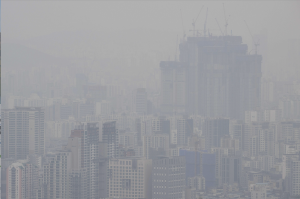
A general view shows commercial buildings shrouded in haze on a heavily polluted day in Seoul on March 25, 2022. Credit: Anthony Wallace/AFP via Getty Images
As an elementary student growing up in South Korea, I faced a curious dilemma that revolved around an unfamiliar accessory- a face mask. I didn’t understand why I had to wear a mask every time I walked outside. There was no widespread virus going on, I was generally healthy, and I was pretty proud of my face. So why was it necessary? I found out answers from the adults around me- my parents and teachers- but their responses were consistent: masks were worn because of air pollution. At first, I had no interest at all; I just didn’t want to wear a mask, and it became an unwelcome part of daily routine.
As time went on, things started to change. The signs of growing issue became increasingly apparent. I realized that my clear vision of the world outside had started to blur. I kept itching my eyes, I wasn’t able to see the clear blue skies I had so often taken for granted. Notably, whenever I didn’t wear a mask, I coughed a lot. I was also devastated by soccer game cancellation. Imagine eagerly preparing for a soccer practice or game, only to be met with the disappointing news of its cancellation due to worsening air quality. Every time I laced up my cleats and stepped onto the field, my heart raced with anticipation. As a soccer player, these unwelcome cancellations have become a constant source of disappointment. One particularly memorable incident occurred during my third-grader year in South Korea. That day had begun with a heavy morning haze, but as the school day progressed, I saw a sky painted an unusual shade of yellow. I was shocked. I had never seen anything like it before in my life. This experience would become a turning point in my journey of understanding.
I saw the main difference in the air and the environment when I arrived in the United States in 2019. Stepping off the plane, I quickly realized that I no longer needed to wear a mask. The sky was pure and clear, my eyes were no longer itchy, and I didn’t cough a lot outside. This made me realize how poor the air quality is in Korea. As I continued to grow, my interest in air pollution deepened, and I developed a strong desire to make a difference. I always tried to do easy but impactful tasks, such as conserving energy and planting trees, and advocating for alternative transportation, like walking or biking instead of relying on cars.
Air pollution, I realized, is an issue that we have to fix as fast as we can. Exposure to pollution is going to have a significant threat on everyone’s health. For example, if you breathe too much pollutants, it can cause severe lung diseases, and in extreme cases, even cancer and premature death. If we want to reduce air pollution, the first step is understanding what causes it. The answer to that is mainly transportation emissions, excessive energy consumption, and various other sources. To address this issue, there are practical steps we can take. you can try planting plants outside, using fewer cars and relying more public transportation or walking, turning off engines, and adopting eco-friendly practices; these are all part of the solution. Although air pollution is undoubtedly harmful and offers no benefits, it is pretty easy and simple to reduce it. Even small, daily actions can collectively make a significant difference in our efforts to create a cleaner, healthier world for all.
Jason Jun
Jason is an 8th grader at Charles Dewolf Middle School. He’s passionate about gardening and cooking, takes his soccer seriously, and always checks the air condition and weather forecast before games. He believes in consuming healthy food to maintain good health. He loves reading articles and watching YouTube videos about nutritious food. His environmental journey began when he realized a significant portion of greenhouse gas (GHG)emissions comes from the livestock industry. This led him to research the connection between food waste and emissions. In 2022, he participated in the StemFest Environmental Challenge, conducting research and presenting on GHG emissions. In 2023, he joined the US Summit for Transformative Education. As Student Council President at his school, Jason and his friends participated in the Walk to School Week in October 2023, gaining firsthand experience of air pollution caused by cars. He also took part in a 2023 photo contest sponsored by OTEC (Old Tappan Environmental Commission). This experience made him appreciate the beautiful natural environment in our neighborhood and understand the importance of protecting it. He plans to actively engage in activities aimed at reducing GHG emissions as an Eco Ambassador in the future.