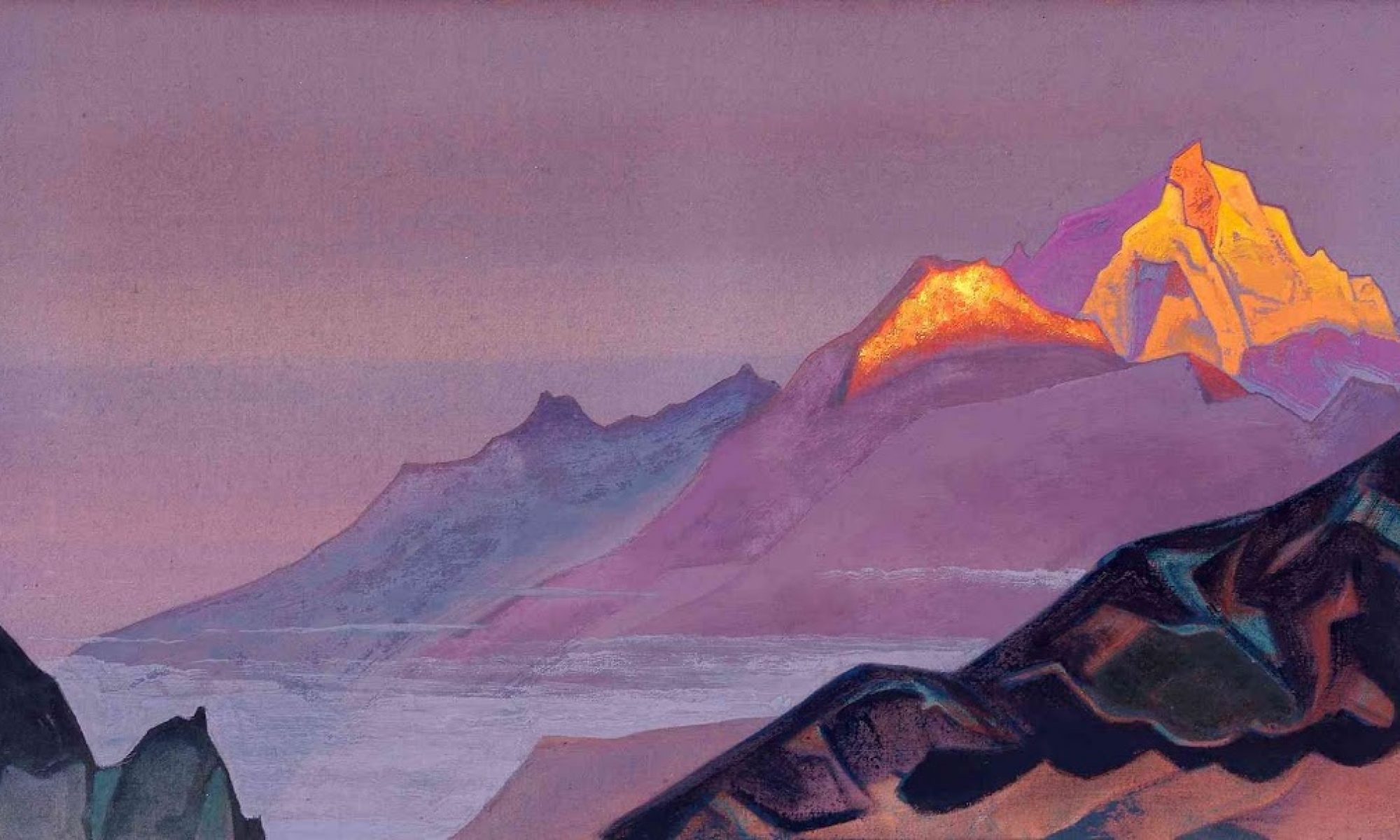
Although there have been few corroborated eyewitness accounts of Shambhala and what it looks like, thus lending it its mysticism, there have been attempts to describe it in detail and even depict the kingdom visually based on religious textual descriptions.
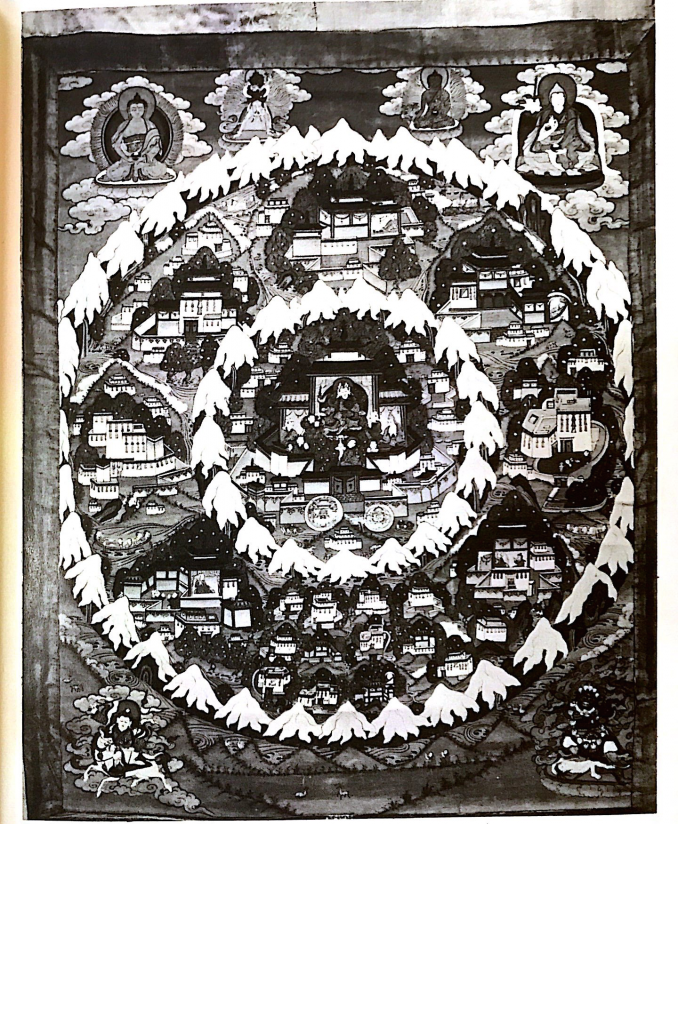
Taken from Edwin Berbaum’s The Way to Shambhala

Taken from Himalayan Art
Above are two examples of attempts to visually depict the mythical kingdom, in accordance with the structure detailed in early religious textual descriptions of Shambhala but also in accordance with the shape of the mandala, as seen below.
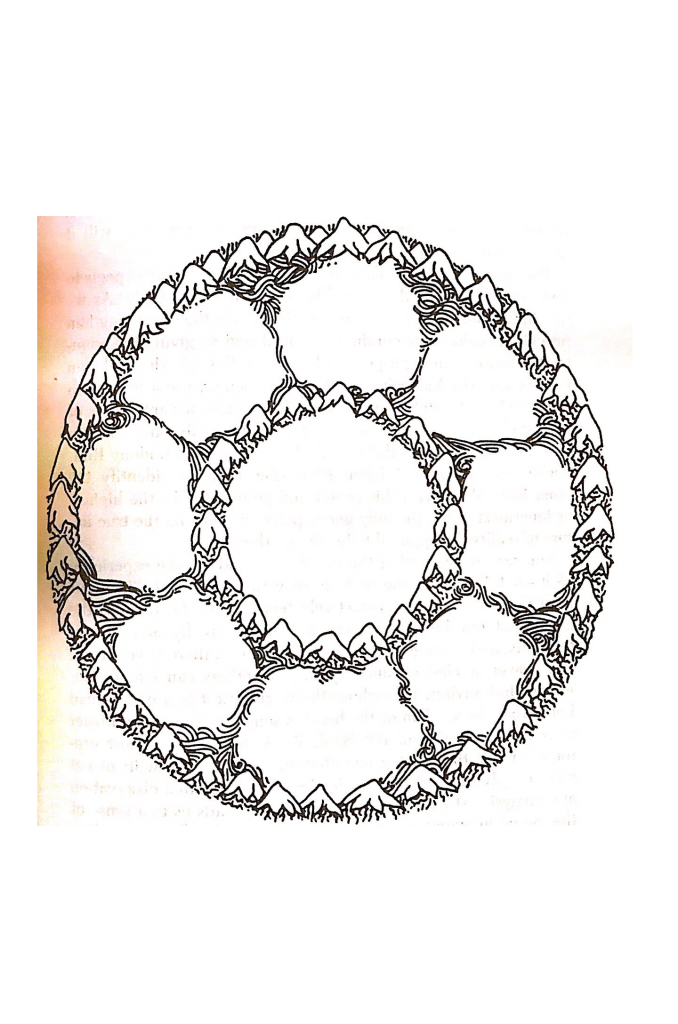
Taken from Edwin Berbaum’s The Way to Shambhala

Taken from Edwin Berbaum’s The Way to Shambhala
Indeed, it was written that Shambhala is shaped like a giant lotus having eight petals (Fig 5), with a circle of great snow mountains around the outer perimeter and the perimeter of the pericarp. The interstices of the lotus petals are formed by rivers and snow mountains, and the entire land is covered with beautiful natural features such as lakes, meadows, and forests (Newman, “Brief History”, p. 54). By following the structure of the mandala, with its sacred center and symmetrically concentric circles, it is also implied that the kingdom of Shambhala embodies a structure to be applied to the cosmos, the body, and the mind (Brauen, 11). For example, in Fig 6, we see a visual representation of how the petal-shaped mandala resembles the levels of the mind, and that the deepest level is at the center, i.e. the place of enlightenment. The eight petals symbolize eight kinds of consciousness, which are shallow but merge into one profound awareness that experiences the truest form of reality without disruption. It is particularly apt for the kingdom of Shambhala to be depicted as such, for the myth and prophecy limits access to the kingdom only to those who are sufficiently spiritually enriched and enlightened. Visualizations of Shambhala, therefore, allow us to tap into our understanding of mandalas, whose most striking feature is their spatiality, to see Shambhala also as a spatio-spiritual metaphor for one’s inner kingdom. (Close readings of the Kalachakra texts will also yield this insight, but that is beyond the scope/capacity of this website’s project.) The strong parallels between the narrative of Shambhala and one’s spiritual journey could also be what lends Shambhala its religious potency.
These are only some of countless attempts to visually illustrate the imagination of Shambhala. Further research into the visualization of myth, the attempt to visually capture something formless, would be welcome, to open up discussions about the interaction between myths and visual representations.