
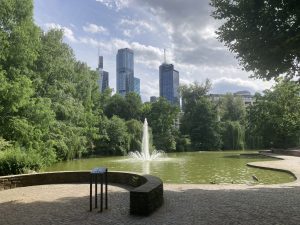
Frankfurt’s Bankenviertel district, seen from the Bockenheimer Anlage (credit: Joseph Karaganis)
Like most other Columbia undergraduates, I was first introduced to the work of Immanuel Kant halfway through my sophomore year. Kant’s slim-but-dense ethical treatise, the Groundwork of the Metaphysics of Morals, is the second text that students read in Contemporary Civilization’s second half.
At the time, I had just finished a year and a half of philosophy courses, and after much deliberation had decided to declare a philosophy major. My previous coursework in Greek and Roman ethics and metaphysics had served me well during the first semester of CC, and I was expecting that the course would go as smoothly in the spring. But I was less prepared than I thought. Despite being only 70 pages long, the Groundwork is brilliant, bewildering, and infuriating all at once. It encapsulates the stunning depth of thought and impassable esotericism that, for better or worse, characterizes much of the best of German philosophy. By the end of the book’s first section, I was uneasy. By the end of the second, I was quietly panicking, and had started to nervously goggle technical terms that I was unfamiliar with. By the end of the third and final section, I had to admit to myself that I was completely lost.
This was my first run-in with Germany’s demanding intellectual culture, but not my last. This summer, I studied 19th and 20th-century German philosophy of law at the Max Planck Institute of Legal History and Legal Theory in Frankfurt. While I can read a little German—the result of an intensive but largely autodidactic immersion in Germany’s literature and history—I cannot understand spoken German at all, much less speak it myself. While Frankfurt—and Max Planck especially—is an international hub, and most people here are proficient if not fluent in English, many of the academic publications and events are still, naturally, in German. What’s more, they often presuppose a rich background of knowledge—accumulated over years-long training in the German legal system and the intellectual traditions that surround it—which I’ve had to approach as a complete outsider. This is a place full of intellectual fireworks and profound thinking. The Kantian tradition of broad-based, rigorous humanistic scholarship—epitomized in figures such as Max Weber, Ernst Cassirer, Karl Jaspers, and Hannah Arendt—still has a place in the contemporary German academy. But, just as with Kant himself, the barrier to entry for appreciating this tradition is quite high. That said, one of the reasons I spent time in Germany this summer is to overcome that barrier. The difficulty of assimilating into a foreign academic culture is not merely an obstacle for my research project to navigate, but rather is built into the project itself.
The feeling of cultural or intellectual distance, and the awkwardness of gradual immersion: these challenges will crop up across your experience with the Core and in many of your research projects, especially if you conduct research abroad. But they are not insurmountable: there are definite, actionable ways to resolve these feelings, or at least, to make their hold on you less fierce. Here are two strategies that have been helpful for me.
First, speak to those who know more than you do. After struggling through the Groundwork, I made a beeline for my professor’s office hours. Talking through the intricacies of Kant’s arguments—and the obscurity of his style—made the text less daunting, and more easily approachable on a second reading. I realized that my initial confusion was a feature not a bug: the Core is made to throw students off balance, to inundate them with theoretical devices, literary forms, and strategies of argument that are unfamiliar and sometimes even uncomfortable. Speaking to established researchers at Max Planck has been useful, too. I now have a clearer picture of the German academic system, which I initially found quite intimidating. I’ve also been reassured that a better grasp of German intellectual culture will come with time.
Second, take advantage of the secondary literature. This is a lesson that I’ve only come to fully appreciate after spending a semester at the University of Oxford, where mastery of secondary literature is almost as central to undergraduate academics as the close reading of primary sources. While loading up on secondary sources ahead of a CC seminar is not usually the best idea—the seminar itself serves as the best secondary source you could hope for—doing so can be helpful if, after the seminar is over, the author’s ideas remain fuzzy and elusive. The best would be to ask your teachers after class if they have any recommendations: given that some of the corresponding secondary literatures are huge and unwieldy, it’s better to read something that directly addresses the issues and topics that were brought up in class—either by your instructor or by your fellow classmates. It’s something I wish I’d done when I was struggling through the Groundwork; and it’s something that was particularly useful over the summer, as I adjusted to the German academic world by reading around the history of German legal methodology and the civil law tradition in Continental Europe.
Joseph Karaganis CC’26