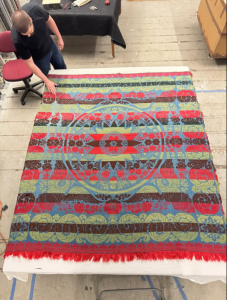
Coverlet from the American Folk Art Museum. credit: Julia Sherman, item located in American Folk Art Museum collections.
Last spring, I was scrambling a bit for a summer internship, as many fellow second-semester juniors find themselves. While I was already planning to work at a law firm in New York City, it was only a part-time commitment. Not only did I need to fill the rest of my time, but I needed to find the rest of my rent. After many applications and interviews, I accepted a role at the American Folk Art Museum (AFAM) as a curatorial intern.
I was initially drawn to AFAM because of the artistic connection I learned about in my American Culture Criticism seminar with Professor Blake. As a history major with a specialization in American Intellectual History, I eventually realized art was a pretty critical part of the traditions I was studying. After reading books on Andy Warhol, Clement Greenberg, and John Cage, I thought I would find at least some tenable connection to my studies at AFAM.
However, on my first day at the museum, when I walked in and toured the collection, the connection seemed to slip away before my very eyes. My bosses threw artists’ names around I couldn’t have even pretended to know and spoke about different micro-movements as if they happened on yesterday’s lunch break. As we all soon realized my knowledge gap, there was a brief moment of silence, standing surrounded by some of the most interesting art I would ever see in my life.
My two assignments for the summer were Diversity, Equity, Accessibility, and Inclusion (DEAI) label-writing and coverlet assessment. For the former, I was tasked with researching and rewriting labels for objects that were taken off display due to their sensitive topics and insensitive portrayals. I may not have known art as well as they did, but at least I knew how to research and how to write. While label-writing is technically a different form of text, I could extrapolate.
So, I started with the basics. I conducted initial research, contextualized it to familiarize myself with the time period, and leaned on my bosses. My historical background began to blend seamlessly into my writing. I had an easier understanding of events of the times, countercultural movements they might have tried to mimic, and started to grasp where the pieces fit within the intellectual and artistic traditions.
As the days of summer started to blur (as they always tend to do), my art historian work, English work, and historical work started to blur as well. I initially thought the coverlet assessment would be purely cataloging. And don’t get me wrong, it was a lot of measuring, photographing, and describing stains. Deeper into it, though, my boss and I started to discuss the women who made these coverlets. Why these colors? Were they just what they had available? Maybe they were the first in their area to use that type of stitch. Maybe it was the first coverlet made by a daughter taught by her mother.
My boss and I were watching a video together one day from the United States foremost coverlet expert. She explained that as she assessed coverlets and saw a skip in the pattern, she wondered if the woman making it had nine children running around at her feet. While I initially laughed it off as some bored version of critical fabulation, I started to see that she had a point. While I won’t wax poetic with my clichés, I’m studying History and English. Of course I love a good story intertwined with academics. As my boss would recognize the weaving technique and stylistic details denoting a particular time period or region, I’d pull at the threads of its cultural history. I spent hours on ancestry.com, trying to trace people’s family trees and stitching patterns back six or seven generations.
On my last day of my internship, my boss told me that he was the only one of my three interviewers who had pushed to hire a history student. “We’ve gotta have a historian in the office. And once I met you, I knew it had to be you.” While initially his comment felt like a slight dig, the path had already been laid out in front of me. Why would I have applied to a job at an art museum if I wasn’t prepared to bring my own skill set?
Furthermore, nothing could have prepared me for how much I would have fallen in love with the work I was doing at the museum. The archival and research work, looking at art objects all day, and the visual story wrapped up in hundreds of coverlets and museum labels. While I spend the rest of my senior year tackling my major classes and thesis, I haven’t forgotten my foray into something a little bit different this summer. While my interdisciplinary mindset has pushed me to make some mistakes (like taking Principles of Economics my first year), I’ve also expanded my interests ten-fold during my time at Columbia.
Julia Sherman CC’26