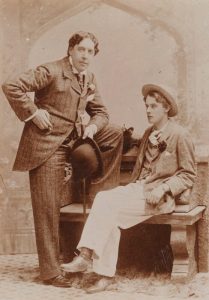
Oscar Wilde and Lord Alfred Douglas, British National Portrait Gallery
When I first learned about the Humanities Research Scholars Program during winter break of my sophomore year, I felt both daunted and excited. I had never done any kind of research before, and I had no idea of what topic I would want to spend a summer studying. But at the same time, the prospect of spending six weeks immersing myself in a particular subject—reading and thinking about it, discussing it with peers, maybe even writing about it—was enormously exciting.
I spent a lot of time over the break thinking about what I might want to research. It was hard, because a lot of my favorite books were translated, and I didn’t think I could properly study them without knowing their original language. Eventually I thought about Oscar Wilde—I had gone through a phase at the end of high school where I read a bunch of his books and a biography of him. But what could I possibly say about Wilde that hadn’t been said already?
When I returned to Columbia in January, I had a vague plan. Ever since I had read that biography, I had been fascinated by the figure of Lord Alfred Douglas, Wilde’s villainous lover and a minor poet. Maybe, I thought, it would be interesting to think about how Wilde and Douglas influenced each other’s poetry. I had only taken three English classes, but one of them had been on Victorian poetry, so I visited my old professor to see what he thought of the idea. He suggested that, rather than considering how the poets influenced each other, I investigate how their poetry, which was widely considered to be derivative, was influenced by preceding poets, and whether it could be said to be original in any way.
Our conversation made me think about other, broader questions. What made poetry original, anyway? How exactly were Wilde and Douglas’s poems unoriginal? Was unoriginal poetry always bad? Could there be some value to it? With these questions floating around my head, I submitted my application.
After I was accepted to the program, my professor (now my advisor) suggested that I divide my time into three two-week periods. For the first period, I should read as much as I possibly could—all of the lovers’ poems, some of their other writings, criticism of the poems, and some theoretical books about originality and influence. During the second period, I should keep reading but also start thinking about any patterns I noticed, and write an outline for a paper. During my last two weeks, I should write.
The six weeks passed quickly. I threw myself into Wilde’s and Douglas’s world, spending my days reading in a little room in Butler that still brings back fond memories, ordering slender and long out-of-print volumes of Douglas’s poems from other university libraries, and walking around campus thinking about how difficult it is to write anything—criticism or poetry—that’s really original.
Eventually, a contrast started to appear. Douglas’s and Wilde’s poems might both be unoriginal, but Wilde was clearly aware of this and saw it as a problem. He only wrote one collection of poems, after which he moved onto other genres, where he was able to be original. Douglas, on the other hand, not only did not see unoriginality as a problem, but embraced it, arguing throughout his life that literary originality was both impossible and undesirable. So he continued publishing highly polished but derivative books of poems throughout his long life, all of which were now forgotten.
By the end of the summer, I had written a paper on these ideas. When I eventually shared my final draft with my advisor, he suggested I submit the paper to Literary Imagination, a journal published by Johns Hopkins Press. I did so, and many months passed. My first semester of junior year ended, and I went abroad. One day near the beginning of my spring break, I was sitting on a bus in the Scottish highlands when I got an email: contingent on my making certain revisions, Literary Imagination wanted to publish my paper. Looking out at rolling brown hills and a glassy loch, I felt a wave of grateful satisfaction that I could not have imagined that winter vacation more than a year earlier.
Sagar Castleman, CC’26