
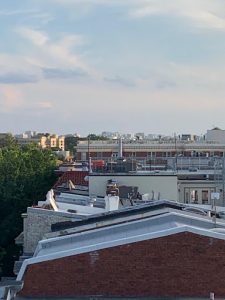
Image overlooking the Adams Morgan Neighborhood in Washington, DC on the Fourth of July, before the fireworks on Capitol Hill (Photo courtesy of Ishaan Barrett)
Imagine for a minute all the spaces that define your life at Columbia: the classrooms where seminars unfold, the lecture halls alive with presentations, the labs buzzing with quiet concentration, and libraries where the daytime hours bleed into the night. Over time, these places stitch themselves together into a web, one familiar and enriched by the places we revisit, but also oddly enclosing. For all its intricacy and complexity, the web of places we might spend our time as students is bounded. Sure, you might venture off campus during the day or throughout the weekend, but when we scrutinize where we spend the academic hours of our days, few extend beyond Morningside or even Columbia’s campus. Intentionally or not, campus builds a physical and invisible boundary that subtly separates how we spend our time and the worlds we come to know. The same can be said for research and the questions, inspired by coursework and mentorship, that we undertake as students. Research conducted within our web of campus spaces is often confined there, but this need not always be the case.
As you consider beginning or continuing campus research—either in a lab or independently through a fellowship—the question of public research (and even researching public issues) should come to bear.
This might be challenging, especially when conducting research in a lab or archive where the work can already feel confined to a discrete environment. But Columbia’s Fourth Purpose provides a scaffolding for defining what publicly engaged research might look like. According to the university, Columbia’s Fourth Purpose is “to leverage scholarly knowledge to create societal and global impact, in close partnership with organizations outside academia.” To put this in simpler terms, scholarly knowledge and research should make an impact on society and, where possible, consult groups outside Columbia’s academic spaces. But how does this idea translate into undergraduate research in the social sciences and humanities? After all, achieving impact on a “societal and global” scale seems especially daunting. Lots of research—especially in medicine—already contains value propositions based around scholarly nuance (i.e. novel findings that will add to an academic field) and social contributions that might improve the wellbeing of others. For humanities and social sciences undergraduates seeking to develop research with a public impact, I argue that the way we define public impact is everything.
On the one hand, think about adapting your research approach to consider public issues or challenges relevant to a community you care about or in which you spend a great deal of time. As a fellow at the Holder Initiative, I researched a public plaza in my hometown and tried to trace its economic and social history to find out why the space itself became so contested. Later as an IRCPL summer fellow, I continued my research in DC by focusing on public art, politics, religious memory, and secularism. I wanted to understand how issues of injustice, statehood, and political representation appeared through mural arts and the similar transformations of public space. However, you might consider producing research with a public effect, defined in several different ways. Bringing new knowledge to light, proposing recommendations about a current process, or critiquing institutions that already exist are all ways of turning research outwards with the public in mind. My time studying NYC’s Ukrainian Village this summer at the Harriman Institute was about finding new ways of seeing—literally—how social issues, immigrant heritages, and international conflict can steer the urban transformation of entire neighborhoods.
Research, as I’ve gradually found out, can always have some sort of public impact if you look hard enough. It begins with thinking about the issues and predicaments that stick with you or that you revisit persistently. What about them captivates your interest and who are the main stakeholders that are relevant? How can you speak, write, and communicate about your research in an accessible way? Can you bring these collaborators outside the university into your work through methodologies like interviewing, ethnography, or public archival research? Or can you envision a social issue or problem that impacts you which you can center in your research approach? These are just questions to get you started, but it’s always worth considering how to invite other people into your research process. Almost always, you’ll find that the contributions of others outside academia are what make your work meaningful and, ultimately, worthwhile.
Ishaan Barrett, CC’26