
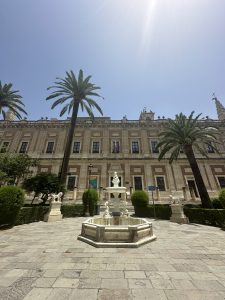
The Archivo General de Indias in Seville, Spain, where I spent this summer researching for my senior thesis (credit: Sarah Bryden)
I didn’t come to Columbia with aspirations of traveling abroad– New York City already felt like a foreign country to me, and its museums, languages, and libraries have enough to occupy ten lifetimes’ worth of curiosity. In my sophomore year, however, I spent my summer working on a language documentation project in Mérida, Mexico, through the Laidlaw fellowship. Taking my research abroad proved incredibly rewarding, both academically and personally. I’ve since traveled to Spain for archival research, worked virtually with research teams in Mexico and Germany, and been thoroughly convinced that conducting research abroad is more beneficial and accessible than you might expect. Here, I want to share some of these benefits (which apply to any major or research area), and some of the paths to international research that are open to Columbia students.
Researchers’ motivations for international travel are often self-evident: archaeologists will travel to digs, linguists to language communities, and historians to archival materials. As undergraduates who have not (yet) specialized academically, these kinds of self-evident travel rationales will not always apply to our projects. This doesn’t mean that traveling for research as an undergraduate is unnecessary– to the contrary, as we develop our academic interests and personal identities, time abroad can be incredibly formative. Moreover, our lack of academic specialization can mean additional opportunities for international travel, and for securing funding. My own experiences abroad have pushed me and my research to grow in two main ways.
First, sharing my work internationally turned out to be an extremely rigorous test of my methodology, framework, and understanding of the importance of my topic. Universities worldwide can approach the same discipline in vastly different ways, so discussing your research in a new context, and maybe even a new language, will challenge assumptions that you might not have even known you held. In Mexico, for example, I was working to document, preserve, and revitalize Yucatec Maya, one of the country’s 68 Indigenous languages. While the need for such work is rarely questioned in American academic spaces, I found that in Mexico, there was more ongoing debate around language revitalization. Claiming that languages should be preserved was a stance requiring justification, and while I did my fieldwork, I also had to partake in this justification. At first, questions about why I was studying Yucatec Maya and why it mattered were difficult for me to answer. Learning to explain my own motivations strengthened my understanding of this research, and opened up questions that I had never thought to ask.
Second, carrying out my research in a new cultural, geographical, and linguistic context forced me to see it in new ways. Travel can be equally difficult (homesickness, loneliness, and culture shock) as it is exciting (new people, places, foods, and sounds). While adjusting to all of this, your perspective on your research will inevitably change, and new problems, questions, or methods may call your attention. For instance, this summer I traveled to the archives in Seville to research colonial-era friars in the “New World,” with funding from the History Department. Andalusian Spanish sounds quite different from the Mexican Spanish I am more familiar with, and my frustration with the language barrier prompted me to wonder if the friars I was studying ever felt the same way. This has opened a new line of questions about how friars actually learned the Indigenous languages they professed to know so well.
As a final note, it’s worth mentioning that spending time abroad– whether for research, work, or study– can be a fun and fulfilling experience, beyond academically enriching. If you are interested in traveling for research in the coming semesters, you can peruse the experiences of past Rose Research Ambassadors here and here. You can also browse for opportunities on the URF database, and look for programs like the Foreign Language and Area Studies (FLAS) grants, NSF Research Experiences for Undergraduates (REUs), and Columbia’s Department-specific funding for research or travel.
Sarah Bryden, CC’26