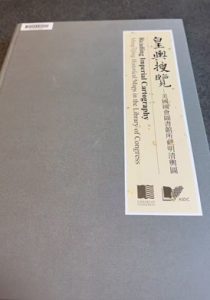
Reading Imperial Cartography: Ming-Qing Historical Maps in the Library of Congress, courtesy of C. V. Starr East Asian Library, Columbia University
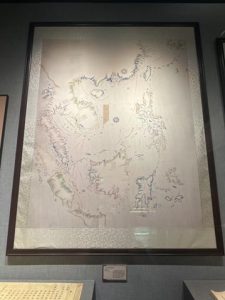
“Map of Sea Lanes of the Eastern and Southern Seas,” Dongyang nanyang haidao tu, courtesy of the First Historical Archives of China, Beijing
This summer, my research project centers on islands as crucial protagonists in investigating the literary representation of “foreignness” in early modern East Asian and Mediterranean contexts. I derived my fascination with the topic of “islands” as alternative spaces where civilizations negotiate their boundaries from my long-term academic interest at the intersection of textual and visual media, regional studies and comparative literature, and the broader historical issues of “the early modern period.” While double-majoring in East Asian Studies and Comparative Literature, I benefited from taking a rich spectrum of courses that provided me a solid knowledge foundation to “think textualities with islands” (my foremost conceptual emphasis in the project), grounded in bibliographic and archival tracings in each tradition in tandem with shifting theoretical visions on what constitutes the maritime. Drawing on sources from different “genres” of texts, including vernacular novels, official histories, diplomatic writings, as well as visual representations, I invite the complex question of “the ethics of comparison” into the conceptualization of “islands” at the crossroads of languages, empires, and the heterogeneous group of historical agents.
Thanks to the generous support from Prof. Shang Wei from the EALAC department and Prof. Pier Tommasino from the Italian Department, I was able to study in dynamic connections and parallels two bodies of texts that intriguingly demonstrate the often-overlooked historical links and figural analogies. For instance, I investigate the historical figure of Tomé Pires (1468-1540), his ethnographic accounts of the Asian littoral, and his diplomatic activities with the Ming Chinese court together with the proliferated contemporaneous Chinese discourse about the Portuguese, while situating those “early modern texts” in a dynamic maritime space where different textual subjectivities cross-document each other, at the interface of ethnic encounters, clashes, and (mis)representations.
Similarly, I read the Chinese pirate Wang Zhi (1501-1560) and his illicit trade network that engages diverse subjects and straddles trans-spatial domains of power in a “Sinosphere” where a shared script was deployed to communicate and contest divergent purposes. At the figural and metaphorical levels, I probe the possibility of reading different species of early modern “pirates” (for instance, the Barbary corsairs and wokou in their different nomenclatures) in a dialogic relationship. When scholars generate fascinating claims about recontextualizing the Decameron from the pandemic Italy to the broader Mediterranean, what fruitful directions of thought can be approached when we read Li Yu and Boccaccio’s short tales together, when both of them create a tantalizing narrative structure that charts a topsy-turvy world that disrupts moral rigidity in the middle, but harks back to the stable structure at the formal closure of the misadventurous journeys?
Thematically, my project considers how the literary cartography of islands shapes a distinct epistemology of paradox, one that mixes fantasy and empiricism, both challenging and reinforcing normative ethicality, political legitimacy, and the boundaries of subjectivities. The paper contends that islands provide us with a fruitful site to rethink significant, yet often nebulous, concepts like “world literature” and “global early modernity,” if we take into account the perspective of reading them as dynamic nodes of relational literary history. In my writing, I begin with an analysis of “pirates” as a distinct type of persona in both historical scenarios and their textual representations as dubious yet surprisingly multi-valent agents who patrolled the watery “heterotopias,” and consider their tense relationships with land-based authorities in analyzing their strategies of constructing political legitimacy and subjective autonomy. A central focus in this section is on how different systems of textualities and literacies intersect, communicate, and perform when adrift subjects are engaged in the same spatial contact zones of islands and seascape, when “identities” are situated within cross-cultural encounters.
By reading in meaningful connections the Barbary corsairs, wokou, and Kaizoku, and specifically the bandits-transformed-pirates in Chen Chen’s sequel to Water Magin, I aim to investigate the speculative power and historicized links between these contexts. The second part proceeds to a particular type of island with established textual lineages in each tradition, in short, “the Woman Island,” and dissects how it functions as a spatial apparatus to mirror the intricate problematics of gender, sexuality, and eroticism. My close analysis proposes to understand the “spatialized queerness” (or the lack thereof) in constructing the island as both challenging and re-articulating the ethical normativity in the native land, within an intricate narratological structure marked by self-reflexivity, representational interstices, and unresolved confusions and paradoxes.
I presented the project in late July at the 2025 ICLA Conference held in Seoul, South Korea, in a panel named “Comparative History of East Asian literatures” chaired by Prof. Haun Saussy (University of Chicago). For me, it was an excellent opportunity to communicate with researchers working in different areas and with various expertise, and I am especially inspired by some interesting comments and questions raised by the audience during the Q&A session. I envision the next stage of this project to substantively engage with early modern Japanese manuscripts written in kanbun and the vernacular, especially the yomihon genre.
Julie Xinzhu Chen CC’26