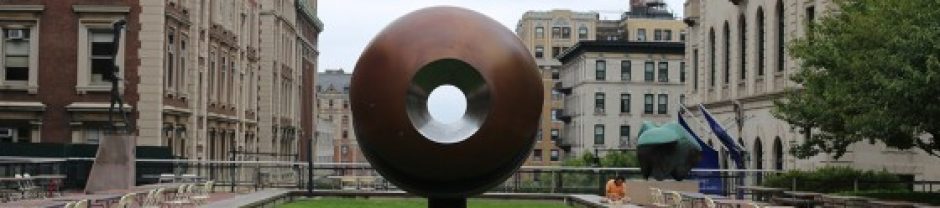
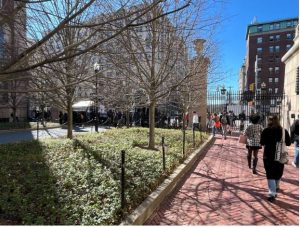
Afternoon photo of campus gates in front of Earl Hall with security checkpoint to scan IDs (photo credit: Ishaan Barrett)
When I first arrived at Columbia, I did not pay much attention to the gates. They were just there. They stood as symbols of arrival, departure, tradition, and maybe even security. But over time, I started to see them completely differently. They became quiet boundary lines separating two contrasting worlds: those who are included and those left out. The question about these gates as symbols of access arose during a class called “Justice Now,” taught by Professor Larry Jackson. The purpose of the class was to develop critical theories and conceptions of justice rooted in the breadth, depth, and interdisciplinary undertaking of the Core Curriculum. In other words, by expanding on the authors and texts presented in Literature Humanities and Contemporary Civilizations, how can we theorize justice from a variety of vantage points with various communities and social issues in mind? Between that class and my other courses in the Core, we read Plato’s ideas on the just city. We read Locke’s theories on property. We balanced conflicting viewpoints and contemporary ideas across multiple hours of deep discussion. But we never read—or even interpreted—the gates standing just beyond the classroom. After a while, I thought that maybe we should.
This question—about the tension between intellectual ideals and institutional structures—has shaped not just my thinking, but my research. From my work with the Holder Initiative and the Institute for Religion, Culture, and Public Life to my work as a columnist for the Columbia Daily Spectator, I’ve explored how physical space reflects power, how governance is encoded in architecture, and how the concept of the public is often contested on the ground. The Core gave me the vocabulary to do so, but research—defined in simplest terms as the act of deep, scholarly inquiry—gave me the terrain to traverse these issues with dexterity and creativity.
I think we often imagine whether or not the Core can do work beyond the classroom and engage outside the purview of the Western Canon that it concerns. During my time as a student representative on the Committee on the Core Curriculum last year, I argued that it could. But critics of the Core may argue otherwise. For those reluctant to tackle the “the insistent problems of the present” through the Core, you are not alone. It can be increasingly hard to understand or connect the world of these thousand-year-old texts and authors to that of the present. However, I think it is important to realize that the work of the Core is realized perhaps at the middle or end, rather than at the beginning. I argue that the experiences it gives you, like the necessary objections you raise with antiquated material, the complex philosophies of the texts, and the deep debate you have in class, builds a critical lens that you can turn outward. I want to show that, to even the staunchest critics of the Core, research is where its mission comes to life.
I began my research project for the Holder Initiative and column in the Columbia Daily Spectator at around the same time. Each were inspired by what the Core asks of all its students: to engage across faculties—from science, math, and politics, to history, literature, and art—and build a critical lens to examine these “insistent problems of the present.” My work as a columnist and a Fellow at the Holder Initiative began with similar questions about boundaries, access, and symbolism. My work at the Holder Initiative studied how a public plaza in Washington, DC changed hands and why, on one day, it was fenced off to a community who had used it the greater part of four decades. In a similar thread, my work at Spectator has tried to understand the politics of space and campus design here at Columbia. While they tried to do different things—one distinctly scholarly and the other uniquely journalistic—they aimed towards a similar vision of what research is and can do. An interdisciplinary question and a public purpose are where my work began; it is also the starting point that I recommend to others interested in research or otherwise reluctant to undertake it.
The lesson that I learned from both of these experiences is simple: research begins in unlikely places. And we should let it. Critics of the Core have a right to their objections; at the same time, those critics will have to accept the interdisciplinary nature of the Core as an important educational project of the College. Whether you like it or not, the Core’s disparate exploration of scholarly fields is, almost always, impossible to escape. It inspired me to take on research that began with abrupt questions about access and equity. I later explored those questions using different fields as methodologies: economics and statistics; ethnography and sociology; history and anthropology. I think that more people ought to take up unlikely topics and research projects by asking those cross-disciplinary questions and tying it together with a public purpose in mind. And whether we directly envision the Core within that process or not, the breadth it encourages inspired my work in unexpected ways. You might not reference one of the texts that you read, but that willingness to look beyond one discipline or faculty of study makes research engaging and, often, the reason it’s worth doing.
Ishaan Barrett CC’26