
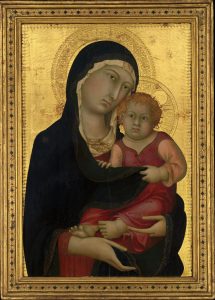
Madonna and Child, Simone Martini, MET
When I was assigned my first paper in Literature Humanities three years ago, I felt somewhat overwhelmed. The paper could be about any aspect of the Iliad, a topic that seemed incredibly rich yet also strangely sterile—what new perspective or insight could I bring to this book that had been read and thought about for thousands of years?
What seemed particularly daunting was achieving a balance between a thesis that was too obvious (for example, that the gods of the Iliad often behave like humans) and one that was too far-fetched (for example, that Homer wanted to trivialize the gods’ divinity and power). Or, to take another example, it seemed intuitive to say that fate played a large role in the Iliad, but to be taking things too far to say that everything that happens in the epic is predestined and the characters have no free will.
In retrospect, I’m not sure how well I struck this balance in my Iliad paper. But after having taken all of the Core classes and written many English essays, I do think I’ve been able to gain some insight into how to go about beginning a paper for any Core class—which I still think is the most difficult and important part of writing a good essay.
The first crucial step is to identify either a pattern or an incongruity in the work you’re going to be writing about. If the work is a book, then it’s helpful to be on the look-out while you’re reading it; if it’s a piece of music or a piece of visual art, then you can search for the pattern or incongruity when you sit down to plan your essay.
A pattern is any interesting element that appears repeatedly (and probably intentionally) throughout the work. For instance, in Art Humanities, I was supposed to write a paper about Simone Martini’s Madonna and Child, a fourteenth-century painting in the MET. This initially seemed far more daunting than writing about any book, but when I spent some time looking at it, both in-person and online, I noticed something striking: the painting was filled to an unusual degree with curving lines. Wherever you looked—from the curls on the child’s hair to Mary’s fingers to the sweeping black mantle—there were curves. To ensure that these curves weren’t part of any painting of the time, all I had to do was look at another Martini painting that hung next to the Madonna: here, the lines were much more straight and fixed.
An incongruity, on the other hand, doesn’t need to appear repeatedly, but has to be unexpected. For instance, when reading Sense and Sensibility for an English class, I noticed that the relatively minor Mr. Palmer is one of the novel’s coldest and rudest characters when he first appears. But later in the book, with no explanation, his entire character seems to be transformed, and he acts in a remarkably generous way. What is going on?
The best situation is if you can find an incongruous pattern. This happened when I was reading The Lais of Marie de France, a second semester Lit Hum book. I began to wonder why the love affairs described in each tale were so similar, and so shallow. They were always reciprocal, and always described in similarly banal language. Why write so much about love if you had so little to say about it?
Once you’ve found a lead, the rest of the paper often falls into place easily. Since both incongruities and patterns were probably created intentionally, it’s helpful to trace them throughout the work, trying to understand why they are there and what their effects are. Once you have a theory for why this is, you have a thesis for a paper that is the result of direct evidence, close reading (or looking, or listening), and critical thinking. In the three examples I gave above, I was able to follow the thread of the initial crux to create a thesis statement that was both plausible and not completely intuitive: Martini uses curving lines to create an atmosphere of comfort and grace, despite the otherwise unappealing looks on his figures’ faces; the transformation of Mr. Palmer’s character is a reflection of the roleplay that the novel’s society pressures people to engage in, and which only extreme situations can break through; Marie de France uses sudden, permanent and mutual infatuations to propel her plots along, but her stories’ major themes are not about love at all. And of course, once you have a thesis statement and evidence, the thinking part of your essay is practically complete.
Sagar Castleman, CC’26