Author Archives: Carolina Castro

Jerry’s Picks 15.32

A burst of late fall interdisciplinary foraging before we mammals hibernate. Be sure to share your event stories!

REMINDERS

November 23: What Can Neuroscience Offer the Study of Creativity? – Seminars in Society & Neuroscience
November 30: From Juvenile Justice to Young Adult Justice: An Emerging Framework for Policy and Practice
December 2: Narrative Medicine Rounds: Rick Guidotti

PICKS

November 24
6:15 p.m. – 7:15 p.m.
Earth Institute | School of Professional Studies
A Tale of Two Insecurities: Why the Paris COP has so Little to Do With Climate Change Impacts on Human Security and What We Can Do About It
Marc Levy, deputy director of the Center for International Earth Science Network, and Josh Fisher, director of the Advanced Consortium on Cooperation, Conflict, and Complexity, will discuss the latest research and policy linking climate and security in the lead up to the United Nations climate change conference in Paris. RSVP here. Lewisohn Hall, Room 602. (Climate Change, Global)

December 1
6:30 p.m. – 8 p.m.
SIPA
The Challenges of Responding to Medical Humanitarian Needs in Sub-Saharan Africa
How can local and international organizations work together to provide high-quality medical care in chronic emergencies like malnutrition and outbreaks such as Ebola? Suerie Moon, research director and co-chair of the Forum on Global Governance for Health at Harvard; Augustin Augier, co-founder of the Alliance for International Medical Action (ALIMA); and Susan Shepherd, manager of ALIMA’s research portfolio, will discuss the current humanitarian aid system. Moderated by Somini Sengupta, United Nations bureau chief at The New York Times. Register here. International Affairs Building, Room 802. (Global)

December 3
12:15 p.m.
The Heyman Center for the Humanities | Society of Fellows in the Humanities
Teaching Contemporary Civilization in Prison – Public Humanities Initiative
Joshua Dubler, assistant professor of religion at the University of Rochester, served as a post-doctoral fellow with the Society of Fellows in the Humanities from 2008-2011 and taught Columbia’s Core course Contemporary Civilizations in Graterford Prison in Pennsylvania. His talk will be a reflection of that teaching experience. The Heyman Center, Common Room, 2nd floor. (Just Societies, Public Square)

6:30 p.m.
Columbia Engineering | Columbia Entrepreneurship
The Future of Food Sustainability
In Columbia Engineering’s series on innovation and entrepreneurship, discussants will look at how startups can address famine, drought, mass relocations, climate change, and more. Speakers include Dickson Despommier, emeritus professor of microbiology and public health; Adnan Durrani ’81SEAS, CEO of American Halal/Saffron Roads; David Rosenberg ’02BUS, founder or AeroFarms; and Sonny Wu, managing director of GSR Ventures. Moderated by Dean Mary C. Boyce (engineering). Reception to follow. Purchase tickets here. Metropolitan Pavilion, 125 West 18th Street. (Global, Climate Change)

December 3
4 p.m. – 5:30 p.m.
CUMC Academic Affairs | Virginia Kneeland Frantz Society for Women Faculty
The Science and Art of Confidence: What Women Need to Know
A lecture with Claire Shipman, senior national correspondent for ABC’s Good Morning America and co-author of the New York Times bestsellers The Confidence Code: The Science and Art of Self-Assurance, What Women Should Know, and Womenonmics. Reception to follow. Register . Alumni Auditorium, 650 West, 168th Street. (Public Square)

December 3 – 5
Historical Dialogues, Justice and Memory Network
The Politics of Memory: Victimization, Violence, and Contested Memories of the Past
Do societies with heightened awareness of their violent historical legacy have a stronger civic democratic identity? This conference aims to explore issues relating to memory, victimhood, and violence. Keynote speakers include Zoe Konstantopoulou, former Greek Parliament president, and Jeffrey Olick, professor of sociology and history at the University of Virginia. Konstantopoulou will speak on truth, justice, and selective memory and Olick will discuss collective guilt. Full list of speakers and program here. International Affairs Building, 4th floor. (Global)

December 4
10 a.m. – 7 p.m.
GSAPP
Climate Change and the Scales of Environment
The symposium will be arranged around questions of scale—space, but also time—to articulate climate change as a necessary agent of change in architectural history, theory, discourse, and practice. Introduction by Dean Amale Andraos (GSAPP) and keynote speech by Dipesh Chakrabarty, Lawrence A. Kimpton Distinguished Service Professor of History at the University of Chicago. Full list of speakers and program here. Wood Auditorium. (Climate Change, Public Square)

For RSVP, ticket availability, and other details, follow the links. We always appreciate hearing from you about future events!
Investing in the American Dream

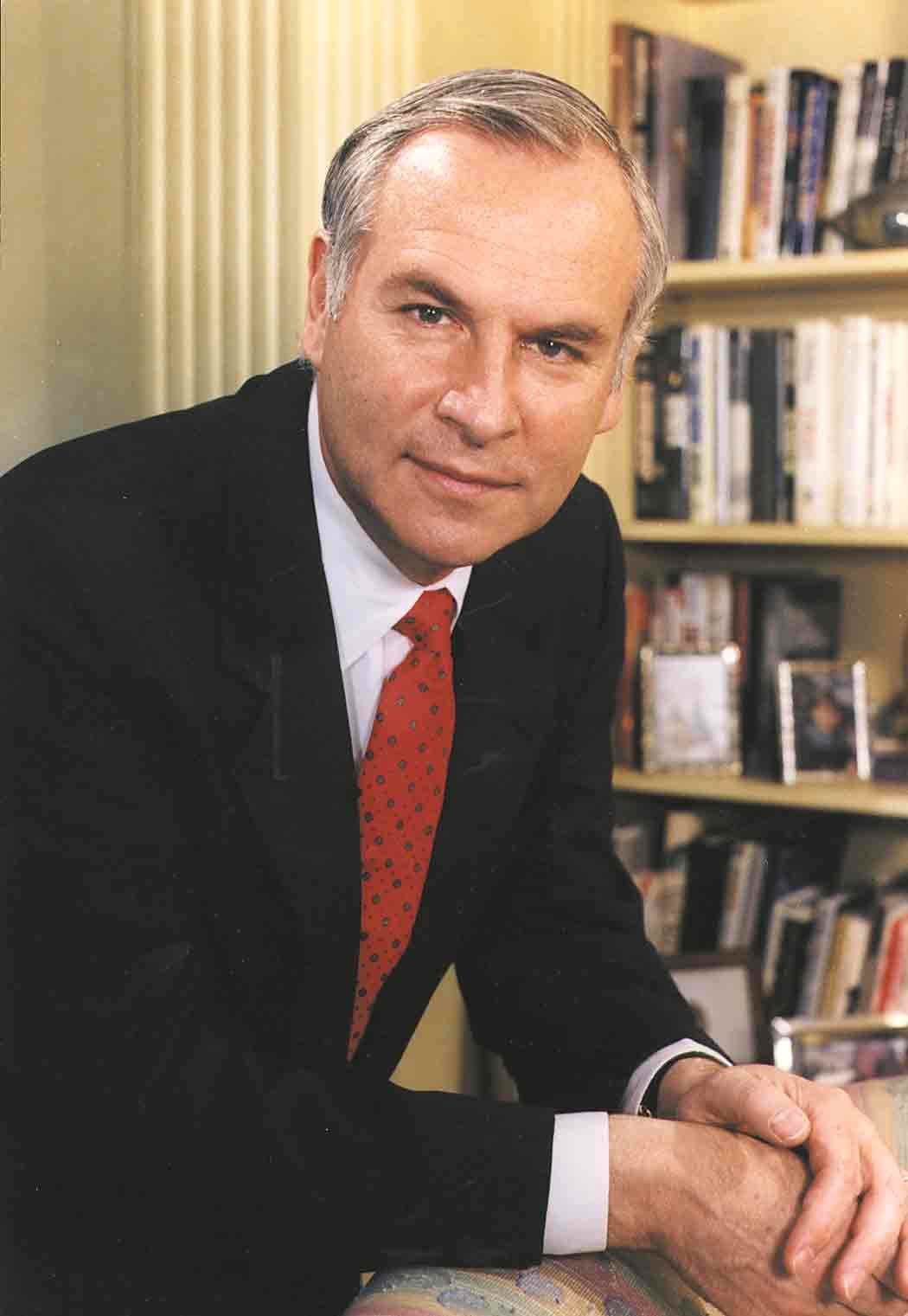
On November 17, I attended Income Inequality: Is This the End of American Dream?, a lecture in Uris Hall organized by the Tamer Center for Social Enterprise at Columbia Business School. The speaker was Peter Georgescu, former chairman and CEO of the advertising agency Young & Rubicam.

pg 3

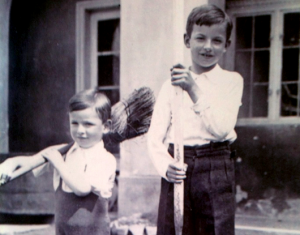
Peter Georgescu and his older brother (http://theconstantchoice.com)

After an introduction by Raymond Horton, the Frank R. Lautenberg Professor of Ethics and Corporate Governance, Georgescu shared his unique success story. Born in Romania at the start of WWII, he was separated from his parents at age 7 after the country was taken over by the Soviet Union. From the ages of 10 to 15 he served in a hard-labor camp with his brother. With the help of President Dwight D. Eisenhower, Georgescu and his brother were then reunited with his parents, who had settled in the United States. He went on to graduate from Princeton University and Stanford Business School before pursuing a successful business career.
PGeorgescuGeorgescu reflected on his topic in light of the post-WWII era, when a strong middle class was established and millions were lifted out of poverty. Now the middle class and the poor are suffering; real wages have been flat for about four decades even though productivity has increased. It appears that companies are more concerned with short-term gains and maximizing  shareholder value, while employees are dehumanized and seen as costs.

FullSizeRender

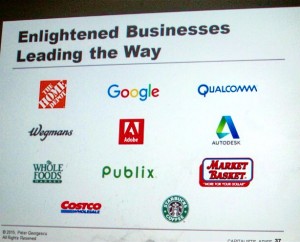
Part of Georgescu’s presentation

According to Georgescu, inequality of income in the United States is creating a caste system where it is becoming more difficult to climb the economic ladder without exceptional talent, athletic skill, or luck. He suggested that companies must lead the way to address income inequality and should invest in their employees, who are the real “value creators.” He showed us a list of “enlightened businesses” – companies that are addressing income inequality and  investing in their workforce, including Google, Home Depot, and Whole Foods.

In response to a question about how to create more jobs, Georgescu replied that private sector companies should invest more in research and development. In the public sector, jobs can be created to improve the nation’s outdated infrastructure. When asked whether the definition of growth should be redefined in business, Georgescu said that was a long-term question, and that companies need to move now on income equality.

I left inspired to support more “enlightened businesses.”  As customers and shareholders, perhaps we should all take a closer look at the companies we support. Luckily, I am already a frequent shopper at Whole Foods.

For more information on Georgescu’s ideas, you can read his recent op-ed piece in The New York Times: Capitalists, Arise: We Need to Deal with Income Inequality.

—Lily Shen

Jerry’s Picks 15.31

Louis Armstrong to Jules Feiffer—another Thanksgiving cornucopia, gratefully featured.  Be sure to share your event stories!

REMINDERS

November 17: Income Inequality: Is This the End of the American Dream?
November 18: Louis Armstrong and the Jazz Trumpet Legacy
November 19: Diplomacy in the Digital Age

PICKS

November 17
8 p.m.
Miller Theatre
Home Within
A 60-minute audio-visual performance by Syrian composer and clarinetist Kinan Azmeh and Syrian-Armenian visual artist Kevork Mourad. In this new project, art and music develop in counterpoint to each other, creating an impressionistic reflection on the Syrian revolution and its aftermath. Purchase tickets here. Miller Theatre. (Global, Just Societies)
 
November 18
8 p.m.
The Institute for Israel and Jewish Studies
Screening of Rosenwald, a new documentary by Aviva Kempner
Followed by a special discussion with Hasia Diner and Rachel Grant Meyer on the history and philanthropy of Julius Rosenwald and maintaining alliances between the Jewish community and civil rights struggles. To RSVP, e-mail [email protected]. 501 Schermerhorn Hall. (Just Societies)

November 23
4 p.m. – 6 p.m.
Presidential Scholars in Society and Neuroscience
What Can Neuroscience Offer the Study of Creativity? – Seminars in Society & Neuroscience
Recent advances in neuroscience offer a new perspective with potential contributions to an explanation of the mechanisms, development, and origins of human creative faculties. How can neuroscience most effectively complement other disciplines? How could it benefit from other perspectives on creativity? Panelists include Rex Jung (University of New Mexico); James Kaufman (University of Connecticut); and Colleen Thomas-Young (Barnard College). Moderated by Andrew Goldman, Presidential Scholars in Society and Neuroscience. Reception to follow. Buell Hall, Maison Francaise. (Zuckerman Institute and the Future of Neuroscience)

November 30
6:30 p.m. – 8:30 p.m.
From Juvenile Justice to Young Adult Justice: An Emerging Framework for Policy and Practice
A discussion of recent research on young adults from Vincent Schiraldi, senior research fellow, Harvard Kennedy School Program in Criminal Justice Policy and Management; Jennifer A. Silvers (psychology); Richard Roderick, programs coordinator at the Justice-in-Education Initiative, subject of The Cooler Bandits, a documentary, and formerly incarcerated at 18 for nearly 20 years. Moderated by Judy Yu, director of the Juvenile Justice Project at the Correctional Association of New York. Jerome Greene Hall, Columbia Law School, Room 103. (Just Societies)

December 2
5 p.m. – 7 p.m.
School of Professional Studies
Narrative Medicine Rounds: Rick Guidotti
Rick Guidotti, photographer of human diversity, award-winning fashion photographer and founder of Positive Exposure, an organization created to “affect a sea change in societal attitudes towards individuals living with genetic difference.” Hammer Health Sciences Center, Room 401. (Just Societies)

LOOKING AHEAD
 
December 7
6 p.m. – 7:30 p.m.
Comics@Columbia | The Institute for Israel and Jewish Studies
An Evening with Jules Feiffer
An evening with Jules Feiffer, award-winning cartoonist and author. Moderated by Daniel Fingeroth, comic book writer and editor. Butler Library, Room 523. (Global)

For RSVP, ticket availability, and other details, follow the links. We always appreciate hearing from you about future events!
JoAnn Huether’s Morningside Treasure Quest

almamater1-300x198

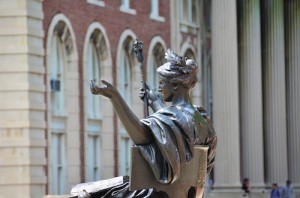
Alma Mater (1903), designed by Daniel Chester French, on the steps of Low Library

When the Museum Meetup: Art on Campus tour appeared on the Jerry’s Picks list for October 20, I immediately signed up. My curiosity about the outdoor sculptures on Columbia’s campus was first piqued when my grandson, Cole, and I chose Columbia’s campus as the subject for his second-grade class assignment, a report on a New York City historical site.  Cole wanted to visit the Empire State Building; I did not. So, I enticed him with a challenge – that he would not be able to find the owl hidden among the folds of Alma Mater’s robes. We spent the afternoon of August 19 on the Morningside Campus.

Of course, our first stop was Alma Mater, and three hours later we had photos of every sculpture of interest to Cole. Although I was able to guide him in his search for the owl, I could not answer most of his questions about the sculptures. And, now, the opportunity for me to learn had presented itself.

P1010254-1024x768

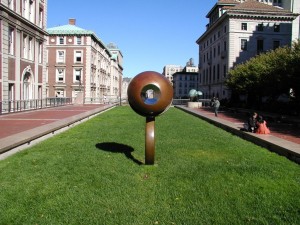
“Life Force” (1988-92) by David Bakalar, on Revson Plaza

Roberto C.Ferrari, curator of Art Properties at Columbia University, led our group of 30 to several sculptures, each with a unique story. More generally, Roberto explained that outdoor sculpture is intended to be in our way. It is there for our interaction. He also pointed out the challenges posed by the conservation of outdoor sculpture, which are both physical and financial: only three of Columbia’s outside sculptures—Alma Mater, Thomas Jefferson, and Life Force—have endowments for their permanent care.

pan columbia

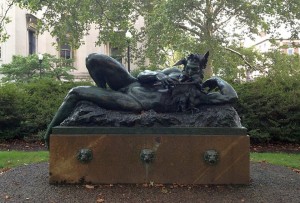
“The Great God Pan” (1863-1938) by George Grey Barnard, on the Lewisohn Hall lawn. Photograph by Roberto C. Ferrari

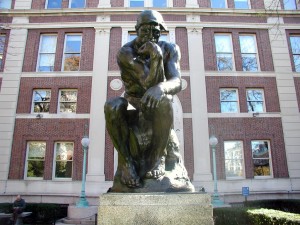
We met at Alma Mater, the most popular public sculpture on Columbia’s campus. Roberto encouraged us to interact with the sculpture, to walk around her, and to find something we had not noticed previously. This exercise produced many different comments and questions, all of which Roberto addressed, often adding something we didn’t notice. In addition to Alma Mater, our tour included The Great God Pan, John Howard Van Amringe, The Thinker, and the many artworks in front of the Law School.

And, as we walked through the Morningside Campus on a beautiful fall day, Roberto enlightened us with, not only the history of these works and their artists, but stories of superstitions, intercollegiate pranks, student songs, and so much more.

the thinker

“The Thinker” (1880-82) by Auguste Rodin, outside Philosophy Hall

To learn more about Columbia’s public art and the artists, visit Roberto’s blog at https://blogs.cul.columbia.edu/outdoorsculpture. Also, check out Columbia Magazine’s feature story Treasure Quest.

Why You Should Think: Jerry’s Picks 15.30

Why you should think about fashion…and race and media…and the Euro…and economic inequality…and digital-era diplomacy…and going to at least SOME of Jerry’s Picks. Be sure to share your event stories!

REMINDERS
 
November 9: Steps to Mass Flourishing: Social Values and Individual Experience 
November 13: The Dark Matter of Ghost Galaxies
November 17: Global Citizenship

PICKS

November 11
6 p.m.
The Center for Study of Ethnicity and Race | Tow Center for Digital Journalism
Race and New Media
A conversation on identity and new digital publishing formats with Minh-Ha T. Pham, assistant professor in the graduate program in media studies at Pratt Institute; Susan E. McGregor, assistant director of the Tow Center for Digital Journalism; Lisa Lucas, publisher of Guernica Magazine; and Ayesha Siddiqi, editor-in-chief of The New Inquiry. Susan E. McGregor will moderate. RSVP here. Pulitzer Hall, World Room. (Just Societies, 21st Century Public Square)

6 p.m. – 7:30 p.m.
Earth Institute
Why You Should Think about Fashion If You Care About Sustainability
Panelists will speak to the environmental and social impacts of the fashion industry, strategies for more sustainable practices, and specific challenges companies face when they try to implement sustainability in apparel supply chains. Speakers include Patrick Duffy, vice president of sustainability, manufacturing and external affairs at Manufacture New York; Scott Miller, director of business development at the Sustainable Apparel Coalition; Teel Lidow, founder of the sustainable fashion startup Boerum Apparel; Leo Bonanni, founder and CEO of Sourcemap; Ruth Hsia Isenstadt, co-lead of the sustainable materials research and development team at Eileen Fisher. Registration is required here. Fayerweather Hall, Room 310. (Climate Change, Just Societies)

November 16
6 p.m. – 7:30 p.m.
Columbia/Barnard Hillel
Judaism and Activism: The Columbia/Barnard Legacy
A discussion with Columbia and Barnard Rabbi activists, including Jill Jacobs ’97CC, executive director of T’ruah: The Rabbinic Call for Human Rights; Joanna Samuels ’92BC, founding executive director of the Manny Cantor Center, a space on the Lower East Side that is redefining the Jewish Community Center and the Settlement House for a new era; and Sharon Kleinbaum ’81BC, spiritual leader of Congregation Beit Simchat Torah, a synagogue that has been a haven for LGBTQ Jews and allies. Kraft Center, Hillel, Room 5A. (Just Societies)

November 17
1 p.m. – 2:30 p.m.
European Institute | Maison Française | European Union
The Future of the Euro
On the occasion of the publication of his new book, Europe’s Orphan: The Future of the Euro and the Politics of Debt, Martin Sandbu, writer at The Financial Times, will discuss the origins of Europe’s monetary union, the impact of the financial crisis, and the way ahead for Europe to achieve an economic and political recovery. Sandbu will be joined in conversation by Mark Blyth, professor of political economy at Brown University, and Adam Tooze, director of the European Institute. Maison Française, Buell Hall, East Gallery. (Global)

6:30 p.m. – 8:30 p.m.
Business School
Income Inequality: Is This the End of the American Dream?
Peter Georgescu, chairman emeritus of Young & Rubicam, will speak about the true business cost of income inequality and what CEOs should be doing to help mitigate it. Moderated by Ray Horton, the Frank R. Lautenberg Professor of Ethics and Corporate Governance. Reception to follow. Register here. Uris Hall, Room 301. (Just Societies)

November 18
7 p.m.
Center for Jazz Studies
Louis Armstrong and the Jazz Trumpet Legacy
Jon Faddis, renowned jazz trumpet player, will be in conversation with Krin Gabbard, trumpet player and professor of comparative literature and English at Stony Brook. Followed by a performance by the Jon Faddis Quartet. To RSVP, e-mail [email protected]. Miller Theatre.

November 19
6 p.m. – 7 p.m.
University Programs and Events | European Institute | SIPA
Diplomacy in the Digital Age
This World Leaders Forum features an address by the Honorable Matthew W. Barzun, U.S. ambassador to the United Kingdom of Great Britain and Northern Ireland. Adam Tooze, director of the European Institute, and Alexis Wichowski, adjunct assistant professor of International and Public Affairs, will moderate. Followed by a Q&A with the audience and then a reception. Registration is required and will open here on Tuesday, November 10 at 10 a.m. Earl Hall, Auditorium. (Global, 21st Century Public Square)

6 p.m. – 8 p.m.
Graduate School of Journalism
NYT Foreign Correspondent Alissa J. Rubin in Conversation With Jill Abramson
Jill Abramson, former executive editor of The New York Times, and Alissa J. Rubin, recipient of the 2015 John Chancellor Award for Excellence in Journalism and the Paris bureau chief for The New York Times, will discuss the risks and rewards of a career in journalism, their experiences at the Times, the challenges of being a female war correspondent, and work-life balance. RSVP here. Pulitzer Hall, Lecture Hall. (21st Century Public Square)

November 20
7 p.m. – 9:30 p.m.
School of the Arts
Invisible Thread
In celebration of the 50th anniversary of the School of the Arts, a new musical depicting a young man’s life-changing experience while volunteering in Africa. Followed by a conversation with the Tony Award-winning director, Diane Paulus ’97SOA, and associate director Shira Milikowsky ’07SOA. Purchase tickets here. Tony Kiser Theatre.

For RSVP, ticket availability, and other details, follow the links. We always appreciate hearing from you about future events!
Jerry’s Picks 15.29

From the PayPal founder to the Venice Biennale artist, the veteran experience to science education, the full Columbia sweep. And check out Brian C. (the colleague) on Brian G. (the theoretical physicist). If you prefer, view on the Jerry’s Picks Blog. And be sure to share your event stories.

REMINDERS

November 5: The Untold Story of Women in Iran
November 11: The Public Health Imagination: Groundbreaking Ideas in Population Health

PICKS

November 9 

9:15 a.m. – 6 p.m. 
Center on Capitalism and Society
Steps to Mass Flourishing: Social Values and Individual Experience 
This conference examines social values and their influence on economic dynamism and innovation. It will also explore the shift toward responsible investing and the idea that new forms of capitalism are needed to solve social problems such as climate change and inequality. Speakers include venture capitalist and entrepreneur Peter Thiel, founder of PayPal and Founders Fund; Peter Jungen, chairman of Peter Jungen Holding GmbH; and Edmund Phelps, director of the Center on Capitalism and Society and winner of the 2006 Nobel Prize in economics. A full schedule and list of speakers is available here. Lunch is available only to registered guests. RSVP here. Casa Italiana. (21st Century Public Square)

6 p.m. – 8 p.m. 
Teachers College
White House Technology Strategist on the Future of STEM Education
Seth Andrew, senior adviser to the chief technology officer of the United States, helps lead the Obama Administration’s efforts to promote, improve, and diversify STEM education. He has advocated for more access to critical technologies for poor and rural schools as a means to improve students’ academic performance. Andrews will give a talk on the future of STEM in our schools, followed by a Q&A. RSVP here. Teachers College, Milbank Chapel.

November 12
9:30 a.m. – 5:30 p.m.
Columbia Journalism School
Journalism and Silicon Valley
Journalism is increasingly dependent on and influenced by the companies that dominate the social web. Companies like Facebook, Twitter, and Google are no longer “just platforms” and are now actively shaping how journalism is practiced and funded. Keynote conversation about the relationship between news organizations and social networks with Emily Bell, professor of professional practice and director of the Tow Center for Digital Journalist, and Mark Thompson, CEO of the New York Times. Reception to follow. Pulitzer Hall. (21st Century Public Square)

7 p.m.
School of the Arts
Joan Jonas with Jason Moran
A conversation with Joan Jonas ’65SOA, acclaimed performance and video artist, and Jason Moran, artistic director for jazz at the Kennedy Center, as they discuss Jonas’ installation They Come to Us Without a Word. RSVP here. Miller Theatre.

November 13
6:15 p.m.
Veteran Initiatives
Cry Havoc: One-Person Play
After battling post-traumatic stress disorder after six years in the army, Stephan Wolfert discovered Shakespeare. With those timeless words and Wolfert’s own personal stories, Cry Havoc is an interactive journey through Shakespeare and the difficulties that our veterans and their families face. Schapiro Center, Davis Auditorium.

November 17
6 p.m. – 7:15 p.m.
Columbia Global Reports | Committee on Global Thought
Global Citizenship
Atossa Araxia Abrahamian will debut her first book, The Cosmopolites: The Coming of the Global Citizen. Abrahamian will discuss global citizenship and statelessness with novelist Joseph O’Neill and professor Rosalind Morris (anthropology). Moderated by Nicholas Lemann, director of Columbia Global Reports and dean emeritus of the School of Journalism. Registration required here. Pulitzer Hall, World Room. (Global, 21st Century Public Square)
 
For RSVP, ticket availability, and other details, follow the links. We always appreciate hearing from you about future events!
Let’s Get Physic-al: Two Brians, the Expanding Universe, and Junior High Romance

I have a thing for physics.  A very complicated thing.

Physics can be thrilling, beautiful, and wondrous.  It makes me feel hopeful.  Physics can also be baffling, contradictory, and impossible.  It makes me feel stupid.

It is a perfect analogy for my first junior high school romance.

So it was with a 13-year-old’s sense of awe and dread that I went uptown to see Brian Greene speak about “Searching for the Deep Laws of Nature” at the Dean’s Distinguished Lecture Series.  Brian is professor of physics and mathematics and sometime NOVA host on PBS who has sold gazillions of books, including The Elegant Universe, a Pulitzer Prize finalist.

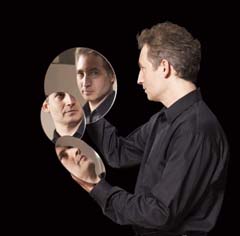
green2

Brian Greene by Lois Greenfield in the Spring 2006 Columbia Magazine

None of that mattered.  He had me at “Deep Laws of Nature.”

Brian Greene is a star (not in the cosmological sense) and draws a crowd, so the auditorium was packed with a few hundred people jamming both the main floor and the balcony.  The crowd was mostly medical students and faculty, and it looked like a scrubs-and-backpacks convention.

When Brian explained that his work is all about trying to understand beautiful concepts  that are beyond our ability to measure, a very serious young doctor behind me muttered “That is so weird, but so cool.”

When he explained Einstein’s General Theory of Relativity as
simply as if it was the way to open a combination lock (turn to the left, turn to the right, turn to the left: Gravity), the person next to me audibly gasped.

And when he explained that the past, present and future actually exist in the universe at the same time (Einstein called the distinction between them “a stubbornly persistent illusion”), I think I actually heard the sound of minds blowing.  But that may just have been mine.

It was another great example of the amazing (literally) things that are available to us within Columbia on any given day.

The Dean’s Distinguished Lecture Series is a set of annual talks by faculty in the Humanities, Basic Sciences and Clinical Sciences for CUMC audiences.  Past speakers include Sylvia Nasar, Simon Schama, Fred Friendly, and Eric Kandel.

There is a lot more about Brian Greene at www.briangreene.org.

Jerry’s Picks 15.28

Women’s rights in Iran, clarinets in Brazil, Panthers on film, self-monitoring bridges, and other events from Sir Michael Marmot to ghost galaxies… 

Be sure to check out our Featured Event Story by Jerry’s Picks own Carolina Castro and share your event stories.

REMINDERS

October 29: Sustainability and Climate Change in the 2016 Presidential Race
November 4: Scents and Sensibility: Representations of the Olfactory World in the Brain featuring Richard Axel and Billie Holiday: The Musician and the Myth

PICKS

November 5
6 p.m.

Barnard Center for Research on Women | Middle East Institute
The Untold Story of Women in Iran
Historian and human rights advocate Nina Ansary ’89BC will be joined in conversation with Richard Bulliet, professor of history and middle east studies to discuss on her new book on the women’s movement in Iran, Jewels of Allah. Barnard College, Diana Center, Oval Auditorium. (Just Societies)

November 6
6 p.m.

School of the Arts | Columbia Journalism School
The Black Panthers: Vanguard of the Revolution
Screening of the acclaimed documentary The Black Panthers: Vanguard of the Revolution, followed by a conversation with the director Stanley Nelson;  producer Laurens Grant, and professors June Cross (Journalism) andJamal Joseph (SOA). RSVP here. 3rd Floor, Lecture Hall, Pulitzer Hall. (Just Societies)

November 7
8 p.m.

Miller Theatre
Jazz: Anat Cohen Quartet
The Jazz Journalists Association’s Clarinetist of the Year for the past eight years,Anat Cohen will perform alongside Jason Lindner (piano), Tal Mashiach (bass), andDaniel Freedman (drums). Cohen specializes in the Afro-Western, improvisatory, instrumental music known as choro — an analogue of early jazz in the U.S. Purchase tickets here. Miller Theatre. (Global)

November 10
5:30 p.m.
Italian Academy | Columbia Engineering
Raimondo Betti: Monitoring the Health of Our Bridges
This lecture is the first in the Italian Academy’s series on the work of Italian scientists in the area of sustainability. Professor Raimondo Betti (civil engineering and engineering mechanics) will discuss aging U.S. infrastructure, spectacular failures, and urgent maintenance needs. Betti will share his vision of the future in which infrastructure will be able to monitor its own health, estimate its structural integrity, and launch corrective actions. Register here. The Italian Academy, 1161 Amsterdam Avenue. (Data and Society)

6 p.m. – 7 p.m.
Columbia Journalism School
What Happens When Television and the Internet Collide
The explosion of screens and devices, the rise of new platforms, innovations in tools and technology, and the growth of digital audiences around the world have spurred new opportunities for creative storytelling and collaboration in news organizations.Meredith Artley, managing editor and vice president of CNN Digital, is this year’s Hearst Digital Media Professional-in-Residence. Artley will share some examples of successes and lessons learned at CNN and beyond. Pulitzer Hall, Lecture Hall.(The Public Square)

November 11
4 p.m. – 5:30 p.m.
Mailman School of Public Health
The Public Health Imagination: Groundbreaking Ideas in Population Health
Join Linda P. Fried for a Dean’s Grand Rounds with Mark T. Bertolini, CEO of Aetna healthcare, and Sir Michael Marmot, chair of the Commission on Social Determinants of Health, who was knighted for his services to epidemiology and understanding health inequalities. Alumni Auditorium, 650 West, 168th Street.

November 13
7 p.m. – 9 p.m.

Astronomy Department
The Dark Matter of Ghost Galaxies
The smallest galaxies, known as dwarf galaxies, present a number of mysteries. Graduate student Jana Grcevich (astronomy) will talk about these mysteries and how astronomers attempt to solve them as part of the Stargazing and Lecture Series. The lecture includes a Q&A session, astrophotography slideshows, and an observatory tour followed by guided stargazing with telescopes (weather permitting). Pupin Hall.

For RSVP, ticket availability, and other details, follow the links. We always appreciate hearing from you about future events!
Castro on Kosovo

Assisting Jerry with the weekly selection of picks has exposed me to an array of thought-provoking and at times soulful events around campus. I had read about the prestigious World Leaders Forum and on Thursday, October 1, I ventured to Low Library to hear Kosovo’s first female president speak.

After passing a few security check points on the steps of Low, I joined the audience, mainly undergraduates and graduate students. Surprisingly, the rotunda was not packed and gave the impression of an intimate town hall.

The lecture was titled “Kosovo: A Country in Transition”. After an introduction by David Madigan, dean of the Faculty of Arts and Sciences, President Atifete Jahjaga dove right in to her presentation recounting Kosovo’s horrific war in the 1990s. She was interested in the ways that post-conflict societies move forward.

From beginning to end, President Jahjaga’s words were compelling. She discussed the ethnic cleansing campaign that took place during the war and the organized rape of women and children. In 2012, Kosovo hosted the first international women’s conference to discuss issues ranging from gender inequality in the workplace to wartime rape. The president emphasized that this was the first time women openly shared their stories. Since the conference, the government has made the commitment to extend wartime reparations to these women. However, the status of these reparations are unclear.

The Q&A session was moderated by Alexander A. Cooley, political science professor at Barnard and the new director of the Harriman Institute. Most questions from the audience centered on what Kosovo will do to step up its efforts to join the international community; it is not yet a member of the United Nations, the European Union, or NATO. I left the lecture contemplating the president’s introductory theme: how do post-conflict societies heal – psychologically, emotionally, and spiritually – and rebuild?

This lecture served as an important reminder that as Columbia continues to globalize and engage with the world, the conversations can become more challenging and emotional. Through platforms like the World Leaders Forum, we gain a footing as global citizens.

You can watch President Jahjaga’s remarks here (her speech starts at 10 minutes in)

Jerry’s Picks 15.27

Brains, noses, rivers, and all that jazz! Be sure to share your event stories!

REMINDERS

October 19: The Negotiator: A Conversation with Senator George Mitchell
October 20: George Rupp: “The Power – and Limitations – of Individualism”

PICKS

October 27
6 p.m. – 8 p.m.
Maison Française
The Bishnois, Ecologists Since the 15th Century
Screening of a documentary by award-winning French photographer and environmental activist Franck Vogel on the lives of the Bishnoi community of Rajasthan in India, who have made wildlife conservation and environmental protection their life’s work. Followed by a Q&A with Vogel, joined in conversation by Ruth DeFries, Denning Family Professor of Sustainable Development. Maison Française, East Gallery, Buell Hall. (Global)

October 29
6 p.m. – 8 p.m.
Earth Institute | Maison Française
Transboundary Rivers
Another evening with photographer Franck Vogel. Vogel’s series has focused on global transboundary water tensions around seven key rivers: the Nile, the Brahmaputra, the Colorado, the Mekong, the Jordan, the Amazon, and the Ganges. Vogel will present his work-in-progress through photography. Also with Upmanu Lall, the Alan and Carol Silberstein Professor of Engineering and director of the Columbia Water Center. Maison Française, East Gallery, Buell Hall. (Global)

November 4
6:30 p.m. – 7:30 p.m.
Zuckerman Institute
Stavros Niarchos Foundation Brain Insight Lectures
Scents and Sensibility: Representations of the Olfactory World in the Brain featuring Dr. Richard Axel
How does the brain know what the nose is smelling? Richard Axel, Nobel laureate and co-director of the Zuckerman Mind Brain Behavior Institute, has the answers. RSVP here. Miller Theatre. (Zuckerman Institute and the Future of Neuroscience)

7 p.m.
Center for Jazz Studies
Billie Holiday: The Musician and the Myth
John Szwed, director of the Center for Jazz Studies, will discuss his book Billie Holiday: The Musician and the Myth. Introduction by Farah Jasmine Griffin, the William B. Ransford Professor of English and Comparative Literature and African-American Studies, with a performance by jazz vocalist Catherine Russell and her trio. Teatro, Casa Italiana, Morningside Campus.

SNEAK PEEK
November 12, 7 p.m.
Fishing for Neutrinos at the South Pole
Act now: these programs tend to fill up quickly! Nevis Labs, Columbia’s science facility in the Westchester river town of Irvington, has begun to welcome the public through a Science-on-Hudson lecture series. This one features Professor Michael Shaevitz describing the IceCube project and the particle detector designed to observe the cosmos from deep within the South Pole ice. RSVP here. Science Center at Nevis Laboratories, 136 South Broadway. Irvington, New York.

For RSVP, ticket availability, and other details, follow the links. We always appreciate hearing from you about future events!