Skip to content

The Human Rights Restoration-Revolution

The Human Rights Restoration-Revolution published on

Poster_9.25


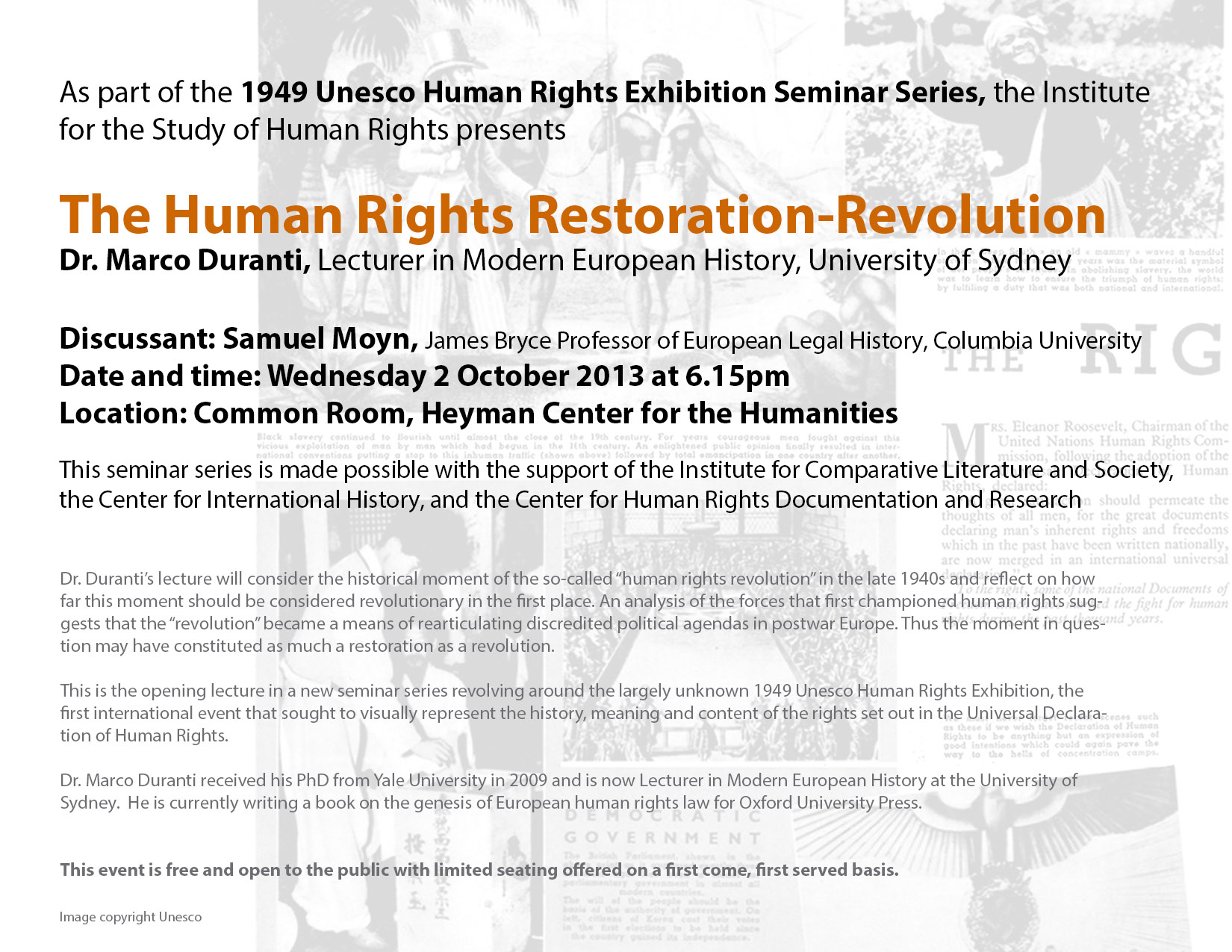
As part of the 1949 Unesco Human Rights Exhibition seminar series, the Institute for the Study of Human Rights is proud to present

The Human Rights Restoration-Revolution, a talk by Dr. Marco Duranti (Lecturer in Modern European History at the University of Sydney).


Discussant: Samuel Moyn (James Bryce Professor of European Legal History, Columbia University)

Date and time: Wednesday 2 October 2013 at 6.15pm

Location: Second Floor Common Room, Heyman Center for the Humanities


With Unesco’s 1949 Human Rights Exhibition as its point of departure, this talk will consider the historical moment of the so-called “human rights revolution” in the late 1940s. Dr. Duranti’s analysis of the forces that first championed human rights invites a reflection on how far this moment should be considered revolutionary in the first place. Instead, Dr. Duranti suggests that the human rights became a means of rearticulating discredited political agendas in postwar Europe, and thus the moment in question may have constituted as much a restoration as a revolution.


This is the opening lecture in a new seminar series revolving around the largely unknown 1949 Unesco Human Rights Exhibition – the first international event that sought to visually represent the history, meaning and content of the rights set out in the UDHR. The series will seek to explore the exhibition’s themes through the research of human rights scholars from various disciplines in an open and interactive setting, leading up to a new display of the exhibition archive at Columbia University’s Buell Hall Gallery in April 2014.


Dr. Marco Duranti received his PhD from Yale University in 2009 and now teaches history at the University of Sydney. He is currently writing a book on the genesis of European human rights law for Oxford University Press.


This seminar series is made possible with the support of the Institute for Comparative Literature and Society, the Center for International History, and the Center for Human Rights Documentation and Research.


The event is free and open to the public with limited seating offered. Find directions here.
 

Coolie Woman: A Conversation with Gaiutra Bahadur

Coolie Woman: A Conversation with Gaiutra Bahadur published on

coolie-woman-k-620x400


Monday, December 2nd, 2013
Title: Coolie Woman with Gaiutra Bahadur
Abstract: In 1903, a young woman sailed from India to Guiana as a “coolie”—the British name for indentured laborers who replaced the newly emancipated slaves on sugar plantations all around the world. Pregnant and traveling alone, this woman, like so many coolies, disappeared into history. Now, in Coolie Woman, her great-granddaughter Gaiutra Bahadur embarks on a journey into the past to find her. Traversing three continents and trawling through countless colonial archives, Bahadur excavates not only her great-grandmother’s story but also the repressed history of some quarter of a million other coolie women, shining a light on their complex lives.
Speakers: Gauitra Bahadur, Author; Moderator: Bruce Shapiro
Location: Dart Center for Journalism and Trauma.
Co-sponsored with the Dart Center.

Digital History Bouquet

Digital History Bouquet published on

posterDH

Introduction

The CU Digital History Bouquet is an half-day event geared towards incoming graduate students of the History Department, though open to all its graduate students and faculty. The goal of the event is to introduce students to the digital dispensation in the profession. The event will take place at Fayerweather 310 on August 29, from 8:45am to 11:45am, including coffee. The program is divided into three tracks: scholarly communications, computational methods and theoretical digital humanities. Each of the tracks begins with an overview of the larger issues and ends with a review of local resources available to Columbia graduate students in each of the tracks. We will also make available a page with many resources for each of these panels.

8:45-9:00
Coffee & Kuchen

9:00-10:00
Computational Methods
Issues
• research methodology vs. tools
• research management and personal archiving: Zotero
• search and discovery: Harnessing Google
• Big Data and API’s
• exhibits, archives: Omeka
• mapping technology: 
Spatial Humanities
• text analysis:
Bamboo Project, TaPoR, ChartEx, PoemViewer, Google N-gram Data

Some useful links:
ProfHackerGradHackerDHNow

Local Resources
• studio@butler
• Digital Humanities Center
• NYC-DH
• CLIO

10:00-11:00
Scholarly communications
Issues
AHA statement on dissertations
• publication genres: SHERPA/RoMEO, Scalar, Creative Commons,
• social media:
• online presence: WordPress
• White House mandate on open access
• peer review experiments
• public history

Local Resources
CDRS: Center for Digital Research and Scholarship, Columbia.
Academic Commons
Digital Humanities Center
• Center for International History

11:00-11:45
Theoretical Digital Humanities

Issues

• Significance of DH
• DH as a Critique Alexis Lothian and Amanda Phillips, “Can Digital Humanities Mean Transformative Critique?” Journal of E-Media Studies. Vol. 3 Issue 1. 2013.
Code Speak
Critical Code Studies
DH Poco
Programming Historian, Code Academy
Local Resources:
Classes
CDML