
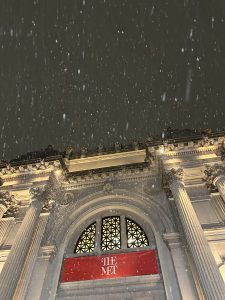
Snow falling in front of the Met (photo credit: Billy Hughes)
Recently I went to the Met with a friend. Having both taken Art Hum, we decided to play a game in the Medieval wing: we would prohibit ourselves from reading the explanatory signs, and instead try to deduce the very basic information (subject, time period, place of creation) about each object we saw. We were wrong almost 100% of the time, but our game was a lot of fun. Since we had taken Quechua together and co-developed an interest in Inka art, we tried this again in the Met’s new ancient American wing, where we were, again, incorrect but happy.
Later, I was struck that the foundational clues of this game– Marian blue, use of perspective, the folds in sculptural fabric, etc.– would have gone unnoticed by me even just two years earlier. It was only because we had taken Art Hum that my friend and I could engage with the Met’s collections this way. My coursework had enhanced my leisure time. More generally, I saw how my education was playing offense against boredom and apathy; the more I learned, the more interesting the world became to me.
This is a conclusion echoed many times in the Core syllabus. For me, the most compelling articulation is from Sor Juana Inés de la Cruz, a 17th century Mexican nun and intellectual we studied in my Lit Hum class. Responding to a Church authority who had criticized her pursuit of education, Sor Juana explained how studying the world enhanced its wonder: “I saw nothing without reflecting on it, heard nothing without considering it, even the smallest material things, for there is no creature… that does not astonish the understanding… I looked at and admired everything.”
As Sor Juana explained, education-induced wonder is not limited to such impressive places as the Met. My neighborhood walks in Morningside Heights have felt different ever since my Art Hum professor pointed out that Columbia’s campus is built as an acropolis, with the high retaining walls of Morningside Park on one side and the steep descent to the Hudson on the other. After reading the musical meditations of John Cage and Pauline Oliveros in my Music Hum, subway screeching and city bustle have become more interesting (and tolerable) to me. If education carves out new pockets of interest in day-to-day life, then the Core– which gives us a kind of intellectual blueprint for the most ordinary and extraordinary parts of modern life– is probably an especially-productive excavator.
Of course, there are many reasons to get an education: better job prospects, ability to solve problems, social connections, awareness of the world’s challenges, the satisfaction of interfacing with “humanity’s most enduring questions,” etc. But I think Sor Juana’s point is worth repeating because, amid all the pressures to achieve and excel at Columbia, it is very easy to forget. Recently, for example, I found myself worrying that the more I learned about my thesis topic, the less interested I would feel. Even if our main motivations in class are practical, and we experience class as something stressful rather than awe-inspiring, it’s comforting and exciting to know that any learning will enhance our daily life. Paperwork, noisy neighbors, and delays on the 1 line become less agonizing; mundane sights become more interesting. And for the record, regarding my senior thesis, time has proven my anxieties wrong and the principle right– as I learn more, my interest has only grown.
Sarah Bryden, CC’26