
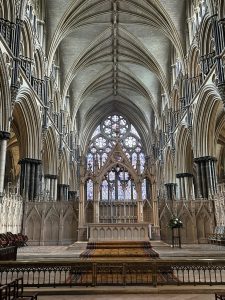
High altar of the Lincoln Cathedral (photo courtesy of the author)
Last summer, I spent four weeks in London through the Richmond Williams Travelling fellowship, a grant that the English department offers to rising seniors to do thesis research abroad. Arriving in London in July, I knew I wanted to research the Pre-Raphaelites, a group of late-nineteenth-century British poets and painters who had been inspired by medieval art. I spent the first several weeks in different places in London—mainly the British Library, which had all the manuscripts, archives and books that I needed, but also several museums that held the Pre-Raphaelites’ work.
By the time my last few days in London rolled around, I had narrowed my topic down to the poetry of a particular Pre-Raphaelite and had read a fair amount of relevant material. But before I left the country, I wanted to get out of the city and see another part of the UK, hopefully someplace that would benefit my research in a new way. I eventually settled on the Lincoln Cathedral, a landmark of English Gothic architecture that was a couple hours on the train from London. The cathedral, parts of which date to 1072, seemed like it should be on any tourist’s bucket list, but it was also a building that the Pre-Raphaelites had especially admired for its medieval grandeur. John Ruskin, probably the most famous English art critic and one of the three writers whom I had spent the last several weeks exploring, wrote to his father after seeing it that it is “worth all the English cathedrals I have ever seen put together.”
On a chilly Monday morning, I walked from my Airbnb to Kings Cross Station and was soon speeding through the English countryside. When I arrived in Lincoln, I went to a café near the train station and sat outside, sipping a coffee and looking around at the historic town. It was an overcast day, but lots of people were bustling about, most of them moving towards a steep hill in the center of town. An elderly woman at a nearby table struck up a conversation with me, and soon she was telling me about the only time she ever went to the U.S.—on her honeymoon fifty years ago, by ship. She had lived in Lincoln for a long time now, and she told me that the cathedral and the castle were both up the hill, along with a lot of interesting shops. She went off to the train station to meet her grandchildren, who were coming to visit for their summer holidays, and I made my way to the cathedral.
The hill was bigger than I had expected and just as I was reaching the top, out of breath, the cathedral suddenly came into view. It was huge and striking, perfectly symmetrical and cut out sharply against the cloudy sky in a grand contrast unlike anything I had seen before. From afar, it was this awesome grandness that struck me most, and I felt like I understood how it had stood here for nearly a thousand years—how could something so hard and powerful disappear? I looked in awe at all the pointed arches of different sizes, carved in identical rows, that I had once learned about in Art Humanities. But as I got closer, an opposite feature caught my eye: not only the extreme detail of the carvings, but the irregularity of them. I remembered reading in an essay by William Morris, a socialist Pre-Raphaelite who I had been studying in London, that the medieval craftsmen who had made these fine Gothic engravings had had the freedom to carve what they wanted to. The details of the cathedral hadn’t been planned in advance by some master architect. Instead, they had been designed collaboratively and in real time, as different builders tried out different carvings.
This contrast between the grandly symmetrical and the irregularly detailed continued when I entered the cathedral. On one hand, there were the magnificent large-scale designs: the astonishingly high pointed arches, the beautiful stained glass windows (one of which had been smashed hundreds of years ago and then glued back together randomly, leading to a strangely abstract mosaic), and a dazzling altar. On the other hand, there was the extraordinary level of individual detail: the complex tracery, the many carved gremlins, and the walls covered with thousands of tiny carved flowers. I was particularly charmed by a finely engraved pillar that had two columns of goblins on either side of it. But at one point on the pillar, where there should have been a goblin, the craftsman had carved what a tour guide explained was a self portrait, as a means of immortalizing himself.
I ended up staying in the cathedral for four hours. On the train back to London, parts of the cathedral kept flashing in my mind. It was hard to say what tangible new information I had obtained about my research, but sitting there watching the sun set over golden fields through the windows, I felt very strongly that the ideas I was thinking about had been brought to life in a completely new and uniquely meaningful way.