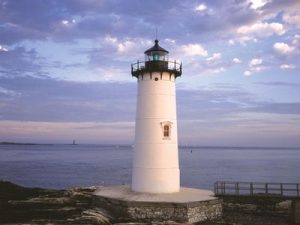
Image courtesy of Encyclopædia Britannica. Photo: Dave Shafer / © New Hampshire Division of Travel and Tourism Development.
I spent several hours of my last winter break as a Columbia student rereading To The Lighthouse. The only other time I had read it had been three years earlier, in Literature Humanities. I remembered finding it dense and tiring, not just because of the text itself but because of the speed with which we had to read it. I remembered my Belgian professor telling us that we had to visit the Isle of Sky, where the novel is set, and I remembered the Ramsays’ six-year-old son wanting to kill his father. And I remembered that we had been reading it when the weather had become really warm for the first time, and everyone was out on the lawns—my first Columbia spring—and there I was, sitting on a bench in Morningside Park on a sunny morning, trying to follow Virginia Woolf’s serpentine sentences.
Partly then, rereading the novel as an English major who was nearing graduation was a way of coming full circle. Since that spring I had read many novels and taken many English classes, and I thought that the book would be more accessible to me now. It would be a way of closing the loop of my time at Columbia and seeing how far I had come as a reader. My other reason was that this particular novel had come up many times in those three years, invariably as an example of novelistic greatness, and I felt that my rushed Lit Hum reading had not led to my appreciating the book as it deserved. It was my girlfriend’s favorite book, it was a book that professors often brought up, it was a book that my father decided to read and then praised enthusiastically. A week or so before the break, I was having lunch with a friend who mentioned in passing that To The Lighthouse was, for him, “everything that a novel could be.” I decided then that I had to read it again.
Something else had also happened to me in those three years. The summer after my sophomore year, I had pursued a research project that was technically about some minor nineteenth-century poetry but was really about the idea of literary originality—what it was, how different writers thought about it, why it was important. As I read different books about this idea, the way that I thought about literature began to change. I started to think that different kinds of writing unfolded in arcs, rather than randomly, that good writers reacted to and built on their predecessors until there was nothing meaningfully new left to do in their form. In the case of the English novel, the form had begun in the 18th century and had reached a kind of formal height in the 19th century with writers like Jane Austen and George Eliot. The modernist novelists, and Virginia Woolf was probably the best of them, had then reacted to the writers of the century before them, primarily by going far deeper into human consciousness than their predecessors had.
This was all in my mind when I returned to To The Lighthouse, which, I might as well say, blew me away. I felt that it was one of the most beautiful things I had ever encountered, a kind of prose poem that seemed to capture every aspect of human experience in the most inevitable and precise language, while also hardly having any plot at all. My friend’s comment, which had seemed faintly ridiculous when he made it, now seemed completely accurate.
But the novel’s formal perfection also made me a little sad, especially once I had finished it. It seemed as if Virginia Woolf had brought the English novel to a height to which it had never returned, and perhaps never could. When I thought about the English novel after the modernists, I saw a lot of irony and language games, writers like Nabokov and Pynchon. They were talented in their way, but none of them seemed to have a finger on Woolf.
Perhaps this is fitting in its way, because if To The Lighthouse is about anything, it is about time passing and people changing. Its middle section, “Time Passes,” describes the deterioration of the Ramsays’ house on the island, and when we meet the family again in the third section everything is different and worse: some people are dead, others are older and more serious. And it was the same with me as well: much had changed since I had last read the book, and much more was about to change in the next few months. These different senses of finality—the decline of the novel, the death of Mrs. Ramsay, the end of college—all fused together as I read the book back in my old home over winter break, and made me feel like few things had before what it means for time to pass away.