
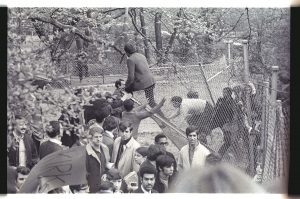
1968 protestors at the site of the Morningside Park gym construction (Credit: Columbia University Libraries)
“They were just so far from an understanding of rage. They didn’t understand the feeling,” says David Schiller, a Fayerweather Hall occupier during the 1968 protest at Columbia. Schiller captured what lay at the core of the divide between the student protestors and the faculty and administration: the feelings that fundamentally underlaid their political ideology. In my final paper for Frank Guridy’s history seminar, Columbia 1968, I wrote about the Ad Hoc Faculty Group, the faculty coalition serving as mediators between the protesting student organizations and the administration. Where the administration suggested harsh and punitive measures, like mass suspensions and early calling of the police, the Ad Hoc Faculty Group suggested rational discourse with the protestors and agreeing to some of their demands, like halting the construction of the controversial Morningside Park gym and forcing the Institute for Defense Analysis’s research off Columbia’s campus and dime.
Despite the Ad Hoc Faculty Group’s twenty-four/seven meeting schedule and several rounds of deals presented to the protestors and the administration, they did not end up getting much done. While the park’s construction was halted and not every student involved was arrested and suspended, the Columbia administration still called in the police and suspended many students. Fundamentally, the students and faculty disagreed on whether institutional change was ultimately for the better, and the emotions behind their beliefs separated their motivations, tactics, and ideals regarding the entire Columbia 1968 crisis. The professors took it as a space for learning, where discourse could be exchanged, and their role as faculty could be tested. It was not life-or-death and rage, like it was for the protesting students.
They could not grasp the New Left’s politics, rooted in urgency, rupture, and anger at the entire system, and looking at widespread events and finding systemic problems as the cause. One undergraduate student said, of the protests, “I understood that for me to have any integrity, I had to now act in a way that I had never expected.” Tom Hurwitz, a fellow undergraduate, said, “You couldn’t stand still, you had to do something.” And Jonathan Brent, another undergraduate, asked of his fellow students, “Are you going to stand up with a voice, or are you not?” To these students at Columbia, the protest and the issues they were fighting for were life-or-death. Most were spurred by the Vietnam War, the Morningside Gym, the Institute for Defense Analysis, and the general racism and prejudice they saw existing at Columbia University. The students empathized with marginalized groups, seeing the fight in the Vietnam War as the same as they saw their fight at Columbia. Although they understood the varying levels of physical safety and harm, the all of the struggles were interlinked, and they knew they had to stand up and protest, or they would not be able to live within their moral code.
Over the past few years at Columbia, with our 2024 protests and ensuing administrative action, many were quick to jump on a side and align themselves fully with it. However, increasing administrators, faculty members, and students have advocated for more of a discourse-focused approach. We saw community roundtables pop up on Butler lawns for public discussions to understand the other side and view issues from new perspectives. However, sometimes, advocates for rational discourse as the sole healing device overlook the charged emotions and connections from both sides. They overlook the rage, the moral crises, and emotions at the core of many students’ beliefs. It’s not simply a question of taking the Lockean approach to protesting, or believing in John Dewey’s pragmatism, or using Foucault as your bible.
Now, I can’t advocate hard and fast for either said. I wouldn’t say trying to understand someone else’s perspective is a fruitless endeavor, and I wouldn’t say that living in an echo chamber because of your own beliefs is perfect either. However, a certain sense of empathy seems to be missing from many ventures to promote discourse. Sure, people listen at the community roundtables, clap after someone speaks, and maybe even remembers what the other has said. There’s a lot less effort to really sit in the emotional reality of someone’s lived experience, even when it diametrically opposes your own. It’s a task that requires fortitude and emotional depth, but it’s certainly a worthwhile one. We can all try and understand each other’s rage a little better.