
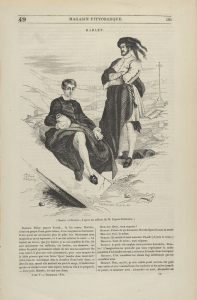
“Hamlet and Horatio,” engraved by Andrew Leloir for Le Magasin Pittoresque, December 1837
Near the beginning of Hamlet, the titular character famously says to his stolid and rational best friend, “There are more things on heaven and earth, Horatio, than are dreamt of in your philosophy.” It is easy to imagine the two of them—the impossibly imaginative Hamlet, bursting with feeling, described by one Shakespeare critic as having “infinite reverberations,” and the kindly, grounded Horatio, who believes that his stoic perspective can satisfactorily explain the world around him. At the risk of overstating my case, it seems like what the Core has the potential to provide are those things that Horatio’s straightforward philosophy cannot dream of.
A Horatian life, I think, is founded on a few principles and focuses mainly on the present. Most of us are living this kind of life most of the time: we work, we read the news, we talk with other people about other people, we exercise, we try to make sense of the different elements of our lives. We come to college living this way, and most of us leave it to continue to live this way. But what the Core can offer us at its best is a bright glimpse of something so different from all of this that it can be overwhelming.
Different people find these slices of transcendence in different places. I remember an afternoon in Avery, listening to Beethoven’s Sixth Symphony for a close listening assignment for Music Humanities. I knew nothing about classical music before the class, but as I tried to track the different instruments I suddenly felt something that I had never felt before and that is hard to describe without descending into clichés. Part of it was, of course, an aesthetic response to a beautiful piece of music. But the other part of it is maybe best explained by returning to Hamlet’s words: it was an overwhelming feeling that there was far more in the world—to think about, to experience, to imagine—than I had ever been aware of.
There are different ways to experience this feeling, and different ways to respond to it. A physics major in my CC class was so taken aback by Marx that when I run into him years later he still brings him up as the crucial encounter of his college years, and the class as the most important one he ever took. (The literary critic Fredric Jameson famously said that it is easier to imagine the end of the world than the end of capitalism; perhaps my classmate now felt himself able to do the latter.) A prospective STEM major in my Literature Humanities class loved the books so much that she decided to become an English major afterwards. Some people are so overwhelmed by these encounters that they transform their life, becoming an academic or a writer (a moving fictional account of this process is depicted in John Williams’s novel Stoner). Others may pursue a more traditional path, but their lives are irreversibly broadened by the Core. I occasionally run into a recent Columbia graduate who is applying to law school but who, whenever I see him, is reading a classic novel; he still sometimes talks about how much the Core affected him. For this latter group of people, a life that may seem Horatian is filled with moments of imagination that would make Hamlet proud.
The important thing, I think, is not about what we go on to do but what we take away. The Core can be seen as a burden or as an unparalleled opportunity to explore what the critic Matthew Arnold called “the best which has been thought and said.” Of course it can’t be comprehensive, and there are interesting debates about what it includes and excludes. But the fact remains that, if you open yourself up to it, it can begin the process of feeling and understanding those things that Horatio could not even dream of.