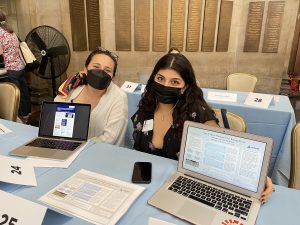
Astrid Liden (Laidlaw ’20) and Ava Sanjabi (Laidlaw ’21) at Columbia’s Undergraduate Research Symposium, October 2021. Photo credit: Ariella Lang.
About two months ago, Columbia and URF hosted their annual Undergraduate Research Symposium, an event that allows students to showcase research projects they have been working on. It happened to coincide with Family Days Weekend, and I eagerly waited on line with parents who were excited to see their student’s research spanning the Humanities, Social Science, and STEM. As I walked in, the 150+ student presenters were well under way, chatting with visitors and sharing color copies of their posters. Full of positive energy, the symposium offers insight for students who are unaware of what undergraduate research looks like to get a sense of not only what each discipline aims to study, but also how to go about finding opportunities, funding, and an advisor. I interviewed four students about their projects and experiences within the research community with the goal of understanding what motivates students. Apart from asking about their individual projects, I posed four questions to each student about their respective fields, and surprisingly came away with distinct conversations.
The questions were the following:
- What inspired you to want to present your project today?
- What do you like about your discipline/field?
- What challenges is your discipline/field currently facing in research?
- How can you make research in your discipline/field more relatable for a general audience?
Below you can find a breakdown of each conversation. I hope you come away from them learning as much as I did!
Adedotun Adegbite
Adedotun is a senior in CC studying Middle Eastern, South Asian, and African Studies. For his project, he wanted to study the intersection between history and religion in the Fulani war against Hausaland (present-day northern Nigeria). Specifically, he was curious about how Muslim leader Usuman dan Fodio led his revolution against his Muslim neighbors when their religion strictly prohibits war between Muslims. The bulk of his work consisted of going through primary sources such as letters and pamphlets.
His enthusiasm radiated as our conversation went onto the other elements of his project. Specifically, he mentioned that his goal was to bring an under-analyzed element of Nigerian history into contemporary conversations. It is part of his broader appreciation of history and how we as a society can rely on it to understand various identities and the present world. However, Adedotun did provide an important warning about history as a discipline. He lamented the fact that history needed a “paradigm shift” because it is not immune to propaganda and that historians must actively “read against the grain”. Perceptions are powerful and difficult to overthrow. Overall, though, he is happy to have applied the historical toolkit from his major to share an important finding with the academic community.
Ashley Gutierrez
Ashley is also a senior in CC studying Biochemistry, particularly structural biology. For her project, she studied the specific rare codon, ATA, and its role in the production of amino acids. She became involved in this research through Columbia’s SURF program which provides students a summer opportunity to gain lab experience in biology. What attracts her to the field is understanding the gaps in the literature. There are many concepts that are “taken as fact”, but the intricate details are not perfectly understood. By having a collaborative academic biology community, people can both contribute to our shared understanding while also making a career out of it.
There are, however, many ways in which that community can improve, particularly with respect to inclusiveness. Ashley described how eerie it felt to be the only woman on her floor in the lab building, and the only female undergraduate in her lab. As a first-generation, Latina college student likewise made it hard sometimes to find peers and colleagues who could relate to the specific challenges she faced: mentorship and exposure to academic/professional resources, for example, were harder to come by, although the diversity and inclusion workshops that the department held definitely helped address these challenges, Ashley notes.
Finally, Ashley shared some of the challenges that come with research that is, as is so often the case in STEM fields, supported by grant funding. Because researchers rely on funding bodies to pursue research, research agendas are often defined by the interests of the foundation providing the funds. Hopefully these research interests align with the scientists’ scholarly interests, but that is not always the case. Despite these challenges, Ashley still wholeheartedly enjoys the work she and her colleagues undergo.
Astrid Liden
Astrid is a junior in CC studying Political Science and Latin American & Caribbean studies. As the daughter of Venezuelan immigrants, her academic endeavors are inspired by a personal connection, and by the needs she sees in her community. That is why for her presentation, she researched Venezuelan migrants’ refugee status through Columbia’s Laidlaw program. She finds that despite Venezuela having the second largest refugee population in the world, they only receive a fraction of the funding that other refugees receive.
The biggest reason she decided to present at the Symposium was because of the political discourse surrounding Venezuela. People politicize the country to advance their political causes without necessarily being cognizant of the refugee experience or other challenges that the country faces. She hopes to bring more awareness to individuals’ struggles, and to understand through her research the policies that have been developed in a range of countries to address the Venezuelan migrant crisis. Among the challenges that Astrid faces is the fact that this is an issue that is still unfolding. As a contemporary challenge, it can be difficult to find real time, reliable data. In addition, comparing immigration across countries or across time can be difficult because every context has its own institutional nuances. For instance, comparing waves of Venezuelan immigration from the past to the present is difficult because of the specific economic conditions, political leadership, and global environment that define each of these moments. Astrid notes, however, that addressing these setbacks are what makes social science so compelling! She is continuing her research through the Mellon Mays Fellowship – a terrific opportunity for students interested in continuing their research journey.
Ana Carolina Oliveira
A Rabi Scholar, Ana is currently a junior in CC studying Physics. Her project focused on studying the algorithms behind the proposed Lunar Gravitational-Wave Antenna (LGWA) and was largely motivated by her desire to pursue a PhD. She is not only drawn to the rigor of the discipline but also to the strong overlaps it has with philosophy. The reason she enjoys presenting is because of the potential inspiration her work could bring in young girls. The gender breakdown in physics is especially staggering according to Ana’s experience. By being present at these events, she reasons, perhaps she can help bridge the gap.
For Ana, the biggest issue facing all of science, not just physics, is credibility. She laments that people can no longer agree on facts, and was especially disappointed at how this manifested itself through the vaccine debates. In her native Brazil, she notes that the public’s polarization surrounding science is leading to the unnecessary deaths of a high number of people. This unfortunate reality is what helps inspire Ana to continue her research, and to continue to serve as an advocate for scientific discovery.