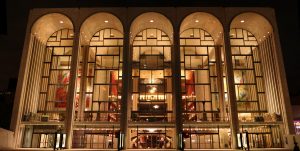
Metropolitan Opera House. Photo Credit: Niall Kennedy, Creative Commons
“Wait, the best is yet to come: Don Basilio, my / singing teacher and his factotum,/ while giving me lessons/ repeats the same theme every day.”
― Wolfgang Amadeus Mozart, Le nozze di Figaro
While Columbia’s notable Core Curriculum is particularly revered for its Literature Humanities and Contemporary Civilizations course offerings, having first introduced the latter in 1919 (just one year after the conclusion of World War I), there is a certain charm that colors its lesser known components. Art Humanities introduces students to the oil paintings of Rembrandt and the grinning Monroe of Andy Warhol, while the Foreign Language requirement offers burgeoning scholars the ability to conduct research in a region that transcends their vernacular. In a similar way, the Music Humanities curriculum––introduced in 1947 and focused on the many forms of Western musical imagination––provides students the chance to understand creation as a medium that can both be written, heard, and viscerally felt.
As a transfer student to Columbia who once majored in the performing arts, as well as a member of a variety of Columbia music ensembles, it is not surprising that I have found myself attached to the Music Humanities syllabus. Gregorian chant seems to inspire the nostalgic feelings of pomp and circumstance that I once felt walking into the cathedral in my hometown, while the hip-hop that concludes the semester-long course reminded me of Columbia’s own positionality in the contemporary world. As I analyzed musical lines that had only ever existed as figments of sound from my Spotify playlist, I was made aware of another truth inherent in the works of Music Humanities: it is our privilege and our responsibility as Columbia undergraduates to both celebrate the imagination of the past, while ensuring that its influence does not diminish in the future.
This revelation struck me on the Music Humanities venture to the Metropolitan Opera, perhaps the most famous performance space in New York City––and another example of the Core Curriculum’s relationship to contemporary settings and modern art. As I sat in the audience, the voices of the performers reverberating along the vast walls of the venue and the audience in a collective envelope of silence, the music––in this case, Mozart’s well-regarded Italian opera, Le nozze di Figaro (The Marriage of Figaro)––was no longer a piece of the past. Instead, as is the case with so many of the musical creations presented as part of the Music Humanities course, the opera seemed to find new life in the present moment. Each new audience that interacted with its four acts, each spectator who erupted in applause as the curtain swept in from the stage wing––these were the vessels through which the imagination of Mozart would be carried into the twenty-first century. The entirety of my Music Humanities class, then, would serve as harbingers of musical art in their own lives––tasked with this responsibility because of their own taught appreciation for the art form through the Core Curriculum itself.
The Core Curriculum is not meant to be experienced in the present and disregarded in the future. Instead, as evidenced by the imagination that can be both felt and internalized through the musical creations that line the Music Humanities syllabus, it provides a sort of blueprint for students to later use in their own lifelong celebration of art and ingenuity. Regardless of the paths that each Columbia graduate chooses to take upon their exiting the gates at 116th Street and Broadway, classes such as Music Humanities encourage the scholars of tomorrow to emulate and expand upon the genius of the past.
That is the special thing about the Core Curriculum: it can only continue to exist if its influence continues to be felt. Otherwise, the works that it celebrates and analyzes are merely the imaginative outbursts of a period long-forgotten. As students, we have the unique opportunity to assure that the history of this art might better our own collective future. Columbia is our starting point, but it is not where this responsibility concludes. Like music, the melodies are meant to crescendo as we grow.