
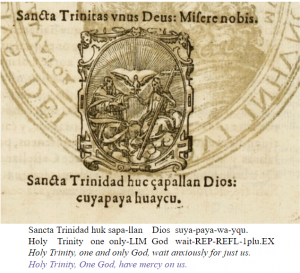
An example of a gloss for a Quechua-language catechism. Credit: Symbolo catholico indiano, Fray Luis Jerónimo de Oré y Rojas, fol. 66r, 1598.
As my six weeks with the Humanities Research Scholars Program (HRSP) began, I felt enthusiastic optimism. I knew my project was ambitious, and that it would challenge me in unexpected ways (my biceps, sore after carrying a pile of dictionaries back to my dorm, were early evidence of this). Still, I trusted my planning, and was excited to learn more about colonial-era translation in Mexico and Peru. Moreover, I was confident in my ability to carry out the translations which would be the crux of my research; with linguistics coursework, previous translation experience, and ample resources by my side, how difficult could it really be to work with these texts?
The answer to this question came quickly: very. Almost as soon as I opened the primary sources I had painstakingly lugged from Butler, I became concerned about the irony inherent in my project. While I tried to study translative choices between Spanish, Quechua, and Maya, I was adding an additional layer of mediation with my English-language analysis. In just the first week of research, I found myself facing a significant methodological problem. I needed to capture subtle grammatical differences between texts, but with minimal Anglophonic interference.
I had just enough translation experience to recognize the gravity of the situation, but not enough (yet) to immediately know the solution. Last summer, for example, I worked with rap music in Maya, Quechua, and Spanish for my Laidlaw research project. Since I was primarily trying to understand content– what rappers were saying in their songs– I followed the guidelines of semantic equivalence; in other words, I paid attention to the meaning of the lyrics, rather than the linguistic features that they contained. In my Quechua class, we followed the same principle when we subtitled a Quechua-language film. Clearly, however, aiming to “get the gist” would not help for my HRSP project: I was working with texts that had already been translated, often three times over, and typically did not vary much in their content. If I wanted to understand how the Maya, Quechua, and Spanish versions of a prayer differed, translating all of them into English via semantic equivalence would give me the same result, three times.
My need to capture structural differences in language placed me firmly outside of my comfort zone, and pushed me towards experimentation. I tried creating literal translations, working word-by-word and ignoring the broader context or connotations. This method helpfully emphasized word order, but failed to register morphological differences between words, like suffixes or verb tense. Since I was working with religious texts, which often rely on abstract language like metaphor and hyperbole, the literal translations also erased a fair amount of meaning.
As my frustration grew, so did my willingness to experiment with increasingly-strange methods. Eventually I turned to glossing, which involves breaking down each meaningful component of language and tagging its meaning. Glossing is the linguist-equivalent of opening the hood and checking the engine; it doesn’t produce a translation any more than an owner’s
manual produces a car. When I put it to the test, however, I saw that glossing was precisely the kind of fine-toothed comb I needed. The process captured the morphological differences that showed me how the texts were translated, without sacrificing much efficiency or nuance. I finally had a solution– a way to “translate” that fit the needs of my project.
Having spent six weeks glossing my way through a mountain of colonial-era religious texts, I am now in Mexico to start work on a new research project: T’aantsil, a corpus of the Maya language. During the next six weeks, for my second summer as a Laidlaw scholar, I will be adding an English layer to the corpus, with the goal of expanding the user base and increasing accessibility. My audience is a general public of non-linguists and, in most cases, non-native English speakers; consequently, my translations need to be accessible, non-technical, and consistent. This is an entirely new set of demands, and will require me to approach translation in an entirely new way. This time, however, I am not quite starting from scratch– with a new understanding of why and how to adapt translative methods to the project at hand, I feel much more confident in my ability to surpass linguistic hurdles. As I start this new six-week research period, I have less trust in my planning, and far more trust in my ability to change plans as necessary.
By: Sarah Bryden CC’26