
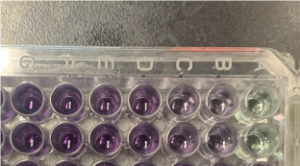
Photo Credit: Maurice Chakour
My first day interning at a biochemistry lab, I messed up a protein assay.
The array of instruments on the bench were new to me. Most menacing of them was the micropipette, and I didn’t know how to tell my boss I was quite clueless (he was the PI, who was already gracious enough to have accepted me—a freshman without research experience). So, I sucked it up and tried my best.
What was supposed to be a beautiful gradient of purple (as shown) ended up looking like a tray of water. I didn’t pipette most of the ingredients needed, wasting an hour of my time and half the protein sample. I braced myself as I confessed to my PI that the plate was a colorless failure. Fortunately, I wasn’t yelled at as expected. In fact, my boss was more than understanding and gave me step-by-step instructions for the procedure.
That moment taught me something I would use for the rest of my time working at the lab: ALWAYS ask questions when unsure. For the next few weeks, I was saved by my new realization countless times—so much so that “Just to make sure” remains an integral part of my vernacular outside the lab.
For example, when running a Western blot (a test to see if a certain protein is in a sample), I made the effort to stop everyone working on the transfer step to check if we were putting the blots in the right direction. Sure enough, our PI told us that we had to flip them for the step to work. Had I kept the hesitancy to myself, the transfer step would have failed, costing us ~a day and half’s worth of work.
A lot of people will say that asking questions is important. Most of the time, though, the questions they’re talking about start with “why.” Asking why things are the way they are is helpful, don’t get me wrong. That’s how a lot of significant research begins. But when starting out as an intern in any field, the “how” can be equally (if not more) important. When performing a procedure that’s new to you, it’s important to be 100% sure about how each step is actually completed. (Sidebar: “how” can also mean is—as in “Is this how to do it?”—and what-–as in “What should I do to fix this?”)
Asking questions also means taking initiative. My second week in the lab, I noticed we were regularly running low on gels—which used to take us a full day to make. I was the second one to arrive the next morning, after my boss. I asked if I could start making some gels (previously, we only made gels when asked of us, usually in the afternoon). He seemed taken aback, but said “Sure.” From then on, we only took ~half a day to make our gels, as a result of the change.
In addition to suggesting a new task, it’s helpful to suggest improvements to the ways those tasks are done. One time, while imaging Western blots (the final step which highlights a target protein), I noticed the protein was more visible on the front of the blot than the back. When imaging the backside of a blot that showed only faint protein, I asked to try flipping it. To my surprise, the front half of the blot had much stronger signal, and now we’re always sure to image the correct side.
Taking initiative and asking questions not only improved my technical ability and understanding of our research, but also taught me to think critically about every step of the process. By staying proactive, I not only showed my colleagues I was eager to learn and try—I demonstrated an intense level of appreciation for the importance of the work we were doing. This approach helped me build trust and opened up more opportunities for deeper learning.
Looking back, I realize my willingness to ask questions and take initiative was the key to my growth as an intern. It transformed my mistakes (which we’re all sure to make no shortage of) into learning opportunities and uncertainties into moments of discovery. To anyone starting a new research position: don’t be afraid to ask questions. Your curiosity is your greatest strength. Embrace your role as a learner, and you’ll find that every question you ask will bring you closer to becoming more confident and capable in whatever you choose to pursue.
Maurice Chakour CC’27