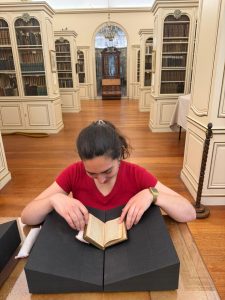
The author at the Dumbarton Oaks Research Library in Washington, D.C.. Here I am reading a 500-year-old Quechua grammar, and looking for something new to say about it.
When I began the senior thesis process, my seminar instructors made it clear that my project should address a “gap in the scholarship” in order to make an “original contribution.” This terrified me. I had serious doubts that I, at the undergraduate level, could find any holes or unaddressed questions in the work of the scholars I respected. Of course there were mysteries to be solved about 16th century Latin America, but it seemed incredibly unlikely that I would be the one to identify them, let alone solve them.
I took some solace in the fact that all my fellow thesis-writers seemed to feel the same way. In talking with my friend and fellow Rose fellow Sagar Castleman, who has done research on originality in Oscar Wilde’s poems, I also came to see that this feeling is pervasive enough to be an object of study in itself– e.g. Harold Bloom’s The Anxiety of Influence. Genre-wise, a senior thesis is pretty far afield from Romantic poetry, but I started to think about my mandate of an “original contribution” along the same principles that were laid out by Bloom and relayed to me by Sagar. I was facing, essentially, the same predicament as these poets: what could I possibly say that hadn’t been said before?
My professors assured me that with enough time, reading, and investigating, I would find my puzzle. They advised me to read all footnotes, to check primary sources myself, to ask how some conclusion might hold up against new data or a new case study; they showed me examples of past theses that had successfully identified and addressed a scholarly gap. I took their advice and encouragement to the library, where I had the strange and novel experience of reading in search of questions rather than answers.
There, I realized that my anxiety was equally-intense but fundamentally different for my thesis research in history (obviously, a very old discipline) as in linguistics (a relatively new one). Historians have been writing about colonial Latin America for centuries, and so in history I felt myself to be up against a mountain of prior work. But in linguistics, I faced only a small hill; the idea of studying language scientifically, as a natural phenomenon, began only in the late 19th century and has co-evolved with developments in computer science, neuroscience, and psychology. Even so, novelty was not an easier target to hit in my linguistics research: though I didn’t have as many predecessors to consult, I had to contend with a flurry of synchronic work, and the very wide span (~7,000 languages) of possible case studies. If my anxiety about novelty in history research was oriented vertically, through time, my anxiety in linguistics was spread laterally across an entire planet of possible counterexamples.
That my originality-anxiety was not a function of the amount of prior work was my first indication that this an irrational and universal concern. Regardless, at the beginning of my thesis research in history and linguistics, I felt paralyzed by the pressure to produce something original. Yet with time and patience, I also came to see that the solution was the same: by lending attention to my own confusion, I could find weak spots in the scholarship. For example, in all my coursework and reading on colonial Latin America, I had never understood how middle-aged Spanish friars could actually learn very complicated, difficult languages like Yucatec Maya to fluency. My confusion didn’t indicate a problem with my learning; it indicated that there was not yet enough research on this topic.
As newcomers to the field, senior-thesis writers have a sensitivity to parts of the scholarly narrative that don’t make complete sense. We can exploit this sensitivity to locate gaps in the scholarship. At this point, I find it comforting to realize that the “original contribution” is an equally-terrifying demand in any field, old or new; I also finally believe the professors who have assured me all along that it is very possible to make an original contribution, even as an undergraduate. Although I’m not yet finished with the senior-thesis process, I think I can leave one piece of advice here for future thesis-writers: as you face the task of producing something novel, you can use confusion in coursework, readings, and problem sets as a clue.
Sarah Bryden CC’26