
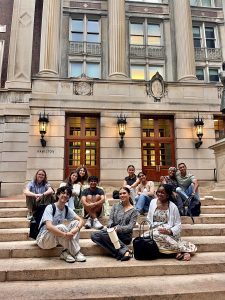
Sitting with members of my Laidlaw cohort outside of Hamilton Hall after a Laidlaw session in June 2026. Credit: Abril Rodriguez Calle
The first time I walked into the 202 Hamilton Conference Room for a research information session, I felt like I had shown up to a party where everyone else had received the dress code and I hadn’t. People were tossing around words like “methodology,” “literature review,” and “qualitative coding” with the ease of people discussing weekend plans. I stood there nodding, wondering if anyone could tell that I had absolutely zero idea what was going on. I wasn’t just inexperienced—I was the least experienced person in the room.
In that moment, I saw all my hopes of getting the Laidlaw scholarship I wanted so badly slip through my fingers. There was simply no way that I could compete with these people who seemed to have résumés full of projects, mentors, and methods I had never heard of. I remember hovering over the “submit” button on my application and thinking, “Who am I kidding?” But I submitted it anyway, partly because I was curious, partly because I was stubborn, and partly because I deluded myself into thinking I could play up my résumé to seem on par with the other applicants.
Well, I’m sure they read right through my carefully worded, sparse résumé, but I don’t think it mattered. Because what I didn’t realize at the time was that programs like Laidlaw are looking for students who are willing to learn and who bring fresh eyes to old problems. And when you have no experience, you also have no assumptions, you’re not weighed down by “the way things are usually done,” and you’re not afraid to ask the questions that everyone else is too embarrassed to ask.
So if you hadn’t guessed yet, I ended up getting into Laidlaw and I just finished my first summer. So it is definitely possible. But if you’re intimidated by the idea of applying to research programs with no experience, here is some encouragement from someone who started at absolute zero.
The first thing I learned (and I learned it fast) is that when you have no experience, you can’t hide behind buzzwords or a list of past projects. Meaning you’re forced to be painfully and specifically honest about why you want to do the work in the first place. In my application, I didn’t have technical skills to parade around, but I did have questions that kept tugging at me, communities I cared about, and a desire to understand the world a little better. That kind of clarity stands out more than people realize, because at the end of the day research programs don’t want applicants who sound like they swallowed a thesaurus, they want students who can explicitly point to what will keep them going when they run into roadblocks or challenges.
The second thing I realized is that your non‑research experiences are often more interesting than traditional research ones. I used to think my background as an EMT didn’t matter much in an academic context, but it ended up being one of the strongest parts of my application. It showed that I knew how to listen and how to stay calm when things get messy, skills that matter a lot in research. If you’ve worked a job, cared for siblings, volunteered, tutored, or simply lived through something hard, you already have material that demonstrates maturity and perspective. The trick is to stop apologizing for not having research experience and start explaining how your actual experiences have prepared you to step into research.
Another unexpected perk of being inexperienced is that you get to be honest about what you don’t know. Experienced applicants sometimes feel pressure to present themselves as already polished. Beginners get to say, “I don’t know how to do this yet, but I want to.” That “yet” is key because it says, “I have potential to grow.” You’re not supposed to be a fully formed researcher at eighteen, and potential is exactly what undergraduate programs are designed to cultivate.
And finally, the most practical tip I can offer: reach out to people even if you feel wildly unqualified. I emailed professors with nothing but a few thoughtful questions and a prayer, and that was enough to start real conversations and relationships. You don’t need a stacked résumé to ask someone about their work. You just need to show that you’ve read it, thought about it, and want to understand it better.
If I could go back to that version of myself standing in 202 Hamilton, convinced she was the least experienced person in the room, I’d tell her this: You’re right. But that’s exactly why you’re going to thrive. When you start from zero, every step is progress and every question is fair game and that’s a superpower.
Abril Rodriguez Calle, CC’29