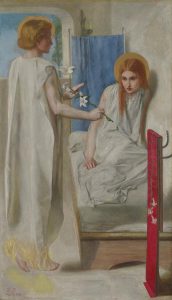
Ecce Ancilla Domini!, Dante Gabriel Rossetti, Tate Britain
I first started thinking about the senior thesis during the beginning of my junior year, when a friend who was a year older than me told me about the Richmond Williams Travelling Fellowship. This was a fellowship that the English department offered every year that funded research abroad the summer after junior year. This sounded like too good of an opportunity to pass up, so I started thinking about a research project I would be interested in which would benefit from being pursued abroad.
The trouble was that, as an English major, most research usually involved a bunch of books that could be found in any big university library. I had done research the previous summer at Columbia, and everything that I could have possibly needed was at Butler—they had even ordered frayed first editions of nineteenth-century poems from Harvard for me! Even the correspondence of most major writers had been published by university presses. I realized that unless I wanted to pursue some pretty niche historical research (hunting through marginalia in the manuscripts of some forgotten writer, say), I needed to think of a reason to travel that wasn’t mainly archival. After pondering this for a few weeks, I thought of the Pre-Raphaelites, a nineteenth-century group of painters and poets who had wanted to make medieval-style art. I had learned about them in a class I had taken on Victorian Poetry, and I had been fascinated by their paintings and poems. (It also helped that most of their best paintings were in museums in London.) I was especially interested in how the Pre-Raphaelites had navigated their attempts to move the formal conventions art backwards without seeming derivative or irrelevant.
My advisor suggested that I focus my research on three writers—Dante Gabriel Rossetti, the central Pre-Raphaelite poet and the figure who had first drawn me to the movement, and William Morris and John Ruskin, two important critics and theorists of the movement. In London, I dived into the works and lives of these writers, reading as much as I could by them while also visiting museums that held their visual art, houses they had lived in, and a cathedral that they had loved. By the end of the process, I had narrowed my focus of study to Rossetti, and I wanted to focus on the unusual ways that in his art he had taken the medieval and made it Victorian.
When I arrived back at Columbia for my senior year, I met with my advisor. Although I had thought that my thesis was fairly narrow in scope—I was, after all, considering the particular formal techniques of a not-very-well-known poet from 150 years ago—my advisor thought it was still too broad. He introduced me to typology, a mode of interpretation where certain people or events are seen as being the fulfillment of other events from long ago. This seemed very relevant to Rossetti, who had thought that he was picking up the thread that had been dropped by his favorite medieval artists and poets, and my advisor suggested that I focus my analysis on Rossetti’s temporal manipulations.
As I write this, I’ve written about half of my thesis and it’s been one and a half years since I first thought of researching the Pre-Raphaelites. In some ways, my thesis has turned out quite similar to what I had initially planned; it’s still about Rossetti, and I still am delighted to be able to discuss both poems and paintings. But on the other hand, its focus has narrowed and shifted quite a bit, so that I’m not just vaguely considering Rossetti’s relationship with the “old” but analyzing the deployment of particular interpretative tools that I didn’t even know about when I began the process. And this is part of what makes the senior thesis so rewarding: not just the satisfaction of having written the final paper, but the huge amounts of reflection and self-criticism that goes into the process of writing it.