Coming to Columbia University as a transfer student in the Fall of 2024, I had one goal, which was to advance the research I had begun during my freshman year. Ever since 2021, when the Taliban regained control of Afghanistan, I began looking deeper into Afghan history, especially because I grew up hearing stories from my family about their experiences as refugees during the Soviet-Afghan War. This deep dive into Afghan history, Cold War politics, and the broader Central Asian, South Asian, and Middle Eastern regions made me realize how little of my community’s story was told by the community itself. Upon entering my freshman year, I was unsure how my research journey would unfold, but I knew I was going to try to put my foot forward to make change. In my first year, what I found helpful and something that I suggest to every student researcher is to take research methods classes as well as classes that center around the region or subjects they are interested in doing research about. By doing this, I learned different research methodologies, got involved as a research assistant in the Moving Stories Project led by one of my professors at WashU, and launched the first phase of my own project, which I titled “Reclaiming Our Narrative” through the Living History program offered by the WashU History department.
My first project was a semester-long study of the Afghan American community’s migration patterns, especially to the Midwest and the St. Louis region. I used a mix of methodologies I had learned from my professors and classes, especially oral history and statistical analysis. After that semester at WashU, I presented my findings to members of the History department. What has stayed with me most is how one audience member came to me afterward and thanked me for preserving the truthful narrative of my community. He said that after 9/11, his view of Afghans and Muslims had always been negative and shaped by the media, but he appreciated learning from someone from the community about the community’s reality. That moment made me realize how much I want to continue this research to clarify the narrative told about my community. Thus, I came to Columbia University largely to advance this research and gain more support for this work, given Columbia’s resources, especially the Undergraduate Research and Fellowships (URF) department.
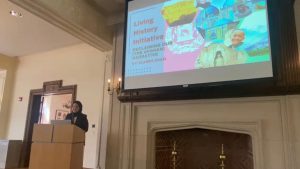
My presentation to member of WashU’s History Department
Within the first few months here, I attended the Undergraduate Research Symposium, talked with representatives of URF, and set up a meeting with Dean Lang, the director of URF. I cannot stress enough how helpful and key URF and their advisors have been in helping my research about my community. Given how most of my work is led by myself, I spoke with Dean Lang about suggestions she would have about advancing my project and applying to fellowships for support. Dean Lang’s advice and encouragement led me to apply to multiple fellowships, including the Mellon Mays Undergraduate Fellowship and the Laidlaw Program.
I was accepted into these programs, and I am ever grateful for all the advice, information, resources, and support I have received from these two programs. As a Mellon Mays fellow, I have been able to learn about various parts of a research scholar’s journey through weekly seminars and support from Dr. Brandi Summers, our faculty mentor, and Kathy Perez, our graduate mentor. The Mellon Mays funding and support has also allowed me to greatly advance my research by attending conferences and also looking deeper into different aspects of Afghan history and culture, allowing me to prepare for my upcoming senior thesis, which I will be writing through the History department. On the other hand, the Laidlaw Program, spanning two summers, has allowed me to advance my research through giving me support to do interviews, historical research, and also get IRB clearance for my project, Reclaiming Our Narrative. This was key for my research, allowing me to publish my work and the interviews I have done as formal research. My only advice for getting IRB clearance is having much patience and starting as early as possible, as the process takes a while, especially if they request additional revisions. Furthermore, through both of these programs, I was able to push myself to find mentors for my research. I have been blessed to get much support from faculty at SIPA as well as Columbia College. Something I would like to warn any others who want to launch their own research and get IRB clearance is to ensure they find a full time professor and faculty mentor as an advisor, as the IRB does not accept certain faculty as PIs, something I learned the hard way unfortunately. Furthermore, for IRB clearance, I would greatly emphasize talking with professors and graduate students as well to help in the process. I want to extend my deepest gratitude to Skylar Kaat, my Laidlaw graduate mentor, and Professor Ali Karjoo-Ravary for helping me with my IRB clearance. If I have been taught anything over the past three years as a student researcher, it is to use the resources and support we have as students at Columbia University, especially our amazing scholarly community.
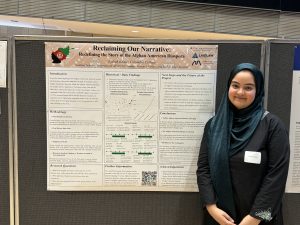
My Poster at the 2025 Undergraduate Research Symposium
I had many doubts coming into Columbia about the future of my work as a researcher, if I would succeed, or if I could even gain funding/fellowship support. Now, two years later, I can say that if you actively seek these opportunities and put in the work, you will find the opportunities meant for you and receive the encouragement needed to succeed. My journey has shown me that there are always people ready to help you in every rough patch. If you want to start your own project, get a fellowship, or anything else research-related, I strongly encourage you to schedule a meeting with URF advisors, which you can find here, and look into opportunities yourself through URF’s database. Furthermore, your professors, any graduate students you know, and your fellow undergraduate researchers are all people who are most likely very willing to help you in your journey, so reach out and speak with them. I hope that every student researcher at Columbia recognizes the vast amount of support available and takes full advantage. I am forever grateful for what I have been able to learn and achieve through all the support from Columbia’s research community.
Elaheh Khazi, CC’27