
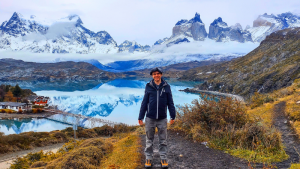
Photo Credit: Harrison Gerson
My summer research abroad as a rising junior (2023) provided me with the confidence to pursue international research within the social sciences. As a Laidlaw Scholar, I worked with the Tourism Federation of Chile to develop their sustainability guidelines. Here’s the process that made my research successful:
Feeling ‘Comfortably Uncomfortable’ Abroad
Comfort is vital to the success and learning of you and your partners. On the other hand, many see entering a new, different space as an incredible learning opportunity. With this in mind, my experience was ‘comfortably uncomfortable;’ I was physically safe and intellectually able to contribute while being outside of my comfort zone in a way that places the least additional burdens on the community.
From my perspective, Chile was the best fit for my research. Here’s why:
- I wanted to conduct research in a less foreign language I speak (Spanish or French).
- I wanted to explore outside of North America and Western Europe.
- The country needed a growing tourism and environmental scene for my research to gain momentum, with little prior related research.
- My safety precautions should not impede my ability to live and work.
Chile, a Spanish-speaking Latin American nation, provided a safe living experience for someone who had never traveled to the region. To prepare, I searched everything online – Chilean history, pop culture, my neighborhood, Santiago transportation, my internship organization, etc. I arranged an AirBnB Room, which worked like a homestay, which led to greater cultural engagement and safety.
Coming from a privileged university and standard of living in New York, maintaining awareness of the space I take up as an outsider to Chile was vital. Many programs abroad push the narrative to leave your comfort zone without providing support to the community that you impact; I want to restress that strong ethics foster success. I carefully considered the impacts of my research findings on Chilean communities in and around tourism. Asking those (who find value in being asked) for feedback on your impact is incredible. For me, this meant asking locals and businesses how specific policy recommendations would change their lifestyles.
Asking for Support
Learning what and how to ask for help can be challenging, but knowing that you need help is a strength. In Chile, Columbia Global Centers | Santiago provided valuable living logistics and answered urgent questions – and questions I didn’t know to ask. The Center connected me with my research position, and I visited the Global Center staff throughout my stay. While I paid more attention to safety in Santiago than at home, I lived and worked in safe neighborhoods and felt comfortable with my surroundings. I also asked the Undergraduate Research and Fellowships Office, Undergraduate Global Engagement, and the Global Center for contacts of students who studied in Chile. I chatted with three students in the months and weeks before travel: one by phone; one over lunch; and another over email. These conversations provided recommendations on how to get around, local student communities, and some culture shocks for me as a New Yorker. This knowledge made me feel comfortable upon arrival, which prompted my success.
Moreover, in my preparation, the Columbia Global Core requirement provided the space to learn how to learn about Chile and its tourism and environment. In my Hispanic Cultures Global Core, the coursework challenged me to research in Spanish, learning how to read and search for complex documents. Moreover, my interests in tourism and the environment propelled my final papers, which increased my confidence in the field. The Global Core, as well as Art and Music Humanities, provided me with a strong universal vocabulary and historical understanding, which provides a lens to begin to understand places I research in Chile and beyond. I frequently message my professors to ask about places to visit related to my coursework before travel. If interested, Completing the Core Abroad, as Chase explains, can further enrich your learning and preparation to research abroad.
Maintaining Connected after the Program
After leaving the field, I strongly recommend that you maintain conversations with those who support your research process abroad. A year later, I remain in contact with my research peers, which they appreciate, and I Whatsapp my AirBnB host and the Global Center. I recently supported the newest cohort of the Kraft Global Fellowship in Santiago, providing logistical advice to the Center and students as a former Senior Fellow. While this support indirectly relates to my research, assisting future collaborations feels incredibly rewarding, and you never know when you may need the continued connection – for me, I will continue working with global center staff for my thesis!
Research abroad is incredibly rewarding. Preparation and seeking support from Columbia resources and beyond fosters smoother, more impactful experiences and contributions.
Harrison Gerson CC ‘25