During his rule, Augustus and his close friend and general, Agrippa, successfully conquered and established peace with Spain and Gaul. In order to honor their successes, the Senate commissioned the Ara Pacis, also known as the Altar of Peace in 13 B.C. Their foreign military success was extremely significant because Rome was continuously plagued with foreign conflicts up to this point. Augustus and Agrippa’s establishment of peace, which became to be known as Pax Augustua, became a defining feature of Augustus’s rule, as it was one of the longest periods of peace the Roman Empire had known. This is largely the reason why Augustus was one of the most beloved emperors of the Roman empire. In the Ara Pacis, Augustus was able to portray himself in a way that defined his legacy, as a great ruler, but also a man of modesty.
In an attempt to make the monument as prominent and visible as possible, the Ara Pacis was strategically placed between the Via di Ripetta and the Tiber River. Travelers, traders and ordinary Roman citizens would have easily seen the Ara Pacis when traveling on the Tiber or the Via di Ripetta, which was a main road in the ancient Roman city. The Ara Pacis itself is fully carved out of luna marble and is covered in reliefs, both in the interior and in the exterior. The reliefs on the exterior are particularly important in defining what this monument meant for Augustus’s legacy. The West and East walls contain the openings that serve as the entrances and exits. Theyportray mythic themes relating to Augustus’s lineage. The North and South portray scenes of a quotidian procession.
Implications on Augustus’s Rule
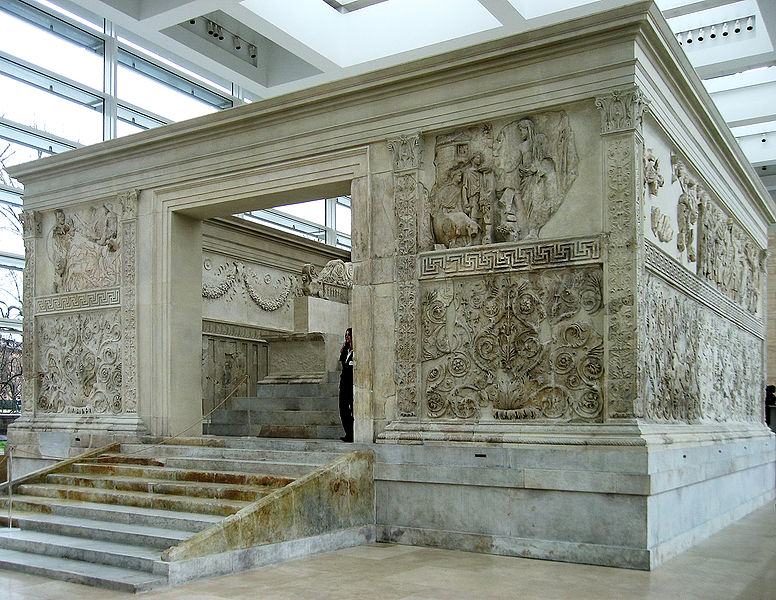
Image taken from http://upload.wikimedia.org/wikipedia/commons/e/e8/Ara_Pacis_Rom.jpg
Sources:
http://www.bluffton.edu/~sullivanm/italy/rome/arapacis/arapacis.html
Charles B. Rose, “Prince’s and Barbarians on the Ara Pacis,” American Journal of Archeology 1990