- Inclusive Discussion Guidelines
- Writing Rubric
- Final Project for Spanish Intermediate II
- Creative Final Project for a Survey Course
- In-Class Assignment
Inclusive Discussion Guidelines
This assignment has been used both in language and content-based courses. My main learning goal is to foster an inclusive environment that belongs and works for all.
Here is a detailed outline of how I proceed:
- Before class
-
- I ask all the students to email me their response to the following prompt: “what an inclusive classroom / inclusive learning environment / inclusivity means to you.”
- Then I print all the statements on separated pieces of paper and take them to class.
- In class
-
- I pair students and randomly distribute among all the statements they had shared with me.
- I ask them to read these statements in silent for a minute and then discuss with their partners specific ways in which we, as a classroom, can tackle the issues touched upon.
- I specify that their statements were a sort of general strategies to think about inclusivity, and that I want them to focus on particular tactics to apply to our classroom.
- Once all the pairs are ready, we begin to share with the whole group. I am in charge of taking notes of everything they say on the board as a way of organizing their thoughts.
- After class
-
- I open a board on the LMS in which I summarize the reflections in a Dos / Don’ts list that I leave opened for comments in case the occasion arises.
- I ask students for an update at least once in the semester.
Writing Rubric
This rubric has been prepared to grade every written assignment in Literature Humanities (2019-2020), a 110-minute seminar required for all first-year students that meet twice a week with 17 students.
I am considering three categories: textual analysis, thesis, and written expression; depending on the levels of performance for each category, I would grade the assignment as exceptional, good, fair or needs improvement. Each category is defined in a way that allows students to see the areas they need to cover to be successful in their assignments. In addition, I make them focus on the reader’s perspective as a way to test and reflect upon the readability of their essays.
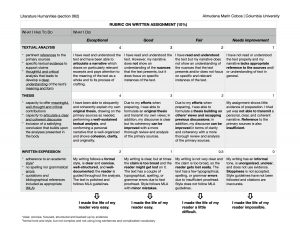
A pdf copy can be downloaded here.
“Thinking Communally:” A Creative Final Project Based on the Use of L2 as a Critical Tool
For the semester project of this advanced L2 course, grounded on community content, students participate reflectively and creatively in different communities by using L2 as a critical tool.
Throughout individual work, they test new linguistic contents corresponding to topics relevant to each project’s step. Throughout collaboration, they bring about genuine communities with their peers by brainstorming ideas. Ultimately, given the public outreach of the project, the creation of an online public platform enables students to share and spread their final products beyond the classroom.
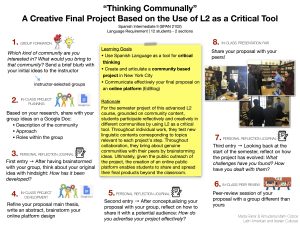
A pdf copy can be downloaded here.
“Ditch” the paper: fostering conceptual thinking through video-creation
For the final project of the survey course Hispanic Cultures II, we decided both to eliminate the traditionally-inspired final paper and to put forward a collaborative and creative task based on video-production.
Students were required to write a script and to record a short film (7-10 minutes) along with a written individual reflection. The purpose of this assignment was to make students put into practice their own creative capabilities in order to analyze the course’s core concepts. As for the course grade, the group work counted 15%, while the individual reflection was up to 15% of the final grade.
To the purpose of generating a series of soft skills via creativity, collaboration, and individual reflections, we tailored a timeline so that students worked on the project throughout the semester. In this regard, students were able to follow-up their own work-in-progress with both classmates and instructor through brainstorming class-sessions. In the last day of class, we planned a group-viewing and peer-evaluation among students. We valued the originality and relevance to the topic of the course, as well as the grammar accuracy of the texts produced.
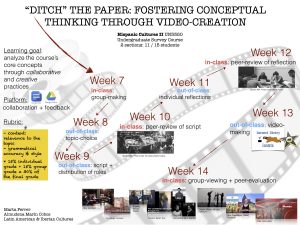
A pdf copy can be downloaded here.
Protest Song in the Hispanic Worlds: a Graphic Report
This in-class assignment was used in the survey course Hispanic Cultures II: Mapping Disenchantment during Spring 2017 at Columbia University, a 75-minute course that met twice a week with 6 students.
It illustrates my approach to active learning in the classroom with specific examples of students’ engagement in their learning processes. For the greater part of this class session, I designed an activity that fitted two of my learning goals for the course: 1. to understand the interdependence between socio-political events and cultural production, 2. to examine cultural artifacts and objects as ways of analyzing its political and aesthetic regimes. This class was a continuation of the study of the dictatorships in Latin American and the movements of protests that arise in the Hispanic world in the 60-80’s. From the previous session, students were already aware of the context (factual knowledge) and had already analyzed the cultural production in Argentina (conceptual knowledge). For this session, students were expected to deepen their knowledge in the protest genre through the examination of its political and aesthetic regimes (procedural knowledge). Once they had digested the information, students exposed it to the classroom through a short presentation with the help of a self-crafted collage. This is a collaborative assignment because it requires collective brainstorming and imagination, and because in that way students were able to exchange and comment on their own ideas, comparing and contrasting points of view.
Find here a detailed outline of this assignment:
a) [2-3 minutes] Students are briefly introduced in the topic through a short powerpoint presentation that underlines the connection to the previous class and summarizes today’s task.
b) [10 minutes] Students will work in pairs (3 groups). They are given two songs without any information on the author or date, just the lyrics. First, students are expected to silently read the lyrics, underlining words or expressions that refer to the topic the song is dealing with and taking notes of their first impressions. Having done the reading, students are encouraged to discuss with their partner following a prompt with the aim of gathering as much information as possible about the songs. They also need to begin thinking why the assigned songs have been put together—what do they have in common? A Spotify playlist will be played in the background to make students aware of the rhythms of their songs.
c) [10 minutes] Students are given a few images that are related to their songs. Images are mixed, so each pair needs to determine which images better fit their songs and what they depict. Each pair has to choose seven images and write a descriptive caption for each, justifying and explaining their choices. If students still need information about the context of the song, they can check the web to complete it.
d) [10 minutes] Now that they have all the information, students are given a blank paper (medium poster-size) to put together a collage in which they include at least 3 images of their choice and the main data of the song. The disposition of these elements should illustrate the narrative they wish to transmit.
e) [5 minutes] Finally, students are asked to briefly present the poster to their colleagues, highlighting the context and how the assigned songs speak about it.
With this activity, I aimed to foster students’ engagement with the subject matter of the class by building on their capacities as creators and transmitters of knowledge. Students are given a cultural object and are led through the analysis that will ultimately allow them to organize and produce information around a cultural manifestation. Metaphorically speaking, they had to assemble the puzzle and forge a narrative that reveals its cultural nature. As for the grading, this assignment is included in active participation, a 20% of the final grade. Their participations are expected to be meaningful and well-thought, and the final poster will be the proof of their success. I was not measuring any particular creative skill here, but their ability to comprehend and transmit information on cultural events. I walked around to assess group participation and interaction, and to help or clarify if needed.