Advanced Language Through Content: Underground Iberia
Undergraduate seminar, particularly thought for students that have finished the Language Requirement and are ready to continue exploring L2 from a content-based perspective. Class met twice a week for 75 minutes.
 The history of a country is made of an established version as well as of many parallel tales that collect the micro-histories of different kinds of people. These accounts continuously challenge the official vision. The purpose of this course is to delve into the telling of the Spanish transition to democracy exploring a series of underground (marginal) artistic practices that focus on a wide variety of genres—film, photography, media, fiction, non-fiction, music, comic, etc. Analyzing the rhetorical devices these objects call into question will be helpful to reconstruct how the pre-democratic Spanish subjectivities claimed themselves to belong to a Spain that never happened. This, therefore, will be the cultural history of an invisible Spain.
Click here to view a PDF of the full syllabus.
Modern & Contemporary Hispanic Cultures: Mapping Disenchantment
Undergraduate seminar required for the major and the concentration in Hispanic Studies. Class met twice a week for 75 minutes.
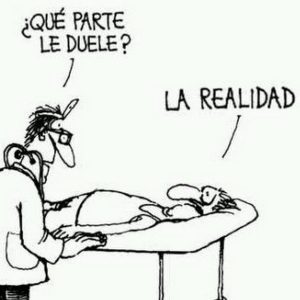 The objective of this course is to provide students with the historical and cultural background and fundaments necessary for the study of Hispanic Cultures in the context of modernity. During the semester, we will study a good array of artifacts with the purpose of acquiring the knowledge of key socio-political events and cultural production that have taken place in the Iberian peninsula and Spanish America from the 18th to the 21st centuries. We will discuss cultural objects that may challenge for a variety of reasons the notions and implications of the idea(s) of disenchantment. This course will propose a review of the feeling of disenchantment from 18th century onwards, opening a twofold discussion. On the one hand, we will focus on how this very concept affects and has an effect on how people react and relate to the world around them; on the other, we will explore disenchantment as a construct that intertwines, waxing and waning, with cultural logic and practices.
Click here to view a PDF of the full syllabus.
The Spanish Transition: From History to Memory and Back Again
Graduate research seminar that would meet once a week for 2 hours, for 14 weeks.
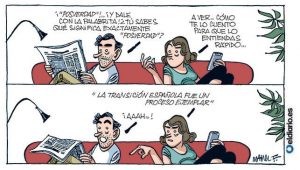
This course explores processes of memorialization in modern post-dictatorial societies, particularly focusing on the case of Spain. When the dictator Francisco Franco died in 1975, the so-called “Spanish Transition” began, an event that marked the end of the dictatorship and the start of a new democratic era. Therefore, in this course we wonder: how do Spaniards remember this transition from Franco’s dictatorship to a European democracy? How do these memories shape and challenge the historical and cultural discourses of the transition? During the semester, we will analyze an array of contemporary cultural artifacts—autobiographies, documentaries, comics, TV shows, museum exhibitions—with the purpose of uncovering the mechanisms that produce cultural memory in Spain.
Click here to view a PDF of the full syllabus.