
[youtube]https://www.youtube.com/watch?v=xHN8wCNVZQo[/youtube]
The most important part of this lecture occurs around 52:00 where there is a discussion of the virtual wall algorithm.
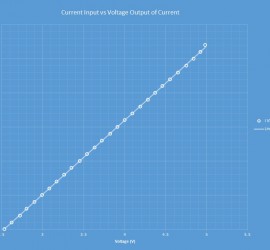
To test the current sensor an arduino, a multi-meter and a current source was used. To calibrate, the offset and the gain was first configured. With no current on the sense lines, the Vref was adjusted to read about 2.5V (actual valued used was 2.52V) on the sensor output line. A known […]
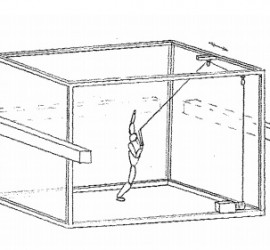
Patent number EP2251767-A1 is another interesting find in our patent search. It has the potential to be an extremely affordable system since it only uses one motor. This makes it viable as a game control for a tennis simulation or rowing simulation, for example. The article kept bringing up the load […]
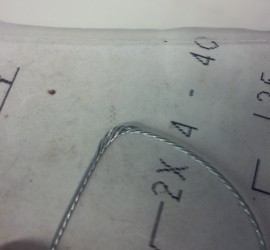
During routine testing of the design, we noticed that the knot tied at the end of the fishing line to secure the line to the spool dug into the plastic of the spool, causing minor damage. We’ve solve this problem by ending the string around a washer.
[youtube]https://www.youtube.com/watch?v=xHN8wCNVZQo[/youtube]
The most important part of this lecture occurs around 52:00 where there is a discussion of the virtual wall algorithm.
While browsing the web, we’ve found out the Stanford has two classes on haptics. ME 327: Design and Control of Haptic Systems CS 277: Experimental Haptics
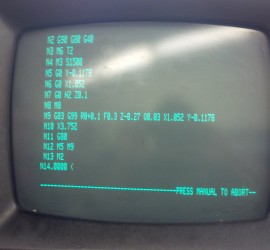
The shop was a bit crowded today, so we have to machine on the old school Fadal machine. Using this machine is a test of skill has it uses pure Gcode as opposed to the conversational language the Fryer mills use.
We’ve competed assembly on one of the three Motor and Spool Sub-assemblies and we’ve discovered a few problems in the design. 1) The set screws are not holding onto the main shaft and are likely to be striped since the thread are made of plastic. Solution: Drive a pin […]
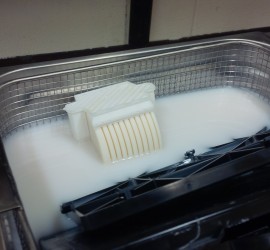
We 3D printed our first spool today. It’s amazing that the spool comes out of the machine ready to use, no filling required. To remove the support material, we must soak the part in a base bath for 24 hours.
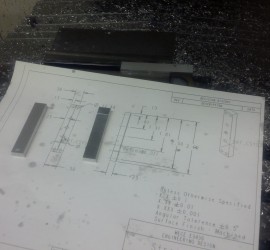
This is one of the last pieces. The plate goes between the two eyelet plates to support the strain gauge system. We are almost done! Woot! Also, 1 to 1 scale drawings are cool because one can put the part on top of the drawing and have them match up.