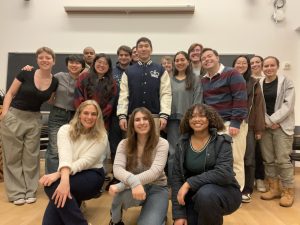
Our Fall 2025 Field Methods class! (Photo credit: Professor Meredith Landman)
One of the larger Columbia-induced changes to my thinking has been an interest in the process of knowledge production. This has been stimulated by my experiences in the Core, which helps us to wonder, for instance, how our understanding of matter got from Aristotle’s four elements to the Higgs boson. This interest has also been stimulated by my senior thesis process, which has involved reading, taxonomizing, and engaging with several swaths of scholarship. I have been surprised at how rapidly scholarship can develop within a decade, let alone a century. Essentially, I have realized that no piece of knowledge should be taken for granted, and that all ideas have an origin point. In realizing this, I’ve also begun to wonder where widely-held ideas come from, how some ideas dominate, and how different groups of thinkers interact with each other.
Aside from senior thesis and the Core, my best window into this problem has come from a linguistics class called Language Documentation and Field Methods. This is an amazing class, and easily the culmination of my years as a linguistics major: over a semester, we worked with a native speaker of an under-documented language to learn, study, and describe the language in linguistic terms. I loved this class so much that I took it twice, both times working with a native speaker of Kalmyk (a Mongolic language spoken in Russia, China, Mongolia, and the USA’s east coast). The goal of this course is to teach the methodology of language documentation, which is a vital task of linguists given that most of the world’s languages are currently endangered.
My classmates and I had zero knowledge of Kalmyk when we started in Field Methods, and our task was fundamentally to figure out as much as possible about the sounds, mechanics, and syntax of the language. In this process of building up our knowledge from scratch, we frequently disagreed with each others’ perceptions and interpretations; we originated debates, trends, and different camps of thinking. In other words, class ended up being a microcosm of knowledge production. On a very small scale, I witnessed the kind of “history of ideas” we all study in the Core curriculum. I could schematize it roughly like this:
- Perceptible phenomena – in the first weeks of our class, we attempted to describe the sounds of Kalmyk. We primarily relied on our ears, and our disagreements were based on our individual perceptions. Our goal was to identify the basic elements (i.e. the phonemes) of Kalmyk. Our disagreements stayed at the level of perception.
- Imperceptible phenomena – after listening for the important sounds of Kalmyk, we worked to identify grammatical components of the language. We used our ears plus our analysis to identify which combinations of sound signaled (for instance) the accusative case. We compiled examples of the accusative case to speculate about the meaning of the accusative in Kalmyk, and the possible uses of this morpheme. Our disagreements now involved analysis and counterexamples; at the same time, we also began putting aside our perceptual differences in order to better understand these “beyond-the-surface” puzzles.
- Mechanical phenomena – we spent the last weeks debating the mechanics of Kalmyk. For example, we tried to explain the origin of the accusative case within Kalmyk grammar: is it assigned syntactically, or based on the noun’s semantic meaning, or in some other way? Our disagreements were now based on theories of how accusative case should work. In this stage, we also broadened our scope of counterexamples, going beyond the data to consider how Kalmyk may have developed over time, how other languages may assign accusative case, etc.
There are similarities here to the intellectual arc we witness in the Core. To paint with very broad strokes: in Art Hum, we begin by looking at art interested in capturing, affecting, and reproducing our perceptual experiences as humans. An example would be the Greek statue Laocoön, which depicts an anatomically-recognizable father, sons, and snakes undergoing the familiar pain of loss. Later in the semester, we examine art with imagery that is less recognizable but equally affecting, such as Picasso’s Guernica. We end with art that is self-referentially interested in the purpose or theory of art, such as Basquiat or Warhol. Similar subdivisions could be made of the Music Hum curriculum, which takes us from Hildegard of Bingen to John Cage, as well as of Lit Hum and CC.
It would be an oversimplification to imply that knowledge progresses or evolves; of course, one piece of art or scholarship can pursue all three of these types of inquiry simultaneously, at any point in history. This kind of integration could actually be something to strive for. Still, I’ve enjoyed considering where ideas come from, and how conversations about ideas can move between observations, deductions, and theoretical conjectures. The microcosm I witnessed in Field Methods has helped me in my senior thesis: in reading about 16th century Latin American history, I’ve seen that new observations can shatter old theoretical conjectures, and I’ve noticed that whole scholarly careers can be devoted to bringing these observations to light (and then, subsequently, to making deductions and theoretical conjectures from those observations). Certainly, it’s been valuable for me to understand ideas as products of a process, and to consider the origins of knowledge I might normally take for granted.