
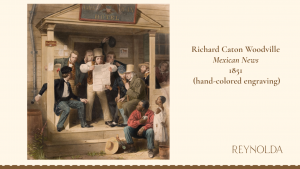
A screenshot from Virginia’s museum tour. Photo Credit: Virginia Ignelzi.
In the spring of 2021, I attended a virtual undergraduate Classics conference and presented my research on Lucian of Samosata, a 2nd Century Greek satirist. In my paper, I focused on a text called On salaried posts in great houses, exploring the nuances and layers of Lucian’s social critique. At this point, the eyes of all non-Classics students might have already glazed over. In other words, this is a very esoteric topic that few would find interesting or relevant to their daily lives. In fact, even I initially struggled to connect this very niche research interest with the rest of my life. I certainly enjoyed the process of researching and writing and found the topic interesting, but would this research ever be used? For months, my recently-gained knowledge sat in the back of my mind, gathering figurative dust. I do not think I am alone in experiencing this frustration. Research topics are often incredibly specific. Sometimes, the “real world” application of a certain project is not immediately evident. In that case, it can be tempting to dismiss the whole endeavor as useless.
But I do not simply want to diagnose the problem of seemingly “useless” research, but rather talk about how I addressed the issue. At the beginning of this past summer, I had the good fortune to be hired as an education intern in a medium-sized American art museum. In my role, I was tasked with designing tours for school children that would incorporate the works of the museum’s collection and impart important historical lessons. The final product of my internship was a Manifest Destiny-themed tour for high school students, featuring visual and primary source analysis.
While designing this tour, I realized that it was precisely my “useless” research that had prepared me for the task at hand. The careful primary source analysis that I used to dissect Lucian’s work was exactly what was needed for my current project. While putting my tour together, I had to examine a variety of primary source documents, carefully analyzing the language. For instance, one tour activity asked participants to read and analyze a dense, 19th century text. Decoding the text, presenting it in accessible terms to young audiences felt familiar. Even though I was no longer writing about an Imperial Greek author, the skills I gained from my research project were certainly transferrable.
And it was not only primary source analysis skills that carried over from my work on Lucian. While making the tour, I had to use clear, lucid language to get my point across, just as in my original research paper. The museum tour was meant for high schoolers, so the script had to be concise and easy-to-understand. During both the original research project and the tour creation, I had to work hard to convey difficult concepts in simple terms, terms that could be understood by someone who had a limited background in the subject at hand. To reiterate my original point, research, even highly specialized topics that may have a limited audience, allow the researcher to develop skills that are often widely-applicable.