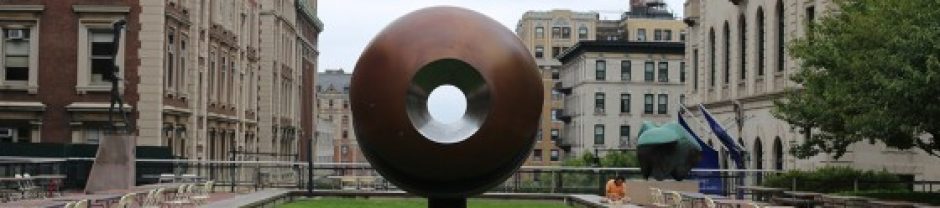

Library. Photo Credit: Stewart Butterfield
“As the stars made themselves visible, Milkman tried to figure what was true and what part of what was true had anything to do with him.”
― Toni Morrison, Song of Solomon
As a transfer student, the arrival to Columbia can often be accompanied by a whole flurry of emotions––uncertainty as to where one might fit into the social fabric; anxieties related to life in New York City; confusion exacerbated by a new environment and the many wonderful quirks that make Columbia our collective home. With that said, one of the largest adjustments that comes with a transition into Columbia is enrollment in our proverbial academic tradition: the Core Curriculum. As a student who had only been introduced to the Core through admissions brochures and information sessions with members of the Undergraduate Recruitment Committee, my knowledge of this robust intellectual framework upon my arrival to Manhattan was limited. However, it is both a unique and beneficial aspect of the Core that students of all academic backgrounds are thrust into its arms in their first weeks on campus.
While transfer students do not traditionally participate in the quintessential Literature Humanities lecture held during the annual New Student Orientation Program, they are as much a part of the Core Curriculum as any one first year student. My Literature Humanities course, taught by a postdoctoral lecturer with a penchant for sweeping tales of romance and the Hungarian Pastry Shop, was both academically stimulating and offered a wonderful way for me to immerse myself into the colloquy of the Columbia classroom. Engaging in dynamic conversation with my peers, I slowly came to realize the many elements of education at Columbia that make the Core Curriculum so unique — especially having come from a separate institution, where general distribution requirements were quite different than those of the Core.
In a similar fashion, I was especially moved by the integration of New York City and the arts into the curriculum for Art Humanities and Music Humanities, given the ways in which I sought to incorporate the location of Columbia into my own transfer experience. From performances of The Marriage of Figaro at the Metropolitan Opera, to involved ruminations on Dante at the Metropolitan Museum of Art, I slowly came to appreciate the proximity of my Columbia experience to Manhattan––thus assuring me that my decision to transfer was the correct one.
In this way then, the Core Curriculum is as much a part of Columbia’s history as it is a fundamental part of my own experience as a transfer student. Shaping both my intellectual relationship with the University and my broader connection with both Manhattan and beyond, the Core continues to offer me the opportunity to see the world and my own role in it through a nascent lens. For that, I am certainly grateful for my decision to transfer.