
“Listen to me, my son, and acquire knowledge,/and pay close attention to my words./I will impart instruction by weight,/and declare knowledge accurately” (Wisdom of Sirach 16:24-25).
There’s an interesting moment in one of Shakespeare’s sonnets where the narrator states:
As fast as thou shalt wane, so fast thou grow’st
In one of thine, from that which thou departest; And that fresh blood which youngly thou bestow’st Thou mayst call thine when thou from youth convertest. Herein lives wisdom, beauty, and increase;
Without this, folly, age, and cold decay (Sonnet 11:1-6).
The narrator here writes about the subject, a mysterious young man, who is choosing to put off the responsibilities of maturing and having children for the pleasures and allurements of youth, all of which lead him away from cultivating his natural gifts by procuring offspring. The narrator considers this promising man’s choice to be a great dereliction of his duty to nature to live a life of “wisdom, beauty, and increase,” all of which leads away from the “folly, age, and cold decay” of dissolute living. Biblical language, from which this sonnet draws, expresses this point in even more stark terms.
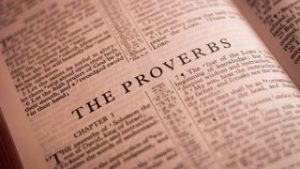
The Book of Proverbs, Photo Credit: Proverbs an Overview, CPH.ORG
Indeed, as Proverbs states, “Wisdom is a fountain of life to him who has it, but folly is the chastisement of fools…There is a way which seems right to a man, but its end is the way to death” (Prov. 16:22, 25). In the Book of Proverbs, the reputed figure of King Solomon of Israel wishes to inspire his younger son to remain steadfast to wisdom, acquiring it, and cherishing this possession as the great guide to his life in the face of the temptations away from this arduous but fulfilling path. The older man, perhaps drawing from his own mistakes, begs his younger son not to trust the elusive seductress, an allegorical figure for deception and vice, but rather to take stock in “a good wife,” who “is far more precious than jewels” (Prov. 31:10). Like Shakespeare’s boy, the youth addressed in Proverbs is told to not trust his appearances, and rather to rest on the sure way to success and fruition.
Often in our classes on the great books at Columbia University, we fail to recognize that the intended or ostensible audience are like us, both in youth and in inexperience. Despite every college student’s insistence that he knows the world, there lurks in his mind a great fear of almost everything, but a simultaneous desire to overcome this pre-experiential fear by learning how to live well and putting such knowledge into practice. Most, say Shakespeare and Proverbs, fall away from this path and sadly remain estranged from it. Some, however, seek out “Lady Wisdom” and find her. Right living, if it is “more precious than jewels” and contains “wisdom, beauty, and increase” should be on the top of our minds when we read the books in the Core. But, if it requires a conversion from youth (“when thou from youth convertest”), how can we walk with the authors featured in the Core Curriculum to bring about this change in ourselves and with each other?
This question of right living or the “good life” is a fundamental issue that the Greek philosopher Aristotle engages in his Nicomachean Ethics, defining the right life as directed toward happiness understood as fulfillment, or eudaimonia. This life is a life of arete, an excellence of life, because this state of being is both complete (is that “for the sake of which” we undertake all actions in life) and is self-sufficient (meaning that it satisfies and is “choiceworthy and lacking in nothing”) (NE, I, 7). Happiness is defined as a good for man and an “activity of the soul in accord with virtue” (NE, I, 7). It is described by Aristotle as a divine or blessed state, one which grants the happy man continued fulfillment and purpose, and a life well-lived.
This question re-emerges in other authors in Contemporary Civilization and beyond within the Western Tradition. We find in the works of the eighteenth-century figures of Adam Smith and Jean-Jacques Rousseau, for example, two conceptions of proper living which differ in some respects from the Aristotelian conception of the good life. Both philosophies, however, dialogue with the concerns of man’s self-love and the problem of how to build systems of governance which avoid the temptations to vice and other societal ills that occupied their precursors in antiquity. Even prior to the figures of the Enlightenment, outlining a system of ethics was a central preoccupation of the medieval figure St. Thomas Aquinas in his Summa Theologiae and of other medieval scholastics. In Prima Secundae Partis, Q3, Art. 8, Aquinas states emphatically that the highest good of man is contemplation of God (the summum bonum, or “highest good”): “Final and perfect happiness can consist in nothing else than the vision of the Divine Essence.” It is this vision that grounds his ethics with its commitment to natural law and biblical revelation, and therefore grounds his praise of the virtuous man as an ideal stemming from his conception of Christ as the incarnate logos, or “wisdom,” of God. More generally, the life of a man well-lived, as Aquinas notes in- line with Aristotle, cannot be removed from questions about his ultimate end or purpose, that which ought to bring him to true fulfillment.
I think we find in these authors a desire to inform or advise those who may be inexperienced in the affairs of the world, and who may desire some formation which will avoid the inevitable pitfalls that befall people who dwell exclusively on the passing things of the world. We want something that will ground us and which avoids the constant nuisance of social media with its frivolous entertainment. As Columbia students learning from the Core, we can encourage one another with careful questions to be open to these questions, to formulate better questions, and to enter into the dialogues of preceding centuries, where wisdom “more precious than jewels” just might be found. If these thinkers can, in their wide knowledge and understanding, can write what they wrote, perhaps we can help each other read and reflect on what they handed down to us.