
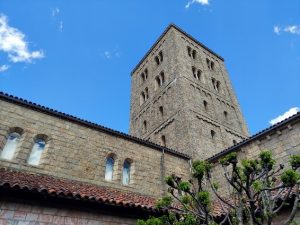
A picture from the Met Cloisters, which the author wishes he had visited before senior spring. A bonus piece of advice: take more advantage of free student admission to museums. Photo credit: Ardaschir Arguelles, 2024.
Since this is my last post on this blog, I thought it would make sense to talk about some
of the principles that guided me to this point in my college career. I am graduating with a double major in Classics and East Asian Studies, having completed a thesis for each major. Amongst Rose Research fellows, a double-major in the humanities is nothing unusual – but since my last few posts have often addressed questions of discipline, creativity, motivation, and so forth in the abstract, I want to take some time to discuss practical principles that have been personally helpful for me in navigating two intensive reading- and writing-heavy majors. My hope is that the three principles I discuss below will be of value to anyone considering a similar track.
My first piece of advice, then, is this: get started with languages early. Again, this advice
is somewhat field-specific. If you are planning to go into the sciences or math, perhaps languages will be less immediately relevant to you. But knowing another language is never a disadvantage. If you have even a vague sense of wanting to do work in some field of the humanities that is not, say, exclusively 19 th -century American literature – or even if you don’t know what you want to study at all – I recommend jumping into a language. I took Latin in my freshman year less because I wanted to study Classics per se (I didn’t, at the time), but because I was committed to the humanities, and I knew that Latin would be essential for the sort of historical work I was aiming to do. I did end up majoring in Classics, but even though I don’t intend to continue Classics research at the graduate level, being familiar with Latin and Greek opens many doors in historical and textual research. So start with a language, ideally one with many potential applications. If nothing else, you will complete the language requirement early – and at best, you will have a very versatile addition to your scholarly toolkit.
My second piece of advice is this: write. This goes for anyone, in any field, but is
naturally most practically relevant for those in the humanities. Write every day, if you can. Write different things – not just academic papers, but fiction, poetry, reflective essays. Consider writing by hand, too. Finding a notebook and pen you enjoy using will not only change the tactile experience of writing, but it will also change the way you think, and shield you from the distractions that are so readily available on any electronic device. So write. I can think of few other disciplines that have proved as formative in the development of my thinking throughout my college career. Recording insights from classes or from late-night conversations with friends; synthesizing various facts and ideas and characters in short stories; trying to pin down a few of the million fleeting experiences of being young, and a student, and in New York City, by writing poems – that is a practice that will pay off a thousandfold, academically and otherwise. If nothing else, the habit of putting your thoughts into words on paper will at least be of great value when it comes time to tackle longer projects, like a senior thesis. My thesis for the EALAC program ended up being 73 pages long, and somewhere in the realm of 23,000 words. Though the writing process was often grueling, it was a comfort to know that in my sophomore year, I had finished an even longer project, a 27,000 word novella, on my own time. Getting used to
writing often will make the process of writing longer pieces more manageable.
My third and final piece of advice is to set goals for yourself – and then make sure you
have structures in place to achieve those goals. I put emphasis on the last point because
willpower alone will only take you so far. I remember one summer when I told myself I was going to self-study Korean to the point where I could place out of the language requirement for the EALAC major. I failed miserably, and ended up having to make up that language requirement in other ways – a story I have told elsewhere, and on the whole a much more enriching experience. I bring this up because the advantage of being in college is not just that you have so many opportunities to learn, but that college provides the structures to achieve those goals, structures that can be much harder to come by later in life. In other words, although classes and deadlines and exams can be a pain when you are in the thick of things, in the end they make sure you keep showing up, and don’t keep putting things off. And joining a class or a club makes things much more manageable for you than if you needed to monitor all your progress yourself, from start to finish. So when you are at your freshest and best – say at the start of a new semester – feel free to set yourself reasonable challenges, to take those classes that are tempting but perhaps somewhat daunting. And then when you are in the thick of things come midterm season, do think back to your earlier passion (although you will have lost it by then) and
try and recapture some of it by taking advantage of the structures at hand.
(This last advice does not apply only to academics, of course, but to any other goals. You
can apply it to music, sports, and so on with all the extracurricular clubs available at Columbia. I suggest you apply this principle to rest. One of the most valuable practices I have taken in recent semesters has been of taking my Sundays completely off from schoolwork. While this was a goal I had in previous years, I wouldn’t have kept to this goal without the structural impetus of weekly church gatherings and of friends also aiming to meet the same goal, who wanted to hang out on Sundays).
To conclude, these are the three principles I would recommend to anyone who is
considering a humanities-heavy track. Start with languages early; write, every day if you can; and set goals for yourself in work and rest, making sure you have the institutional, social, and personal structures in place to meet those goals. Those are my parting practical suggestions, which I hope will be of benefit to rising philologists, humanists, and future Rose Research fellows.