Photo Credit: Rachel Smith
My LinkedIn recently reminded me that I have hit the one-year mark since starting my laboratory research here at Columbia. So I asked myself: over the past year, what have I learned? Not only about translation in prokaryotes (which I knew very little about one year ago), but also about research itself. What advice would I offer to prospective or new researchers? Two things come to mind: (1) ask questions, and (2) reflect.
The old adage says that there are no stupid questions. To my mind, at the beginning of a research experience, every question is stupid–or rather, uninformed– and smart. Every question is uninformed because you are just starting out––you don’t know what you don’t know. I can remember many of the basic questions that I asked my mentor. I once asked her the laboratory equipment equivalent of “Is a #2 pencil just a regular pencil?” I have asked her to explain what her project is, and how the different parts of her project fit together, about once a month since I arrived. And that’s just the tip of the iceberg.
At the same time, the practice of asking lots of questions is smart. Questions not only allow us to learn; they are vital to a research environment, where questions allow researchers to learn scientific theories and develop practical skills, and in so doing to embody the spirit of a research scientist.
That brings me to my second piece of advice: reflect. It’s really just my first piece of advice in disguise: ask questions not only of others, but also of yourself. What have I learned? What don’t I know? Where am I going? I reflect best when I write. So, when I started my research, I started a journal. Every evening, I would spend 10 minutes jotting down everything that stuck with me from that day. I also wrote down my thoughts and questions, hopes and fears. That journal is a mix of instructions for running gels, making buffers, and reading microscope traces; the rationale behind running toeprinting reactions and using slippery sequences; practical information, like the meaning of acronyms and location of the biohazard bin; and silly reminders about lab practices that identify air and secondary structure of RNA as “enemy #1,” and magnesium as “a friend.”
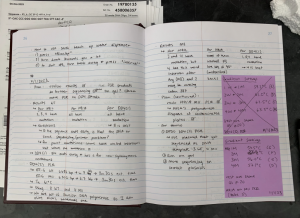
Later, I got my very own lab notebook. It is a living document, written in both blue and black pen. In it, I’ve written procedures, drawn diagrams, and made charts. Colored sticky notes poke out every few pages. The writing goes left to right and top to bottom; it curves and it slants.
I am a neat person. My lab notebook might sound messy, but that doesn’t bother me. Because research is messy. I am not talking about lab work itself––the dPAGE gels that harden on their molds if left too long or the powdery LB agarose that gets everywhere no matter how careful you are with it. I am talking about research itself. In research, your set of “facts” is constantly changing. Some “facts” may even turn out to be wrong. You assess others’ claims––and your own––with incomplete information. You don’t know everything, and you never will. And that can be uncomfortable for Columbia students, because we are not often exposed to the unknown. In the classroom, we learn from experts in their fields––people who know so much and can answer our questions. In the lab, there are some questions no one can answer.
But that is why research has so much to teach us. It teaches us to be comfortable with the unknown, and equips us with the skills to know the unknown. It also inspires us––it inspires me––to keep learning. Dean Emeritus of Columbia College, James J. Valentini, spoke repeatedly of “Beginner’s Mind.” My Contemporary Civilization professor and Columbia College alumnus, Sam Abrams, emphasized for a year that the Core Curriculum’s greatest lesson is humility. Both of these hold true for research.
Research encourages us to look backward and forward. When we look backward, we see how far we have come as a team of researchers. The number and scope of the discoveries we have made is astounding and inspiring. But we also look forward, in the direction of all that we don’t know yet. And you should be astounded and inspired by that, too. I know I am.
By: Rachel Smith