
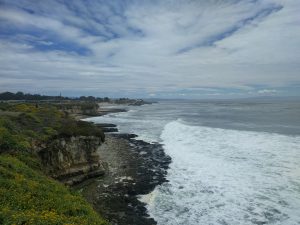
View from the lab trailer. Photo Credit: Sara Bell
I spent the longest summer of my adolescence in the company of more fish than people. There were mosquitofish, bass, alewife, three-spined stickleback, guppy, herring; fish that had been preserved since 2013 and fish that were euthanized early that morning; ethanol-soaked fish sitting in jars, dried fish in Ziploc baggies piled in the fridge, icy fish biding time in the freezer. Fish seemed to occupy nearly every available storage space. I spent the whole summer in that tiny freshwater ecology lab at the University of California at Santa Cruz, slicing open mosquitofish with a scalpel, then pulling out their gonads to weigh them, so as to theorize the effect of water temperature on fish gravidity.
(This is a memory from way back when you could voluntarily spend your free time sitting in a tiny lab trailer with six other people for hours; from the days, too, when Santa Cruz County wasn’t on fire. I’m not here to write about disaster, but UCSC is under mandatory evacuation orders as of today, and I can see and smell the smoke from the Santa Cruz mountains as I write this, so I have to note: things are not now as they once were.)
My friend Cat is a (brilliant) math major, and spent the better part of this present summer on a math research project, poring over representations of convex geometries. She tells me over the phone that her research mostly consists of deciding: “‘now I’m going to sit down and think–’” hardly a scalpel-and-fish situation. It’s instead more reminiscent of the way I might make use of Bakhtin in an essay about Emma, taking a form of logic and applying it to a specific case, coming up with a theory about that case mostly by sitting down to have a think. On the other hand, there’s no one correct way to think about Emma, and there is an answer to what will happen to fish eggs gestating in warmer water, even if we will never definitively know it, can only collect evidence to suggest it.
You may be able to tell from the air-quotes in the title: not only am I pretty uninvested in drawing a clear divide between work in STEM fields and in the humanities, but it’s a divide that I rarely find useful. Why write about this for an undergraduate research blog? Maybe it’s not as pragmatic as telling you how to get books you need from the libraries, but the way you formulate your interests now can help shape your work in the future. I think it’s worth thinking deeply about what exactly you consider your fields of interest, how they differ from each other, and how they might overlap—questioning, even, if your interests really fit neatly into one discipline, and if not, letting that answer lead your work in new and interesting directions. I’m a SEAS to CC transfer, meaning I’ve had to think and rethink my interests and how I want my academic experience to build my career. With experience in both scientific and humanities research, of course I have thoughts on the way we categorize disciplines. But these questions can still suggest interesting approaches to research even if, like Cat, you’ve chosen your field and already delved deep.
I don’t write this post to postulate a grand new theory of academic divisions in 700 words, but instead to remind you that they’re not set in stone. Cat sees her convex geometry work as following a purer logic than science, placing science as a sort of midway point between the necessary nuance of the humanities and the straightforward truths of math. I can suggest, on the other hand, that humanities research actually forms a sort of middle ground between math and science: I aggregate evidence about theories, I must give them some backbone of logic, but can use my evidence to devise new logics therein.
We talk about the STEM/humanities divide so acceptingly because it makes for more streamlined separation of people into types, particularly as young people think about careers, but you don’t have to let that limit the way you view your work. There’s more than one way to conceptualize how our fields relate to each other—more than one way, maybe, to gut a fish.