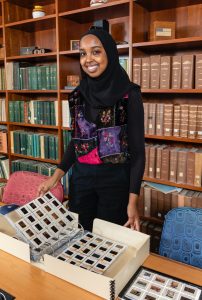
Author Muna Ali in the National Anthropological Archives (NAA) reading room, pictured with rehoused film slides from the Stanford and Jodry papers. Photo credit: Brittany Hance, National Museum of Natural History, Smithsonian Institution.
This summer, I had the exciting opportunity to intern with the Smithsonian National Museum of Natural History (NMNH) as part of a program called Natural History Research Experiences (NHRE). Throughout my 10-week NHRE internship, I was able to prepare a poster presentation on my research, conduct an outreach event with the general public, and interact with museum professionals across varying natural history disciplines.
The work I conducted this summer was twofold: for the first five weeks of the NHRE program, I rehoused film slides from the Dennis J. Stanford and Pegi Jodry papers. Through my rehousing work, I gained hands-on experience with museum archival processing techniques. For the final five weeks of the program, I conducted extensive research on Dennis J. Stanford and Bruce Bradley’s controversial Solutrean hypothesis. Stanford and Bradley postulated that archaeological stone tool similarities between the Clovis people (early peoples of North America) and the Solutrean people (early peoples from modern-day France) “proved” that the first peoples of America arrived from Europe. My project centered around the ontological violence towards Indigenous communities that resulted from Stanford and Bradley’s hypothesis, as well as the co-option of the hypothesis by white supremacists. My project also addressed the need for decolonial methodologies in archival research and archaeological fieldwork, and advocated for a decentering of Western epistemology.
An important aspect of my research experience was grounding my work in perspectives and existing scholarly publications from Indigenous peoples. Given my own positionality as a non-Native researcher exploring an issue directly affecting Native communities, I found it particularly important to make Indigenous voices and scholarship the center of my research. To do so, I conducted interviews with Indigenous professionals working in repatriation offices across the Smithsonian Institution. These interviews added an intriguing perspective to my research: each interviewee emphasized the need for dialogue between archaeologists, museums, archivists, and Indigenous communities. This is especially pertinent given the historically deleterious relationship between archaeology / archives and Indigenous peoples.
Through my interviews, I also learned about efforts within the Smithsonian Institution more broadly to return sacred objects, funerary items, and human remains via repatriation to Indigenous communities. Furthermore, I gleaned a renewed understanding of what repatriation in a contemporary context looks like, whether it be digital or physical, or even a mix of both. Throughout my NHRE internship, I also had the opportunity to interact with individuals from Indigenous communities partaking in community visits at the National Anthropological Archives (NAA) and learning about their perspectives on repatriation efforts by the NMNH and the Smithsonian Institution more broadly.
My NHRE internship culminated in a poster presentation. The task seemed daunting at first, since I had never created a full-scale research poster before. With an 800 word maximum, I also was concerned about my ability to convey my time at NMNH in a concise manner on my poster—especially given that I did not conduct traditional experimental research like some of my fellow interns. I also wanted to make sure my poster would be easily accessible to audiences with visual impairments online. Luckily, with training provided by NHRE, I was able to address each of these concerns and complete my poster successfully. Of each of my concerns, I think I struggled most with limiting how much text I put on my poster—given how invested I was in my work this summer, my natural inclination towards over-explaining makes sense. My biggest piece of advice is to view your poster as a “big picture” version of your project, and not as your project in its entirety. When presenting the poster, you can elaborate on more specific information regarding your research and fill in the gaps. I found it markedly easier to cut extraneous information once I shifted my perspective on what my poster should actually include.
Overall, I truly enjoyed my research experience with the NHRE program this summer. Partaking in hands-on processing work and research in the discipline that I am studying here at Columbia (Anthropology) was incredibly meaningful. I can genuinely say that I enjoyed going to work every day! I credit my positive research experience to my mentors Molly Kamph, Josh Bell, and Torrey Rick, who were incredibly supportive and kind.