
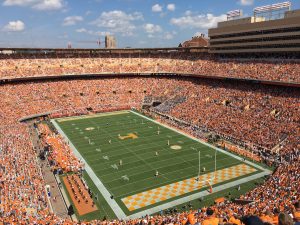
The University of Tennessee, Knoxville (where the conference would have been held, if not for a global pandemic). Photo credit: Unsplash.
It might be helpful to think of this post as a “Part 2” to what I wrote last month. If you haven’t had a chance to take a look, in that post I discussed how I developed a final paper for a class into a piece of work ready for presentation at a research conference. In this post, I want to explain what happened next. In other words, what was the conference itself like and how did I end up there? As opposed to October’s post which talked mostly about my writing process, this will be a little bit more logistics-focused. While some of this information might seem basic or obvious to those who have already participated in similar opportunities, I hope that this explanation will serve to demystify the process for those in the earlier stages of their research.
But let’s start at the very beginning. In the early fall semester of my junior year, I received an email from the Classics department that was sent to all majors. This email was a forward from the University of Tennessee Knoxville, which hosts an undergraduate Classics conference each year. In this email, there was a call for abstracts. Basically, you could explain your idea for a Classics-related research project, and the conference organizers would decide if your project was strong and a good fit for the conference. I sent in 250 words that outlined my project and explained why it was significant to the field of Classics, and then I waited.
A few weeks later, I got the good news that my project was accepted. Given that the conference was taking place in the middle of a global pandemic, it was clear from the beginning that an online platform would have to be used. Thankfully, the conference organizers still worked to create a sense of community among the presenters. A list of all the presenters was released so that we would be able to identify peers with similar interests to our own (I was also happy to see two other Columbia students on the list!). Also, there was a pre-conference meet-and-greet on Zoom, which let us put faces to names.
On the Saturday of the conference, we opened with remarks from a representative from the university and then a keynote lecture on the Odyssey from a Chapel Hill Classics professor. Then, it was time for presentations from the students. We were separated into six different sections, which were divided further into three different time slots. Although participants were not required to participate in all the other sections, I wanted to see as many talks as possible, which I know made my conference experience much richer. When it was time for my presentation, my section presider introduced me to the audience, and then I presented my paper (again, for more information about that paper itself, see my October post!). While I was nervous about sharing my research, the supportive environment that the moderators worked to create really helped. In addition, I was so excited to swap ideas with my fellow undergrad Classics students that I almost forgot my nerves! After a few questions from the audience, my session was over, and, after some concluding remarks from a University of Tennessee professor, so was the conference.
As you can probably tell, my experience presenting at the UTK Classics conference was very exciting and informative. I really enjoyed hearing about the research that my peers were doing, and I know that I became a better researcher as a result. I hope that this post helps people who haven’t had the chance to go to a conference yet feel like it’s a possibility and something to work towards. In conclusion, don’t ignore emails from the head of your department, and don’t be afraid to put your research out there!