
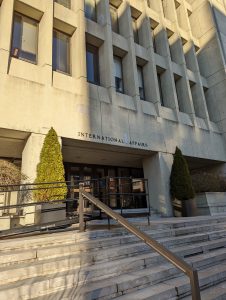
Outside of the International Affairs Building, which is home to the Political Science and Economics Departments. Also where Christian has probably spent most of his time at Columbia. Photo Credit: Christian Flores.
Phds were always mysterious to me. Growing up, I had no exposure to an academic, let alone my parents who were poor immigrants from a developing country. All I knew is that it was the highest degree one could get, and in a world where credentials carry so much weight, it was something that I presumed I wanted to attain. It was not until I came to Columbia and began interacting with faculty members that I learned about the doctorate, and subsequently what it takes to get one in the social sciences. These are some of the tidbits of advice that have resonated the most with me as a first-gen, low-income student. I should mention that the question about whether or not to pursue a PhD is related but deserves its own post. For now, given that application season just passed and decisions will be imminently released, I figured that I would write up some of the lessons I picked up from my professors over the years. I also want to emphasize that while there is great advice out there on getting into PhD programs, this is my own perspective and I hope that anyone who lacks the knowledge that I did before college finds these thoughts helpful.
- Go to Office Hours
There is honestly nothing more informative that you can do in college. Given that we attend Columbia, a school with endless opportunity, office hours might comparatively not seem like the most glamorous use of time. But it is the best resource at your disposal – during no other time will you have mentors who are paid to sit down and chat with you. This is your opportunity to chat about general research interests and about what they found helpful during their application process or careers (e.g., what is a PhD and do you even want one?). Notice how I explicitly never said Professor – your TA can be an equally important resource. They are currently in graduate school, working towards a PhD, and have more recent experience with the application process than faculty. They can also provide you with the inside scoop on which faculty members share your interests and which ones might be available to chat with you.
This one-on-one time with faculty is also a valuable opportunity for you to cultivate relationships which can then lead to strong recommendation letters (often considered among the top 3 most important aspects of an application). You have 8 semesters during college – I strongly urge you to have too many faculty to ask for a letter rather than scrambling to reach the required number.
- Take Math (As much as you can!)
Reading foundational texts in CC is satisfying, especially debating the core social science ideas that come from Weber, Smith, De Tocqueville, etc. However, while modern day social scientific research rests on the groundwork of these texts, especially in my major field of economics-political science, it has also turned towards quantitative methods, hence the science component of social science! To engage with this research, you need to be able to speak the language of math. The only way of improving literacy is through practice, so it is important to take math classes and to demonstrate to admissions committees that you can handle their quantitative training. If you are unsure about which courses specifically to take, the American Economic Association has put out this helpful reference for those aspiring to do an economics PhD. For political science, I have been advised that the necessities are multi-variable calculus, linear algebra, and as much econometrics as possible (Game Theory is a plus).
With that being said, one of the most frustrating experiences I have dealt with is the nonchalant attitude that comes with advice on math courses. Those who are gifted at math can sign up for these courses and seem to do well as a matter of course. I, however, never had a rigorous math background that could guide me through the difficult material. Thus, whenever I see a wall of intense math courses that I need to ace, I can get a little overwhelmed. What has worked for me is to take each class one step at a time, and not take too many difficult ones simultaneously. Your grades in harder classes serve as signals to admissions committees, and it is important to be in a comfortable environment to do well. Just as one would not schedule multiple interviews on the same day, spreading out those hard math classes as much as possible has worked for me.
As far as doing well once in the class, again, office hours are your savior. Prioritize the class and treat the extra time to review the material as mandatory so that you can do well on the exams. While math might not necessarily be your forte, with enough practice, you can certainly make it!
- Have Research Experience
This one is important not just for admissions, but also for you personally to see if you enjoy the PhD lifestyle. Whether you assist a faculty member or TA on their project, or you write your own thesis, it is important for you to have a body of work that demonstrates your familiarity with research. When a reader is reviewing your application, they can be impressed by a high GRE score or stellar grades. But their ultimate goal is identifying whether or not you have the credentials to be a successful graduate student and future expert in the field. For this reason, your experience is a key component in demonstrating that you have what it takes. Equally, research experience will allow you to explore which questions you may want to engage with (or, equally important, which questions you do not want to engage with) as a graduate student.
All in all, these are the 3 aspects that resonated most with me as I went through undergrad. Know that my thoughts are not gospel, but I hope that you can learn from lessons I picked up.