
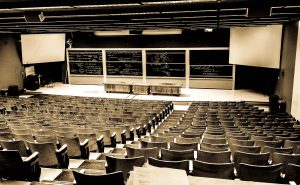
Old MIT Classroom.
Photo Credit: Ryan Tyler Smith
“The object of education is to teach us to love what is beautiful.
― Plato, The Republic
When the Core Curriculum is introduced to eager first-year students during their initial weeks on Columbia’s campus, or even earlier during a proverbial visit to Morningside Heights during their junior year of high school, it is often assumed that Columbia’s most renowned faculty will be present in the classroom when the first words of The Iliad are introduced. And, in many instances, this is exactly the case. Students pour into classrooms already reverberating with discussion and philosophies, sitting side by side at desks positioned just slightly too close together. At the front of the room, they might find the Chair of the English department, or a former Nobel laureate. In my own experience, however, my first day of Literature Humanities found me addressed by a graduate student, adorned in a floral blazer and tweed pants.
A year later, I would have a similar experience as I joined my Contemporary Civilizations section––albeit, this time via Zoom. And yet, after a year of the Core Curriculum as introduced by a graduate student, I was not only familiar with this pedagogical structure but looking forward to it. The thing is, classes taught by graduate students often pose questions for students, especially during their first several months on a college campus: what are the differences between the courses taught by faculty and those taught by graduate students? Are there advantages or disadvantages to taking a course taught by a graduate student, especially as a new student to Columbia? The short answer to these questions is that no one academic experience is the same as another. Each graduate student, like any instructor, approaches their own instruction from a disparate vantage point, informed by their background, disciplinary training, and interpretation of Core materials. Similarly, undergraduate students each have specific preferences related to their own academic experiences.
The point of this post is not to advertise any one preference in class composition or instruction as superior to another, but rather to acknowledge the profound worth and advantage that can accompany a Core Curriculum course, regardless of whether it’s taught by someone early in their scholarly career or by someone who is more established. Graduate students, in addition to serving as future leaders in their respective areas of study, are often students of the same texts or ideas that are analyzed within the Core Curriculum. They are, first and foremost, devoted to the exploration of ideas and the broadening of their own academic knowledge––a passion that is typically manifest in the class discussions they lead as part of the Core. Furthermore, graduate students have the unique opportunity to relate to students from the perspective of other students, thus equalizing an educational playing-field that can often present itself as notably hierarchical.
As someone raised by two public school teachers, the value that can be found in an education imparted by one truly devoted to their own role as an educator has been an ideal that I seek out in each of my own academic endeavors. In keeping to this belief, the Core Curriculum courses that I have taken with graduate students have provided a space that truly feels revelatory in its appreciation for the course material, its commitment to the advancement of the entire student population, and its own realization of the themes that make the Core such a unique and fundamental part of one’s Columbia College experience.