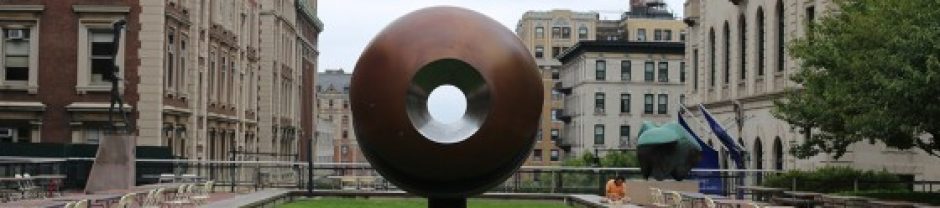
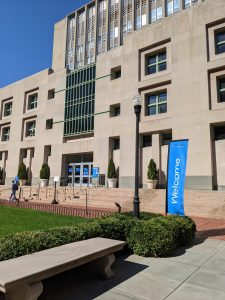
Columbia Business School. Photo Credit: Christian Flores
A few weeks ago, I wrapped up my summer research internship at Columbia Business School (CBS). Their internship program provides students a paid opportunity to work on a summer project with CBS faculty across multiple quantitative social science disciplines: finance, economics, marketing, management, decision sciences, operations, accounting, or data analytics. I worked on an economics project with Professor Cailin Slattery that analyzed governors’ decisions to invest in state level company incentive deals (e.g. Amazon HQ2 in New York City) versus other economic development programs like education. More specifically, for the bulk of the summer, I compiled a database of small business programs across different states and years. This entailed me manually sifting through state budgetary documents and putting the titles of the programs into a spreadsheet. Then, for the final few weeks, I worked with data from a survey that Professor Slattery commissioned. I compiled some descriptive statistics that I found interesting and produced some graphs that I think could motivate future research.
I hope that my following reflection will not only teach you something about my experience, but also give you insight into what you might want to be thinking about as you work on your own potential projects. Apart from the actual topic I worked on, I think I learned most about what full-time research entails and looks like.
For example, how one even goes about coming up with an interesting question is a process in and of itself. Typically, you want to read a recent publication to have a reference point. The authors will include a discussion of the current state of the literature where they cite other seminal works they build on. From there, you can compile a list of other publications to review in order to have a solid grasp of what the topic generally studies. Alternatively, there are journals whose mission is to provide updates or reviews for a particular topic. For instance, in political science, the Annual Review of Political Science can be a great reference point to not only get background information on your desired area, but also introduce you to research you might have never been exposed to. In economics, a more reader friendly publication (less mathy and technical) is the Journal of Economic Perspectives. Often, these articles talk about what questions remain unanswered and it is actually where my inspiration for my honors thesis came from. As a Columbia student, you have access to these through CLIO. Once you have a topic, data collection is key. Knowing what good data is and the limits of it is something I am still learning, but generally I think the best way to learn is by doing. Taking a course in statistics or econometrics will give you the basic tools to understand what social scientists are trying to find, and working alongside a professor as a research assistant will help you develop these skills.
With summer being the first time I spent as a full-time researcher, there are aspects that I enjoyed and others not so much. I personally loved the freedom I had on a day-to-day basis. I’d be given a task and a deadline of when to deliver it. How I finished that work, though, was largely up to me. I stuck to a 9-5 schedule to simulate a regular office job, but there were days where I decided to go enjoy exercise outside while the sun was still shining. Later, any work I needed to make up could be wrapped up in the evening. That level of autonomy is certainly not available in standard careers and I appreciated it while it lasted. However, this can also be a double-edged sword. Because a research project is an intensive endeavor, it was mentally difficult to take time off. Whenever I wrapped up my tasks for the day, I couldn’t help but feel that I should continue reading more material or dive further into my data. Establishing boundaries and work/life balance was tough, and having talked to a few professors about this, it is apparently a common problem. Toward the end of the summer, I felt much better about it, and I can hopefully take these habits into my thesis writing journey.
All in all, these are just a few of the tidbits I picked up from my time as a research assistant. I also came away with a better idea of my career preferences, but I will comment on that once I begin writing my honors thesis!