
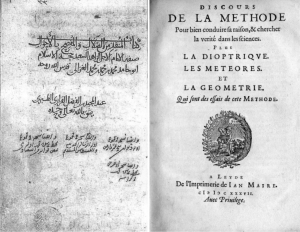
The first pages of Al-Ghazzali’s “The Rescuer from Error” and Descarte’s “Discourse on Method”. Because Arabic books open in the opposite direction, the page is, as shown, the left-hand page; whereas Descartes’ is also, as shown, the right-hand page. Note also that The Rescuer from Error was handwritten.
It’s almost a bit of a joke in Middle Eastern Studies that Descartes stole ‘I think, therefore I am’ from Abu Hamid al-Ghazzali. The argument is convincing, though al-Ghazzali would have to step into the longer line of people Descartes could have stolen it from, most likely of whom, as Professor Christia Mercer in Columbia’s Philosophy Department (who I took Art Hum with!) argues, is Teresa de Ávila. I should admit my bias, which is that if Descartes did steal from al-Ghazzali, I wish he would’ve done so better, because as it is he seems to have missed the most important point.
We have all heard that phrase I think, therefore I am. We know that this is supposed to be the kernel of total truth from which Descartes is able to escape from the depths of knowing nothing to the beginning of knowing something. I suspect nobody knows the line after that, and to be honest, I still don’t. Descartes does not have much difficulty proving the self’s existence, but encounters a much more formidable problem when it comes time to move from the internal to the external world — the world of other people, other things, other ideas.
Here is where al-Ghazzali points out that we have been looking at the problem all wrong. He, too, starts from a position of total lack of knowledge. But he does something very strange: He admits that there is no way out of this dilemma! There is no way to gain ‘knowledge’ from nothingness, not without some kind of miracle. And that is the crucial point — it is precisely by way of a miracle that al-Ghazzali finds the certainty he was looking for — a ‘light from God’.
The fundamental argument is that “logic” as understood by both al-Ghazzali and Descartes is but one limited instance of a wealth of ways we can know about the world. All we have shown in our failure to derive knowledge from pure logic is the inability of pure logic to produce knowledge. Reason must be “anchored”, in some sense — an idea wonderfully conveyed by the Arabic word for logic, ‘aql, which literally means that which ties together, or binds. As Professor Hallaq explains, the word has a literal connotation of the tethering of a horse to a post. A horse which is tethered to nothing is not tethered at all.
Where Descartes looks inwards, al-Ghazzali looks outwards. I see beauty, therefore I see love. There is a kind of directional inversion: Descartes must create the external with the internal; al-Ghazzali sees the internal as the product of the external. The underlying emotional reality to all of this is a forceful, almost egoistic pushing in Descartes’ case, and an explicit and intentional move towards humility and gratitude in al-Ghazzali’s. It is a choice to be concerned about whether anything is real at all, just as it is a choice to be bowled over by the fantastic wonder of the world around us.
This is not to disparage the usefulness of reason. Rather, it is to suggest a different relationship with the facts with which we structure truth. The best way to see this is to examine the process of learning — and what better place than the Core?
One of the parts of The Rescuer from Error that has stuck with me the most, rather strangely, is when al-Ghazzali discusses prophets. How are we supposed to know which prophet is correct? Simple: listen to the things they say and whether they seem correct, look at their character and if they seem good, then, do the things they say and see if it makes you a better person. This does not go only for prophets — he explicitly makes an analogy with doctors, too. Is the medicine working? Are they listening to you?
This goes just as much for the Core as it does doctors or prophets. Actually, it often really did feel for me like I was being faced with a new prophet of a different religion every week (of course, sometimes I really was!), then was tasked with figuring out which was ‘right’, or at least, which was right for me. But I often returned to something a friend had told me before I started the core: “When you read Plato, be a Platonist for a week. Then you’ll read Aristotle, so be an Aristotelian for a week…” (etc.) The point here isn’t to give up our beliefs, or accept ideas we increasingly see are problematic. The point, instead, is to fully embrace the process of knowledge acquisition, understanding that, as al-Ghazzali argues, this is only possible if we are really willing to believe it.
By: Henry Taylor Bansbach, CC’27