
By Mara Bulzan
It’s 2024 and I could not stop staring in disbelief at the costumes worn by Columbia students at Halloween parties. Ostentatious reproductions of stereotypical Roma clothing (derogatorily referred to as “gypsies”) worn to frat parties by young, white, and highly educated women. And no one called them out for it. They were not Roma, so their smiles and dancing could not have been weighed down by a history of over 800 years of enslavement, genocide, forced displacement and eugenic policies. They were not stigmatized for “looking Roma,” so they could use it as a costume. When they looked in the mirror that night, the face of someone deemed a perpetual outsider did not glare back at them.
Contemporary popular culture has normalized the stereotypical depiction of Roma women to the point in which it has become an aesthetic with fetishistic tendencies. She is only allowed to be a free-spirited, sly seductress with fortune-telling abilities. It is preferable that she can read palms, cups, cards, crystal balls and anything else the white consumer might desire. She has to be the mystical other. She could not possibly have agency.
The identity imposed on Roma women is elaborate and deeply rooted in historical European racial hierarchization. Migrating to Europe around the 12th century, particularly to Eastern Europe, they were not Christian, spoke a foreign language and had different cultural specificities. They were perceived as living in opposition to the archaic Western customs and European values. Eroticized, exoticized and ascribed supernatural powers, the Roma woman quickly became a motif in literature and art. These harmful depictions are just as trendy in today’s mainstream culture as they were in the 17th century.
Shakira’s hugely popular 2009 song “Gypsy” is the perfect example of a celebrity successfully using a catchy tune and cheerful dance to exotify Roma women.
‘Cause I’m a gypsy, are you coming with me? I might steal your clothes and wear them if they fit me. Never made agreements just like a gypsy/ And I won’t back down ’cause life’s already bit me/ And I won’t cry, I’m too young to die If you’re gon’ quit me/ ‘Cause I’m a gypsy”.
The song reduces the Roma woman’s identity to being “metaphoric material” of the arts: the essence of their identity is the free-spirited, passionate, devoid of ethical principles, sexualized and poor, but always content, person. The song rewrites the story of the Roma woman in favor of a whitewashed metaphor that attaches itself to “glitz and glam,” concealinging the realities of the centuries-long socio-economic exploitation and oppression felt by Roma women.
Shakira gets even more tone-deaf. In a lighthearted interview titled Shakira Confesses to Gypsy Lifestyle, she says that she lives “like a nomad”, stating “I definitely live like a gypsy!”, because she must constantly travel for her concerts. The Vulture promotes her song with the caption “Being a gypsy seems pretty fun”. I cannot imagine what could possibly be fun about being part of a population of over 12 million people in Europe and 1 million in the United States with a significantly lower life expectancy, facing systemic exclusion from employment and education and being constantly reduced to the fortune-teller trope for entertainment purposes. On top of facing the ubiquitous sexualization of Eastern European women in the Western world, Roma women have to feel the racism too.
Living in poverty traps at the fringes of a hateful society is also considered fun by Kate Moss. In her photoshoot Kate & the Gypsies, the blonde multi-millionaire supermodel is once again the epitome of Western fashion and conception of beauty. Moss’s props are the Roma people and their highly stylized environment to fit a boho-chic aesthetic. It is saying that she can be the stereotypical Roma better than anyone else. It leaves a distinctly colonial impression.
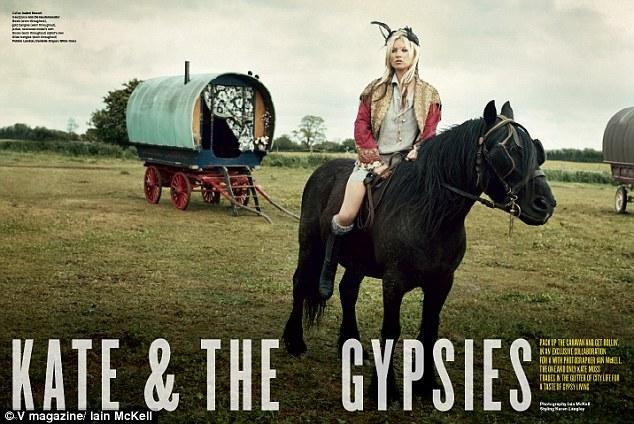
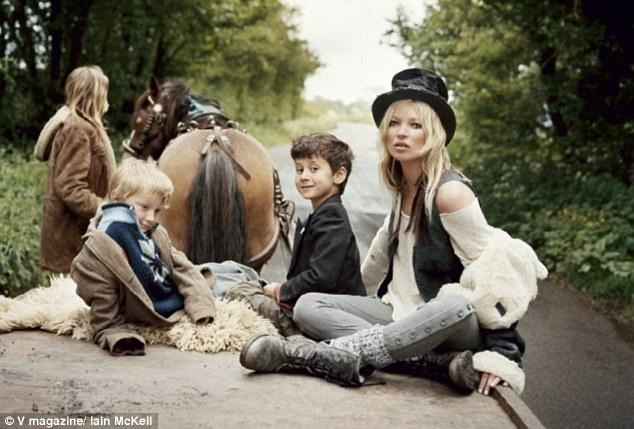
When Shakira twirls in her “Roma costume,” or Kate Moss poses amid caravans, they are aestheticizing the consequences of persecution. What has been normalized online as a “quirky” lifestyle of Roma peoples is an utter misrepresentation that homogenizes the experience of Roma peoples and turns forced migration, segregation, and poverty into symbols of erotic liberation. It also gives permission to public figures who hold the power of representation to ignore the stereotypes that affect the daily lives of Roma peoples. To cite just a few of the myths that persist: that the Roma are criminals, when, in fact, there is no evidence that they are “prone to crime”, instead they are routinely overpoliced and overrepresented in prisons; that the Roma are nomadic and choose precarity, when their mobility was actually historically forced by expulsions and evictions; that they do not want to work or to educate their children, when they actually face significant barriers to accessing employment and schooling.
Columbia students are not immune, nor cured of racism or ignorance just for being at an Ivy League university. These harmful narratives about Roma women have permeated all forms of art and mainstream media. They go unnoticed or, worse, are celebrated in public spaces. The consequence of not challenging this cover-up to the history of oppression is that it cannot be acknowledged and mitigated. It will continue to impact the Roma peoples, who are forced to adapt their behavior to what dominant culture dictates: concealing their identity to pass and avoid the suspicion and prejudice of peers.
The Western complicity with othering and fetishizing the Roma women is longstanding and obvious. Whoever expected Columbia to be the catalyst for change should think again: the issue is rooted in the media we consume. Hence the deeply ignorant Halloween costumes. When contributing to the Roma Peoples’ Project at the Institute for the Study of Human Rights, I understood that no amount of Columbia Universities and op-eds could single-handedly challenge these forms of discrimination. It is a collective effort that is as important as it is overdue. It can start with simply rethinking your Halloween costume.
Bibliography
- Grigore, Cristiana. “I’m Roma, and Your Halloween Gypsy Costume Is More Trick Than Treat.” Newsweek, 31 Oct. 2019, https://www.newsweek.com/halloween-costume-roma-gypsy-tropes-1469002.
- Daily. “Caravan Kate: Miss Moss Showcases Gypsy Chic in New Magazine Shoot.” Mail Online, 1 Sept. 2009, https://www.dailymail.co.uk/tvshowbiz/article-1210171/Kate-Moss-showcases-new-gypsy-chic-look.html.
- Iordanova, Dina. “Mimicry and Plagiarism: Reconciling Actual and Metaphoric Gypsies.” Third Text, vol. 22, no. 3, May 2008, pp. 305–10. DOI.org (Crossref), https://doi.org/10.1080/09528820802204276.
- Shakira – Gypsy. genius.com, https://genius.com/Shakira-gypsy-lyrics. Accessed 17 Nov. 2024.
- Silverman, Carol. “Everyday Drama: Impression Management Of Urban Gypsies.” Urban Anthropology, vol. 11, no. 3/4, 1982, pp. 377–98. JSTOR,
- Trumpener, Katie. “The Time of the Gypsies: A ‘People without History’ in the Narratives of the West.” Critical Inquiry, vol. 18, no. 4, 1992, pp. 843–84. JSTOR,
- Wightman, Catriona. “Shakira Confesses to ‘gypsy’ Lifestyle.” Digital Spy, 12 Mar. 2010, https://www.digitalspy.com/showbiz/a208393/shakira-confesses-to-gypsy-lifestyle/.
- Zimmerman, Edith. “Shakira Seduces a Sweaty Rafael Nadal in Her ‘Gypsy’ Music Video.” Vulture, 26 Feb. 2010, https://www.vulture.com/2010/02/shakira_seduces_a_sweaty_rafae.h