
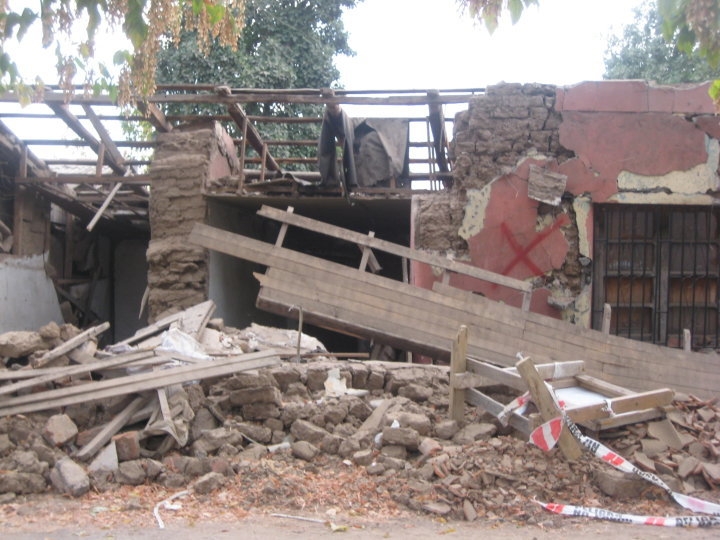

Talca, Chile Post Earthquake
Excerpts from USHAHIDI-CHILE GRANT REPORT 16 JAN 2011
There were only a few hours between the moment the earthquake struck Chile to the first student-volunteer who browsed through media to find reports of needs and responses. The project was not planned and there was no infrastructure in place at the start of the deployment. For these reasons, the Ushahidi management team was forced to develop solutions to problems in real time and make decisions in the moment. Through the process of enacting plans and learning from mistakes, the team took away many lessons about deploying an emergency response effort that may be useful to future Ushahidi deployments. This section summarizes the key lessons learned from the Chile deployment and that could be applied to other Ushahidi projects.
Training
There were numerous training sessions held throughout the project duration, and the management team quickly found that volunteers learned best by actual, hands-on crisis mapping. Initially, there was an acute need for core management members to be working in the Situation Room around the clock to guide new volunteers through the mapping process. To alleviate the demand on the core team, the team began training volunteers to be trainers themselves. This community approach to training increased the number of people who could train new members and enabled dedicated volunteers to play more of a leadership role in the project. It was also important to have clear instructions to pass on to volunteers and trainers; therefore, logs, notes, and indices were kept at the Situation Room that were available to all volunteers and also posted in an online wiki. The team also found that it was important to develop training materials and references that could be shared with all volunteers. These standardized materials were developed in English, translated into Spanish, and could be modified for use with other projects.
Process flow
Through trial and error, the team learned the best way to break down the process flow was to create three roles for volunteers: media monitors, mappers, and administrators. This division of labor is effective when there is a high volume of reports to be monitored, mapped, and approved. The problem encountered with this division of labor was that there was an overlap of information and there needed to be clear and cohesive instructions within the three groups. The creation of wikis, Google forms, and spreadsheets aided with this process. In the future, other tools such as CrowdFlower and SwiftRiver will be helpful because it will simplify the process flow, cluster and geo-locate the monitored reports automatically.
For the management structure, we found that it was best to assign roles from the beginning and to be flexible in responsibilities depending on how needs and priorities change throughout the project phases. In the Ushahidi-Chile effort we found it helpful to have separate roles for project management, technical and mapping coordinator, monitoring coordinator, volunteer coordinator, partner coordinator, media coordinator. We found it extremely important to insist on communication during the project, as pieces and information moved extremely quickly in the post-disaster phase. Specifically, we recommend cc-ing other relevant management members on emails and establishing frequent management team meetings early on.
Closing the feedback loop
It is a constant struggle for people using Ushahidi to close the feedback loop, and indicate which needs posted on Ushahidi have been acted on. Chileans knew about the existence of the Ushahidi platform within two days of the earthquake. However, the volunteers in New York had no way of knowing who was using the site in Chile. This was a huge challenge for student volunteers, as we did not know which reports, if any, were actually making a difference in the recovery process.
Volunteers in the Chile deployment had knowledge of how Ushahidi was used in Haiti, and during the initial phase of the Chile project the volunteers had to act on faith that the Chile project would have an impact on disaster relief as it did in Haiti. It was not until volunteers reported a significant number of incidents that the team started to receive feedback from people on the ground and establish partnerships with local organizations. Understanding how Ushahidi is being used by media, international, and local organizations would increase the utility of Ushahidi and help motivate volunteers. For future projects, it will be helpful to connect new volunteers with past volunteers who can articulate how their work was used on the ground.
It is also important to clearly articulate to people reporting the information how this information will be used. For instance, there is often the understanding that if a person texts in a need, that that need will be acted on by a relief organization. Although this may happen, it is not guaranteed, and the information is more often used to paint a general picture of needs. This reality needs to be communicated to those submitting reports.
Volunteer motivation
Although our experience has shown that it is fairly simple to recruit people to train on Ushahidi, it is a constant struggle to motivate volunteers to consistently monitor and map reports. It was to the team’s disadvantage that there was less of an emotional impact for Chile as it was in Haiti. Because it was less obvious that the volunteers were directly making a difference on the ground, the number of volunteers dwindled after the first two weeks of operation. Ushahidi-Chile demonstrated that supporting volunteers with food, drinks, and a good working environment where they can map and monitor in a group setting is essential to recruiting and retaining student volunteers. The Mozilla Grant helped the management team provide these refreshments for the volunteers.
Having a dedicated Situation Room was critical for motivating our volunteers. Although students can volunteer remotely, it is more cooperative and inspiring if there is a team of mappers and monitors that can interact in person. Also, having the Situation Room visible to the larger crowd is successful in enticing new students to volunteer. Not knowing how many reports to expect made volunteer recruitment and planning difficult. There were a few instances where we recruited many volunteers to help with what we expected to be a large number of incoming SMS reports, only to have none arrive when the volunteers were ready. These instances taught the team that recruitment timing is essential, and that volunteers should be recruited only the management team has an accurate prediction of how many volunteers are truly needed.
Technical difficulties
The technical aspect of Ushahidi is difficult for non-technical users. Most volunteers did not have a technical background, which resulted in a high dependency on volunteers who could program. There were also time delays when technical glitches were being fixed, which posed operational challenges and increased volunteer frustration. In one example, it was unclear when SMS messages from the senders were received in the system. There needed to be a more obvious indication of messages being received, but the team did not possess the in-house knowledge to be able to fix these issues. A programmer had to be recruited to fix these problems. Another example was that the Ushahidi platform did not support accents in the text, which caused problems working with Chile, a Spanish-speaking country. Recruiting a dedicated volunteer with a technical background from the beginning who can be involved throughout the entire project and improving the communication flow between the non-technical and technical volunteers can alleviate these problems.
Travel
Establishing a presence on the ground is critical for a successful deployment of Ushahidi, as it’s critical to meet key stakeholders face-to-face and learn about the reality and resources on the ground. Prior to traveling, it is required that a phone or Skype meeting is conducted so that all parties are on the same page when they meet in person. The team found that the longer the team is able to spend on the ground and meet with stakeholders, the more beneficial the trip was. This allows the Ushahidi representative to gain a stronger understanding of the realities on the ground, and establish more meaningful relationships with partners. For Ushahidi-Chile, it was beneficial to send representative in two trips, as the team was able to use the second trip to build on previously established partnerships. Ideally, the core management team would be on the ground in country the map was based in.
Communication abroad
Effective communication with local partner organizations is key. It is important to understand that emailing may not work in the same way as it does in the US, and that having a, face-to-face meeting is powerful. Also, it is critical to know the right contact within the organization. For example, knowing the computer programmer of one organization may not be as useful as knowing the international volunteer coordinator of the same organization and it often takes intimate knowledge of an organization to know who is the most beneficial contact. It is also important to remember that one meeting may not be enough, and that it takes time to build meaningful and mutually beneficial partnerships.
Local partnerships
Upon traveling to Chile, we learned that many of the organizations were already proficient users of the Ushahidi platform . The success of the platform often depends very heavily on these stakeholder organizations working together. The management team’s most effective role was to introduce these organizations to each other, connect their goals and strengths, and facilitate their meetings. It is also helpful to connect local organizations with local media to increase publicity and recognition. It is advised to attend related events such as the Global Voice Conference to increase contacts in the field. Finally, as it is difficult to research local organizations, it will be beneficial to partner with already-established NGOs.
The role of US-based volunteers
It is important to clarify what the role of student volunteers are. Many partner organizations misconceived the Ushahidi-Chile team as a non-profit organization, aid agency, or business. It is important to indicate what the team is doing and not doing. This identity must be addressed and understood prior to meeting partner organizations in person. It is also important to stress what the tool is capable of and what it is not. This was most evident in our work with Radio Bio-Bio, which expected more real-time processing than we could guarantee.
Sustainability
Although the team traveled to Chile in hopes that the Chileans would be able to use the Ushahidi platform for long-term uses, the team learned that sustainability was difficult to obtain, especially as the earthquake response moved from emergency aid to long-term development. The role of Ushahidi in the long term redevelopment after the earthquake was not as prominent and many of the organizations using Ushahidi during the initial phases found it difficult to prioritize Ushahidi during these later phases. These organizations are often faced with the same volunteer recruitment difficulties that the SIPA team faced, and will only prioritize Ushahidi in so far as it advances their own goals. In order for Ushahidi to be sustainable in the long run, it must support the mission of the organizations that use it. More research and Ushahidi trials should be run to investigate how and if using the platform can support reconstruction efforts.
Documentation
It is always difficult to record operations during a crisis; however it is important to document these steps and identify lessons learned so that later operations can learn from these experiences. There should be a better mechanism that facilitates documentation during all phases of the project, and records changes in operation or procedure. This can be facilitated by identifying key members to continually blog and document throughout the crisis.