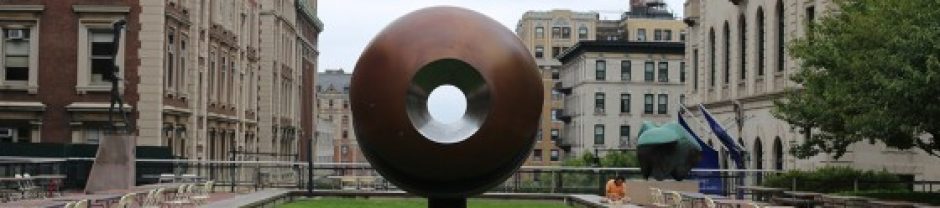

Columbia University’s Butler Library. Photo credit: Richard Cole.
“Someone will remember us / I say / Even in another time” ― Sappho, If Not, Winter: Fragments of Sappho
There is something fascinating about the historical reimagination of the Core Curriculum, especially since its first course (Contemporary Civilization) was introduced to a war-torn student body in 1919. While the Core was originally designed to produce students who were well-rounded, innovative, and aptly capable of influencing and shaping the political and social order of the day, various identity groups were left outside the margins of its original syllabi.
This is made most explicit in the edifice that adorns Butler Library, which is often touted as paying homage to the many writers, philosophers, and political actors whose work appears in the Core Curriculum canon. While this fact is mostly true, it is important to recognize the shared qualities of these individuals: namely, their whiteness and their gender. Homer, of course, is the first author read in introductory Literature Humanities lectures, and it is not shocking to find Shakespeare and Cicero adorning a building that houses some eight million written works. Yet, this symbolic gesture seems to discount the many women and nonbinary creatives whose work has both affected and uplifted the academic world that Columbia undergraduates inhabit.
It is this omission that provided the context behind the recent Butler Banner Project, a 2019 tribute that paid homage to two previous efforts to diversify the names that currently line the perimeter of Butler Library: one, in 1989, which was disrupted by campus security only two years after Columbia became co-educational; and a second, in 1994, which saw a diverse banner designed to cover the aforementioned male names during Women’s History Month. Efforts like these are fundamental to the maintenance of an activist spirit on Columbia’s campus, as we continue to see those of all gender identities and backgrounds using their time on and beyond campus to excavate change in a world that has often attempted to silence their voices. In a similar fashion, the male-focused syllabi first introduced in the first three decades of the twentieth century have seen themselves readdressed and reconsidered against the backdrop of the new millennium––with particular efforts made to diversify Literature Humanities, Contemporary Civilization, and Art Humanities in the last five years.
In this way, then, the Core Curriculum has seen its canon placed under the microscope of the modern day and, like the students it is meant to influence, it has used such inspection to better represent the many populations who study on Columbia’s campus. It is, in a way, a scholastic interpretation of Beginner’s Mind–– the concept popularized by outgoing Columbia College Dean James Valentini (affectionately known as Deantini), which suggests that students might use their time at Columbia to better understand the world that surrounds them.
The Core Curriculum was introduced to diversify the mindsets and critical thinking prowess of its pupils, and a diverse set of thinkers and perspectives is absolutely foundational to achieving this goal. As an ongoing project, the Core will always have work to do in adapting to the present day. Yet, as we address the disparities that still exist on Core syllabi, it is important that we also acknowledge and find a point of celebration in the work that has been done to study the works of women authors who have forged the paths upon which we now might stake our own claims in the world as Columbia students.
As English professor Carolyn Heilburn stated in a 1987 lecture in Low Memorial Library, “The academic community must face the necessity of moving women from the margins of universities to their center. Not to do so will indicate the degree to which the male tradition has dictated what questions we may ask of our universities, our ‘legacy,’ and of our ‘old fashioned values.’” It is exciting to see the Core redefine its legacy, and to see a celebration of an increasingly diverse set of voices––voices which, it should be noted, should one day adorn a library all their own.