
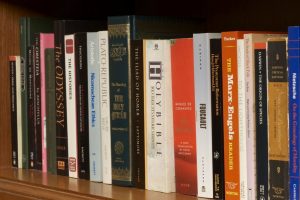
Columbia Core Books. Photo Credit: Christian Flores
This past summer for Music Hum, our class was assigned to watch Mozart’s Don Giovanni. It is one of Mozart’s most seminal pieces and widely considered among the greatest operas ever composed. Watching this particular performance in 2021 was an eerie experience, however. Of course, I enjoyed the opera’s undeniable charm. From the music to the writing, it is clear why people continue to revisit the comedy centuries later. The performers’ solos, known as arias, wowed me, particularly the female sopranos. And yet, there is heavy baggage that comes along with any piece of art that is hundreds of years old. For example, I learned that Mozart was friends with other composers whose work was largely financed by companies heavily involved in the slave trade. A 21st century audience deals with these complications differently than Mozart’s contemporaries. But as I reflect a bit more on what exactly I watched, I am particularly interested in the fact that centuries before me, someone sat in an opera house and watched the same characters perform more or less the same music. The same dialogue, perhaps the same stage direction, everything that I witnessed has been shared by people of a different time.
Art provides an intertemporal opportunity to revel in the human experience, with each generation approaching the same medium with a unique set of perspectives. What we as a Music Hum class took away from the opera is distinct from what baby boomers took away, which surely would have been even further apart from 19th century viewers. This of course, then begs the question of the value in revisiting these performances, especially within the context of a canon. The historical perspective is illuminating – nothing wowed me more during this class than studying jazz’s origins and their present elements in hip hop. Yet, personally going through a canon is more rewarding than reading a book about the topic because you have the opportunity to insert yourself into the material. In our class, there were those with extensive musical backgrounds that shared their technical opinions about a specific piece. And while I picked up some intuition behind music theory, I will not be commenting on the pitch or harmony of a piece any time soon!
Despite my lack of expertise, I still contributed by tapping into my broader interest of politics and inequality. For example, when first discussing more widespread opera performances, I questioned whose enjoyment was being prioritized by composers if only wealthy people could afford to attend. However, I learned that the association between wealth and opera is only a recent phenomenon, and that in fact, many working-class families in the 18th century owned pianos at home to play the music they finished listening to at the theater. This moment of discovery encapsulates the spirit of a canon because I now had a new question – how did that association come to be? Should I ever choose to start a project to answer it, I’ll no doubt come across other pieces which themselves can lead to other research directions. With every person having their unique curiosities, it is no wonder why a vibrant community of music scholarship still exists. Not only do we contribute to our shared set of ideas, but we also part with our own personal reflections. To me, that is the beauty of the Core.